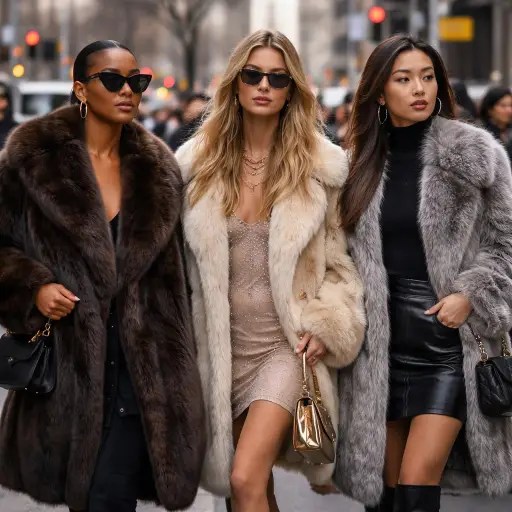
Vintage and faux fur reclaim the spotlight in street style and on the runway, igniting fresh debate over ethics, aesthetics, and fashion’s cyclical memory.
On city sidewalks and beneath the glare of runway lights, fur has reemerged as one of the most striking visual statements of the season, appearing in both vintage heirlooms and newly engineered faux iterations that signal fashion’s renewed fascination with texture, tactility, and unapologetic presence.
In the final stretch of winter, as wardrobes typically settle into predictable practicality, plush coats and dramatic collars have instead taken on symbolic weight, photographed on editors, stylists, and influencers who layer sweeping mink silhouettes over minimalist tailoring or style cropped faux jackets with denim and sneakers.
What distinguishes this resurgence from past revivals is the prominence of vintage, with resale platforms reporting a marked rise in demand for archival fur pieces marketed not as indulgence but as sustainability, reframing decades-old garments as responsible alternatives to new production in an era wary of excess manufacturing.
For younger consumers especially, the appeal lies in what some stylists describe as closet archaeology, the rediscovery of coats inherited from relatives or sourced from secondhand boutiques, where provenance and patina add narrative depth to garments that once symbolized untouchable luxury.
At the same time, faux fur has undergone a technological evolution that complicates the visual conversation, as advances in textile engineering have produced fibers capable of mimicking the sheen, density, and fluid movement of natural pelts with unprecedented realism.
Designers this season have leaned heavily into that ambiguity, presenting jewel-toned opera coats, sculpted blazers trimmed with plush lapels, and exaggerated shag silhouettes that blur the boundary between authentic and artificial, making identification nearly impossible without a label check.
Runway collections have emphasized tactility as an emotional response to uncertain times, with enveloping coats styled as protective armor, while other houses approach the material with irony by pairing brightly colored faux layers with athletic separates, signaling a remix rather than a replica of past decadence.
Yet the comeback unfolds against an undercurrent of ethical friction, as animal rights advocates argue that even vintage fur normalizes animal-based luxury, while proponents counter that discarding existing garments undermines sustainability by rejecting reuse in favor of moral absolutism.
Social media has amplified these tensions, turning street style photographs into flashpoints for commentary where one image is celebrated as circular fashion in action and another condemned as insensitive, underscoring how aesthetics and ethics now travel together in the digital age.
Retailers are responding with strategic caution, investing heavily in high-quality faux collections while simultaneously acknowledging the buoyant resale market for legacy pieces, and independent designers are experimenting with recycled and plant-based fibers that seek to reconcile plush appeal with environmental accountability.
Beyond debate, however, there is an undeniable appetite for drama after seasons dominated by pared-back minimalism, and fur, whether real or simulated, delivers instant visual impact that photographs powerfully and communicates confidence in a culture shaped by constant image circulation.
Street style offers the clearest evidence of this shift, with voluminous collars punctuating tailored wool coats, shearling layered over hoodies, and faux stoles reappearing as statement accessories that bridge old-world glamour and contemporary nonchalance.
The resulting aesthetic tension defines the moment, as plush textures collide with everyday casualwear, transforming what was once a marker of rigid luxury into a flexible styling tool adaptable to both high fashion spectacle and ordinary urban life.
As winter edges toward its close, the material’s renewed visibility feels less like a fleeting novelty and more like a recalibration of fashion’s relationship with history, technology, and conscience, suggesting that the industry is once again renegotiating the meaning of opulence.
In fashion’s cyclical rhythm, few elements ever disappear completely, and fur’s return to prominence demonstrates how trends are continually reinterpreted through evolving values, proving that even the most contentious materials can resurface when aesthetics, innovation, and cultural mood align.




 The Tower Post