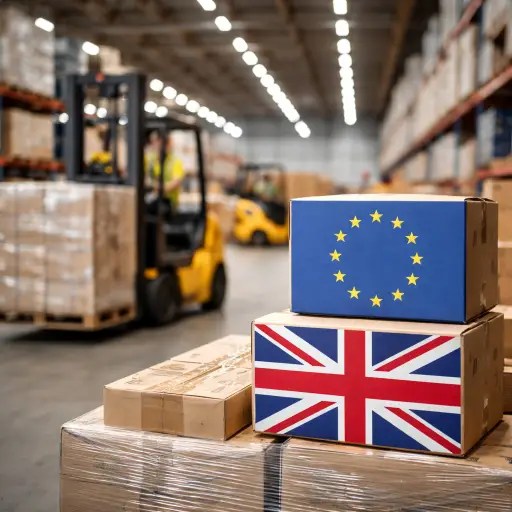
Nick Thomas-Symonds warns EU industrial strategy risks trade barriers as wider UK-EU reset hangs in the balance
The European Union’s emerging “Made in Europe” industrial strategy is fast becoming more than an economic blueprint, evolving instead into a political test of how far Brussels is prepared to assert strategic autonomy and how willing London is to tolerate the consequences for post-Brexit trade.
Framed by the European Commission as a necessary response to intensifying global competition and geopolitical fragmentation, the initiative seeks to channel public money and procurement rules toward goods with substantial European content, reinforcing domestic manufacturing in sectors deemed critical to security, climate policy and technological leadership.
In Westminster the proposal is being interpreted not only as industrial policy but as a signal of the EU’s broader direction of travel, one that privileges internal consolidation over external openness and could redefine the balance of cooperation with close neighbours such as the United Kingdom.
Nick Thomas-Symonds, the UK minister responsible for managing relations with the European Union, has issued a pointed warning that rigid origin requirements embedded in the plan could hit supply chains, raise costs and create unnecessary barriers to trade between two economies that remain deeply intertwined.
His intervention reflects mounting concern within the British government that a strategy designed to bolster European sovereignty may in practice sideline UK firms from procurement frameworks and subsidy regimes at the very moment London is attempting to stabilise and reset its relationship with Brussels.
Officials in Whitehall argue that automotive, aerospace and advanced manufacturing supply chains still operate across the Channel with components crossing borders multiple times, meaning that strict European-content thresholds risk transforming technical compliance rules into de facto trade obstacles.
The political sensitivity is heightened by the fact that both sides have sought to lower the temperature of recent years, pursuing pragmatic cooperation on energy, research and security while avoiding the confrontational rhetoric that characterised earlier phases of the Brexit process.
Within the EU the debate over “Made in Europe” is inseparable from a wider strategic narrative that Europe must reduce dependency on external actors and build resilience in critical industries after years of supply shocks and strategic vulnerabilities.
France and several other member states have championed a robust European preference as a matter of sovereignty, arguing that public funds should primarily strengthen industrial capacity inside the bloc rather than flow into third-country supply chains.
Other governments, particularly those with export-oriented economies, have cautioned that excessive rigidity could undermine competitiveness and provoke retaliatory measures, complicating the EU’s external trade relationships at a fragile moment for the global economy.
For London the stakes extend beyond immediate commercial impact, touching on the credibility of its strategy to remain economically aligned where beneficial while maintaining regulatory independence outside the single market.
Diplomats note that if UK firms are excluded from major European procurement initiatives, domestic political pressure could grow for a firmer response, potentially hardening attitudes just as both sides attempt to build a more constructive partnership.
At the same time British ministers are wary of appearing obstructive, mindful that the EU is entitled to design its own industrial framework and that open confrontation would risk undermining recent efforts to rebuild trust.
Business leaders are urging calm but pressing for clarity, warning that prolonged uncertainty over eligibility rules could delay investment decisions and weaken the very industrial base both London and Brussels claim to protect.
The unfolding dispute illustrates how industrial policy has become inseparable from geopolitics, with procurement criteria and subsidy conditions now serving as instruments of strategic positioning as much as tools of economic management.
As the legislative details take shape in Brussels attention will focus on whether flexibility can be built into the framework to accommodate close partners or whether the final text will draw sharper boundaries around the bloc’s internal market.
In the current political climate the handling of “Made in Europe” may serve as a barometer of the broader UK-EU relationship, revealing whether the present thaw can survive the pressures of economic nationalism and strategic recalibration in an increasingly contested global order.



 The Tower Post