Federal pledge of 50,000 CHF per victim framed as national act of solidarity after one of the Alpine resort’s darkest nights

The Swiss government has announced that it will grant 50,000 Swiss francs to each victim of the devastating bar fire that tore through the Alpine resort earlier this winter, a move officials describe as a concrete expression of national solidarity following one of the most tragic incidents in the destination’s recent history.
The decision, unveiled as the country approaches the close of the winter season, reflects mounting public support for a collective response to the catastrophe that claimed lives and left numerous others injured during a crowded evening at a popular après-ski venue.
Federal authorities stressed that the compensation is not intended to replace ongoing judicial inquiries or private insurance settlements, but rather to provide immediate financial recognition of loss and suffering while investigations and potential court proceedings continue.
In Bern, members of the Federal Council characterized the measure as a gesture rooted in Switzerland’s long-standing tradition of communal responsibility, emphasizing that moments of national grief demand more than words of condolence.
The blaze erupted inside a timber-structured establishment known for drawing seasonal workers, tourists and local residents, and it spread with alarming speed through the interior before firefighters were able to contain it, according to preliminary accounts from emergency services.
Rescue teams from across the canton of Valais responded within minutes, yet the intensity of the flames and heavy smoke complicated evacuation efforts, leaving the tight-knit mountain community grappling with shock and disbelief in the immediate aftermath.
Investigators continue to examine the origin of the fire, focusing on electrical systems and building materials, while cautioning that definitive conclusions will only be presented once forensic analysis is complete.
Prosecutors have not ruled out the possibility of negligence, and several administrative reviews are underway to determine whether safety regulations were fully observed in a structure that blended traditional Alpine architecture with modern hospitality functions.
For families who lost loved ones, the federal pledge represents both symbolic acknowledgment and practical relief at a time when grief has been compounded by financial uncertainty and legal complexity.
Relatives of victims have spoken of sleepless nights and unanswered questions, describing how a routine evening in one of Switzerland’s most celebrated ski resorts turned into a national tragedy within minutes.
The compensation package will be administered through cantonal authorities to ensure that payments are processed efficiently and transparently, with officials indicating that verification procedures are being handled with sensitivity toward those affected.
Survivors who sustained serious injuries are expected to receive additional coordinated support in collaboration with health insurers and regional social services, reflecting a broader framework of assistance beyond the fixed federal sum.
The tragedy has prompted renewed scrutiny of fire prevention standards in mountain resorts, particularly in venues housed in older wooden buildings that are emblematic of Alpine heritage yet present unique safety challenges.
Safety experts note that Switzerland maintains rigorous building codes, but they also acknowledge that evolving hospitality demands and seasonal renovations can create gaps that require consistent oversight and updated inspections.
Industry representatives have publicly endorsed a comprehensive review of safety protocols, while cautioning that reforms must balance stringent protection measures with the economic realities faced by small, family-run establishments that form the backbone of resort life.
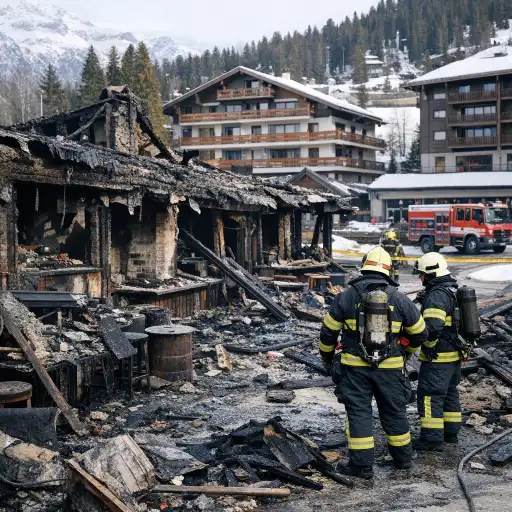
In Crans-Montana itself, the charred remains of the bar stand as a stark reminder of the night that altered the rhythm of the season, with flowers, candles and handwritten notes continuing to appear near the cordoned-off site.
Local officials are discussing the possibility of a permanent memorial, underscoring a shared desire to honor the victims while reinforcing commitments to prevent similar disasters in the future.
Beyond the mountain resort, the incident has resonated across Switzerland, sparking debates in parliament and among civil society groups about public responsibility in the wake of unforeseen calamities.
Analysts observe that the federal compensation aligns with a broader European pattern of solidarity funds activated after catastrophic events, mechanisms designed to stabilize families during protracted investigative and insurance processes.
As winter tourism continues and ski lifts operate against a backdrop of fresh snow, there is an unmistakable undercurrent of reflection in the resort, where residents speak of resilience tempered by remembrance.
The government’s pledge of 50,000 francs per victim has thus become more than a financial calculation; it stands as a statement that collective responsibility remains central to Switzerland’s civic identity even in moments of profound sorrow.
While legal inquiries and regulatory reviews move forward, the compensation decision marks an early chapter in what will likely be a longer national reckoning over safety, accountability and the preservation of trust within communities that depend on hospitality and tourism.
In the quiet that follows the height of the season, the country finds itself balancing mourning with resolve, seeking both answers and assurance that lessons drawn from tragedy will translate into lasting change.
For many observers, the measure announced by the federal authorities signals that solidarity in Switzerland is not confined to rhetoric, but is expressed through tangible commitments when citizens face irreparable loss.