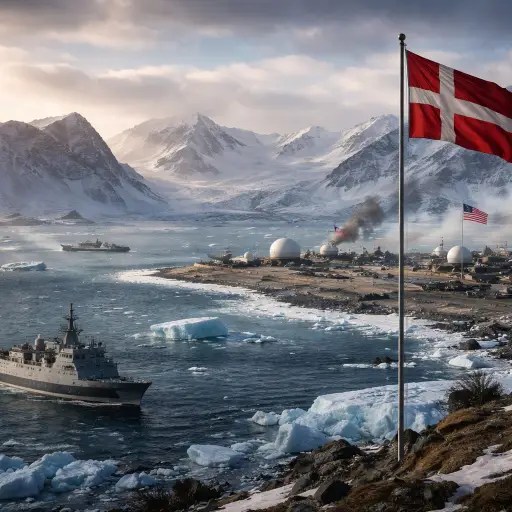
Snap election reflects deepening geopolitical unease as Copenhagen navigates a fraught standoff with Washington over Arctic security and sovereignty
Denmark has called a snap general election as mounting tensions with the United States over Greenland’s strategic future spill decisively into domestic politics, compelling the government to seek a renewed mandate at a moment of unusual strain between two longstanding allies.
The move follows weeks of increasingly pointed exchanges between Copenhagen and Washington over expanded American security activities on Greenlandic territory, an issue that has exposed fractures within Denmark’s governing coalition and sharpened debate across the political spectrum.
Greenland, a self-governing territory within the Kingdom of Denmark, occupies a pivotal position in the rapidly transforming Arctic, where retreating sea ice is opening new shipping corridors and intensifying global competition for minerals, infrastructure, and military reach.
Officials in Washington have pressed for enhanced surveillance systems and logistical upgrades tied to existing defense installations on the island, arguing that a strengthened Arctic posture is essential to monitor rival powers and protect transatlantic security interests in an era of renewed geopolitical rivalry.
Danish leaders have reaffirmed their commitment to the alliance while insisting that any expansion of foreign military capabilities must proceed with full respect for Greenland’s autonomy and in close coordination with its elected government in Nuuk.
The dispute has evolved into a defining national issue, with opposition parties accusing the government of allowing the situation to escalate without presenting a coherent long-term Arctic strategy capable of balancing security obligations with political sovereignty.
The Prime Minister framed the election as a democratic necessity in light of shifting global realities, casting the vote as an opportunity for citizens to determine how Denmark should position itself at the intersection of alliance politics, Arctic transformation, and domestic accountability.
Coalition partners have diverged in tone, with some urging a firmer defense of sovereignty against what they perceive as undue pressure, while others advocate careful diplomacy to preserve economic ties and longstanding security cooperation with Washington.
In Greenland, political leaders have voiced concern that the island risks becoming a stage for great-power rivalry, emphasizing environmental protection, sustainable development, and the right of local communities to shape decisions that directly affect their land and livelihoods.
The Arctic’s growing strategic weight has heightened the stakes, as increased naval patrols, scientific missions, and infrastructure investments by multiple nations signal that the region is entering a more competitive and militarily sensitive phase.
Public opinion in Denmark appears divided, with many voters supportive of the transatlantic partnership yet wary of deeper militarization in the High North and cautious about being drawn into confrontations driven by broader global rivalries.
Economic considerations further complicate the picture, as Greenland is believed to hold significant reserves of rare earth minerals vital to renewable energy technologies and advanced manufacturing, resources that have attracted intensified international attention.
Analysts say the snap election effectively transforms a diplomatic standoff into a referendum on Denmark’s strategic identity, compelling political parties to articulate how a small European nation should navigate intensifying competition in the Arctic while preserving democratic principles.
American officials have publicly sought to temper perceptions of conflict, reiterating shared values and decades of defense collaboration, yet the episode has revealed differing interpretations of partnership and the practical limits of influence within allied relationships.
By turning to the electorate, Denmark’s leadership appears to be seeking broader legitimacy for whatever course ultimately emerges, whether that involves deeper security coordination, clearer safeguards on sovereignty, or a recalibrated approach intended to reconcile both imperatives.
As campaigning accelerates, Greenland’s constitutional role within the Kingdom is likely to feature prominently, with calls for structured consultation mechanisms and greater transparency in defense negotiations gaining renewed urgency.
The outcome of the vote will shape not only the composition of Denmark’s next parliament but also its posture in one of the world’s most strategically sensitive regions, where climate change, resource competition, and military planning increasingly intersect.
With allies and competitors alike watching developments in Copenhagen, Denmark now faces a consequential decision about how to define its Arctic future while maintaining democratic accountability and the delicate balance that underpins its relationship with Greenland.


 The Tower Post