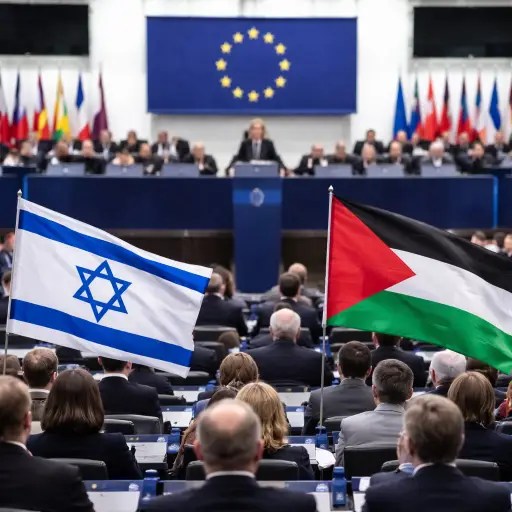
Growing concern in Brussels over proposed Israeli legislation targeting Palestinians raises questions about human rights commitments and the future of EU-Israel relations
Pressure is mounting inside the European Parliament as lawmakers push for potential sanctions in response to Israel’s proposed expansion of the death penalty, a move that many in the chamber argue runs counter to the European Union’s core human rights doctrine.
The draft legislation, advancing through Israel’s parliamentary process, would broaden the circumstances under which capital punishment could be imposed, particularly in cases involving Palestinians convicted of certain security-related offenses, prompting warnings in Brussels that the measure risks breaching international legal standards.
Members of the European Parliament from multiple political groups have voiced concern that the bill could undermine protections embedded in international humanitarian law, especially provisions governing the treatment of populations in occupied territories and the prohibition of discriminatory application of criminal penalties.
The European Union abolished the death penalty across all member states decades ago and has since made global opposition to capital punishment a pillar of its foreign policy, routinely attaching human rights clauses to trade and cooperation agreements with third countries.
Lawmakers argue that failing to respond to Israel’s legislative initiative would weaken the bloc’s credibility at a time when it is pressing other governments worldwide to halt executions and commute death sentences, framing the issue as a test of consistency in European diplomacy.
Several parliamentary committees are now examining whether the proposed Israeli law could conflict with international conventions to which Israel is a party, with legal advisers cautioning that selective or disproportionate use of the death penalty may invite scrutiny under established humanitarian norms.
The debate unfolds against a backdrop of already complex EU-Israel relations, where strong economic, scientific, and security cooperation coexists with persistent political friction over settlement expansion and the broader trajectory of the Israeli-Palestinian conflict.
Diplomats acknowledge that any move toward sanctions would require consensus among EU member states, a process that is often fraught with divergent national interests and differing assessments of how best to balance strategic engagement with values-based conditionality.
Among the options under discussion are a formal parliamentary resolution urging the European Commission and the Council to review elements of bilateral agreements, the possibility of targeted restrictions tied to human rights compliance, and intensified diplomatic pressure aimed at discouraging adoption of the law.
Supporters of a firmer stance contend that the EU’s founding treaties commit it to promote the abolition of the death penalty worldwide and that silence in this case would signal a retreat from principles that European institutions frequently describe as non-negotiable.
Israeli officials have defended the proposed legislation as a security measure designed to deter acts of violence, insisting that any application of capital punishment would be subject to strict judicial safeguards and rejecting allegations that the bill is discriminatory in intent or effect.
Human rights organizations across Europe and the Middle East have echoed parliamentary concerns, warning that implementation of the expanded death penalty could inflame tensions, complicate de-escalation efforts, and deepen mistrust between communities already divided by years of conflict.
Analysts caution that sanctions, should they materialize, would carry tangible consequences given Israel’s participation in major EU-funded research programs and its preferential trade arrangements under existing cooperation frameworks, potentially affecting economic and academic ties on both sides.
At the same time, observers note that the European Parliament’s assertiveness reflects a broader institutional shift toward embedding human rights conditionality more firmly within the Union’s external relations, particularly in regions marked by protracted instability.
As deliberations continue in committee rooms and plenary halls, European leaders face a consequential decision over whether to translate their longstanding opposition to capital punishment into concrete measures or to rely instead on sustained diplomatic engagement.
The outcome of the debate is likely to resonate beyond the immediate controversy, shaping perceptions of the European Union’s commitment to universal human rights and signaling how far Brussels is prepared to go when its normative principles collide with geopolitical realities.


 The Tower Post