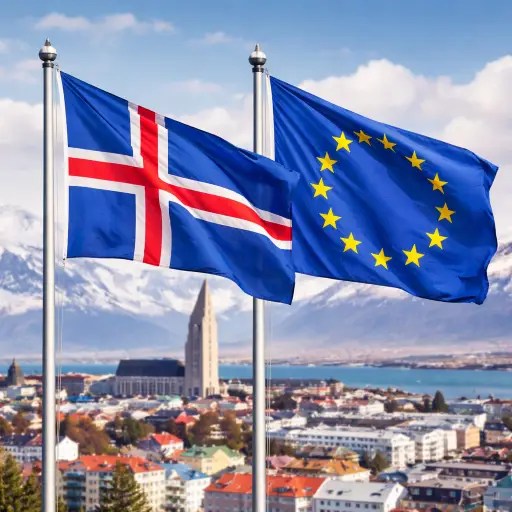
Prime Minister signals imminent vote on launching accession talks as public opinion shifts and Arctic strategy comes into sharper focus
Iceland’s prime minister has announced that the country will hold a referendum in the coming months on whether to open formal accession talks with the European Union, bringing forward a political decision that many observers had expected later in the government’s mandate.
The vote will not determine immediate membership but will instead ask citizens whether Iceland should begin negotiations with Brussels, a step that could eventually anchor the North Atlantic island within the EU’s institutional framework while fundamentally reshaping its economic and geopolitical alignment.
Recent opinion surveys conducted this winter indicate a narrow but noticeable shift in public sentiment toward supporting accession talks, marking a significant change in a country that suspended its previous membership application more than a decade ago and long maintained a cautious distance from full integration.
In announcing the move, the prime minister described the referendum as a democratic necessity in light of shifting global conditions, arguing that Iceland’s strategic environment has transformed amid economic uncertainty, evolving Arctic trade routes, and deeper European security coordination.
Iceland already participates in the European single market through the European Economic Area, aligning itself with a wide range of EU regulations while remaining outside the Union’s political institutions, an arrangement that has allowed access to continental markets without surrendering formal sovereignty over key sectors such as fisheries and agriculture.
That balance now lies at the center of a renewed national debate, as fishing communities voice concern that accession negotiations could ultimately challenge Iceland’s control over its valuable North Atlantic stocks, while business leaders argue that full membership would provide greater long-term economic stability.
Financial analysts in Reykjavík note that Iceland’s independent currency has historically amplified economic volatility during global downturns, and some contend that deeper integration with European structures could strengthen investor confidence and reduce exposure to external shocks.
The government’s coalition dynamics add complexity to the decision, as pro-European parties have pressed for a referendum since returning to power while more skeptical partners insisted on updated assessments of economic and legal implications before agreeing to move forward.
Across Europe, the announcement has been received with cautious optimism, with diplomats privately suggesting that Iceland’s strong governance standards and existing regulatory alignment would likely make any accession negotiations technically smoother than previous enlargement rounds.
At a time when the European Union faces questions about strategic autonomy, fiscal reform, and the pace of enlargement, Iceland’s renewed interest injects fresh momentum into debates over integration, offering the prospect of a stable Arctic democracy seeking closer ties rather than assistance or transition support.
The geopolitical implications extend beyond Brussels, as Nordic neighbors monitor developments closely and analysts speculate whether Iceland’s decision could revive dormant membership discussions in other non-EU countries in the region.
Particularly significant is the Arctic dimension, where melting sea ice and shifting maritime routes are intensifying global competition and elevating Iceland’s strategic position between North America and continental Europe.
EU membership talks could strengthen coordination on climate policy, maritime safety, and environmental regulation in the High North, reinforcing the Union’s role as a central Arctic stakeholder alongside its Nordic member states.
Security considerations also form part of the broader calculus, as Iceland remains a founding member of NATO and hosts allied infrastructure, while cooperation between EU defense initiatives and transatlantic structures has grown increasingly interconnected in recent years.
Public opinion remains finely balanced, and the coming campaign is expected to feature vigorous debate in town halls and national media, with younger voters appearing somewhat more supportive of integration than older generations shaped by earlier sovereignty disputes.
Civil society organizations have begun mobilizing on both sides, with environmental groups highlighting the EU’s climate framework as an opportunity to accelerate Iceland’s green transition while sovereignty advocates warn against incremental commitments that could become politically irreversible.
For the prime minister, the referendum represents both opportunity and risk, as a clear endorsement would strengthen her government domestically and internationally, while a rejection could fracture the coalition and stall broader reform efforts.
Even if voters approve opening accession talks, negotiations would likely span years and require further national consultations before full membership could be secured, particularly in complex areas such as fisheries management, agriculture, and monetary policy.
Regardless of the eventual outcome, the decision to accelerate the referendum has already reshaped Iceland’s political landscape, signaling that the country no longer views itself as a peripheral observer of European integration but as an active participant in shaping its northern future.
As winter recedes and national debate intensifies, Iceland now stands at a pivotal juncture, confronting not only the technical question of EU negotiations but the broader issue of how it defines its identity and strategic direction in a rapidly evolving Europe and an increasingly contested Arctic.

 The Tower Post