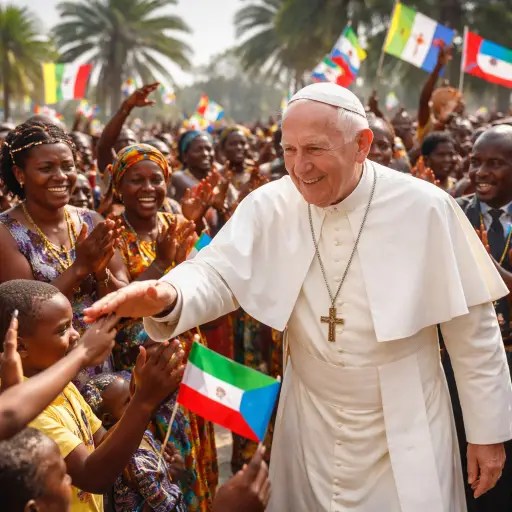
Vatican signals renewed focus on the Global South as the Pontiff prepares a multi-nation visit blending interfaith dialogue, development priorities, and Europe-Africa bridge-building.
In a move widely interpreted as a defining gesture of his young pontificate, Pope Leo XIV has announced an ambitious diplomatic and pastoral journey across Africa, placing the continent at the heart of the Holy See’s global engagement strategy and signaling a recalibration of Vatican diplomacy toward the Global South.
The upcoming tour will take the Pontiff to Algeria, Angola, Equatorial Guinea, and Cameroon, underscoring Africa’s growing spiritual and geopolitical significance within the Catholic Church and the broader international community at a time when global power dynamics are increasingly shifting southward.
The itinerary will also include Monaco and Spain, a deliberate pairing that Vatican officials describe as symbolic of renewed bridges between Europe and Africa, highlighting shared Mediterranean histories, migration realities, economic interdependence, and the Church’s role as a transcontinental moral actor.
Senior Vatican diplomats indicate that the journey is structured around three pillars central to Leo XIV’s papacy: development cooperation rooted in Catholic social teaching, deepened interfaith dialogue particularly with Muslim leaders, and the projection of soft power through moral persuasion rather than political coercion.
Africa today represents one of the most dynamic centers of Catholic growth, with expanding congregations, rising vocations, and increasing theological influence, making the Pope’s decision to dedicate a major early tour to the continent a strategic acknowledgment of its demographic and spiritual vitality.
In Algeria, attention is expected to focus on interreligious coexistence and dialogue, with planned encounters between the Pope and prominent Islamic scholars aimed at reinforcing shared commitments to peace, dignity, and social stability in a region marked by complex historical tensions.
Angola presents a different context, where the Church has long played a stabilizing role in post-conflict reconstruction, and where Leo XIV is expected to emphasize youth empowerment, education initiatives, and sustainable development partnerships that align ecclesial structures with long-term national growth.
Equatorial Guinea offers a more delicate diplomatic landscape, and Vatican observers anticipate a careful balance between pastoral engagement and quiet encouragement of governance reforms, consistent with the Holy See’s tradition of discreet dialogue rather than public confrontation.
In Cameroon, where religious diversity intersects with regional challenges, the Pope is likely to stress reconciliation and unity, meeting with Catholic bishops, Protestant representatives, and Muslim leaders to reinforce a message of coexistence grounded in shared responsibility for the common good.
The European stops carry strategic symbolism, with Monaco expected to host conversations on environmental stewardship and ethical finance, and Spain serving as a platform for reflections on migration, historical ties with Africa, and renewed solidarity across the Mediterranean basin.
Officials within the Secretariat of State privately characterize the mission as an exercise in pastoral diplomacy, leveraging the Vatican’s unique position as a sovereign entity without military or economic leverage but endowed with a vast transnational network of institutions and moral authority.
The timing of the announcement comes amid intensified geopolitical competition for influence across Africa, where major powers have expanded economic investments and security partnerships, making the Vatican’s emphasis on human development and spiritual accompaniment a distinct alternative model of engagement.
Preparations are already underway in the four African nations, with bishops’ conferences coordinating large-scale liturgical celebrations expected to draw significant public participation, while behind the scenes discussions are anticipated on debt relief, climate vulnerability, and migration management.
Analysts suggest that this journey may define the broader contours of Leo XIV’s foreign policy vision, privileging relational diplomacy and grassroots engagement over traditional centers of Western influence, and positioning the Church as a mediator attentive to the lived realities of emerging societies.
By traversing North, Central, and Southern Africa within a single extended pilgrimage while anchoring the route in key European locations, Pope Leo XIV appears determined to present a coherent narrative of interconnected destinies between continents, faith traditions, and political systems.
As anticipation builds, the tour stands not merely as a ceremonial sequence of visits but as a calculated diplomatic statement that the Catholic Church’s global horizon is increasingly shaped by the aspirations, challenges, and spiritual energy of the Global South, marking a significant chapter in the evolving identity of this pontificate.


 The Tower Post