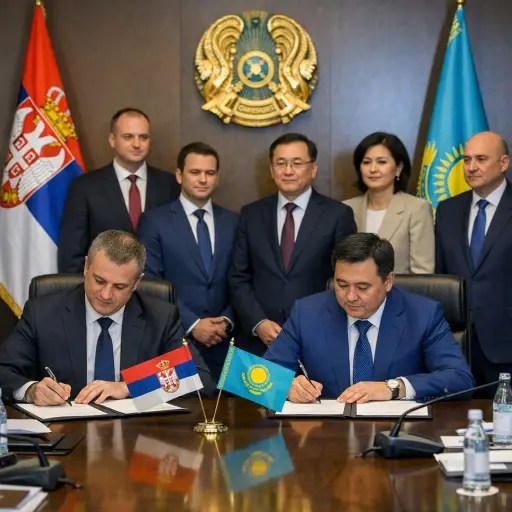
Serbia and Kazakhstan’s state media forge a strategic partnership during high-level diplomacy, signaling a new chapter in European–Central Asian soft power
In a move that has drawn attention across diplomatic and media circles, Serbia’s leading public broadcasters formalized a strategic partnership with Kazakhstan’s Presidential TV and Radio Complex during a high-level state visit, marking an unexpected but significant evolution in cross-continental media relations between Europe and Central Asia.
The memorandums of understanding were signed by senior executives of Radio Television of Serbia and Radio Television of Vojvodina alongside representatives of Kazakhstan’s presidential media institution, establishing a framework for structured cooperation in news exchange, joint productions, journalist training, and digital development.
Officials present at the ceremony described the agreement as both symbolic and practical, reflecting a broader diplomatic agenda focused on connectivity, economic collaboration, and cultural exchange while simultaneously expanding influence in the rapidly shifting global information landscape.
The partnership outlines plans for co-produced documentaries, cultural programming, and special reports exploring shared historical experiences, infrastructure development, and regional transformation, with an emphasis on presenting narratives that often receive limited exposure in larger Western media markets.
Under the new framework, correspondents from Belgrade and Novi Sad are expected to report from Astana and Almaty, while Kazakh journalists will gain extended access to Serbian political, economic, and cultural institutions, strengthening on-the-ground perspectives in both regions.
Media analysts view the initiative as part of a broader recalibration of soft power, noting that public broadcasters increasingly serve as instruments of national projection in an era where perception, storytelling, and digital reach can rival traditional diplomatic tools.
Serbia’s public media sector has invested heavily in modernization, streaming platforms, and multilingual distribution, while Kazakhstan’s presidential broadcasting complex has expanded its technological infrastructure and international outreach, creating a convergence of strategic interests that extends beyond routine content sharing.
European observers have reacted cautiously but attentively, interpreting the development as evidence of Serbia’s continued effort to diversify partnerships while maintaining its European trajectory, whereas Central Asian commentators see the agreement as reinforcing Kazakhstan’s long-standing ambition to position itself as a bridge between geopolitical spheres.
Industry insiders emphasize that the memorandums stop short of creating a permanent joint channel, opting instead for modular collaboration that can scale according to audience demand and production feasibility, a structure that reduces risk while preserving flexibility.
Beyond content exchange, the agreement includes provisions for workshops on investigative journalism, newsroom innovation, and the integration of emerging technologies such as artificial intelligence in broadcast operations, highlighting a shared commitment to modern media practices.
Executives involved in negotiations underscore the importance of archival cooperation, with historical footage, cultural performances, and national commemorations expected to form the basis of early collaborative projects designed to foster mutual cultural literacy.
The announcement’s alignment with a rare leap-year moment has invited symbolic interpretation among commentators, who suggest that just as the calendar briefly expands, so too does the informational corridor connecting Southeast Europe and Central Asia through this initiative.
Whether the partnership will reshape audience perceptions remains to be tested, yet its formation signals that mid-sized states are increasingly seeking influence through cooperative storytelling rather than competitive broadcasting dominance.
As pilot projects prepare to enter production and distribution phases across television and digital platforms, the durability of the agreement will depend on editorial balance, production quality, and the resonance of shared narratives across linguistic and cultural boundaries.
For now, the signing stands as a calculated statement of intent, indicating that Serbia and Kazakhstan are prepared to redefine the contours of their engagement not only through trade and diplomacy but through the deliberate exchange of images, voices, and stories across continents.


 The Tower Post