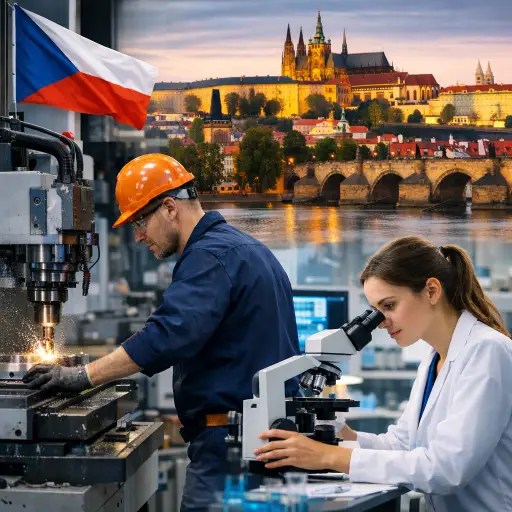
A new Prosperity Index ranks the country eighth in the bloc, yet economists caution that future growth will depend on innovation rather than industrial muscle alone.
Czechia has climbed into the European Union’s top tier of economic performers, securing eighth place in the latest Prosperity Index and marking a symbolic milestone at a moment when the calendar itself grants an extra turn, inviting reflection on how far the country has advanced and how carefully it must tread to sustain that ascent.
The ranking underscores years of steady industrial expansion, disciplined public finances and deep integration into European supply chains, elevating the Central European nation into a select group of economies widely regarded as the bloc’s most advanced and competitive.
At the heart of the achievement lies a formidable manufacturing base that continues to power exports across the continent, from automotive production and precision engineering to high-grade machinery that feeds into Germany’s factories and beyond, reinforcing Czechia’s reputation as a reliable industrial engine.
Analysts point to robust output, solid productivity gains and a workforce known for technical skill as central drivers of the country’s rise, noting that Czech firms have modernized aggressively in recent years, upgrading equipment and expanding capacity even amid global uncertainty.
Equally significant is the country’s comparatively low public debt burden, which remains modest relative to many European peers and has strengthened investor confidence while preserving fiscal flexibility at a time when governments across the bloc are grappling with heavier borrowing and tighter budgets.
Economists say this combination of industrial strength and fiscal prudence has given Czechia a resilience that proved crucial during periods of external shock, allowing it to recover steadily and maintain credibility in financial markets while others faced sharper turbulence.
Yet beneath the celebratory headlines, a more cautious assessment is taking shape among policy experts who warn that the very model that propelled Czechia into the top ten may now limit its future prospects if it is not adapted to a rapidly shifting global landscape.
A growing share of recent capital spending has flowed into machinery, plant upgrades and incremental efficiency improvements rather than into research, digital platforms or breakthrough technologies, raising concerns that the economy risks becoming overly dependent on mid-value manufacturing.
While such investments deliver tangible short-term gains in output and employment, analysts argue they do less to secure long-term competitiveness in an era defined by artificial intelligence, advanced robotics, clean energy systems and high-margin digital services.
Several economic institutes observe that Czech expenditure on research and development still trails that of Europe’s most innovation-driven economies, and venture capital activity, though gradually expanding, remains limited compared to established technology hubs further west.
The danger, economists caution, is not immediate decline but gradual stagnation, as global supply chains evolve and higher-value segments of production cluster around regions that combine industrial capacity with cutting-edge research ecosystems.
In Prague and Brno, technology parks and university incubators have multiplied, signaling ambition and a recognition among policymakers that future growth will hinge on nurturing domestic innovation, yet business leaders acknowledge that scaling start-ups into global players remains a persistent challenge.
Many young firms in biotechnology, advanced materials and software engineering have demonstrated technical promise, but securing sustained domestic financing and retaining talent in the face of international competition continue to test the resilience of the emerging innovation sector.
Industry representatives stress that Czechia possesses many of the prerequisites for a successful transition, including respected technical universities, a well-educated labor force and a strategic geographic position at the crossroads of European markets.
However, they also emphasize that shifting from a production-driven model to an innovation-led economy demands more than capital expenditure, requiring regulatory reforms, deeper collaboration between academia and business and a cultural embrace of entrepreneurial risk.
The broader European context adds urgency to the debate, as member states intensify efforts to secure leadership in semiconductors, green technologies and advanced digital infrastructure, areas likely to shape competitive advantage for decades to come.
Slower demand in key export markets and structural changes within the automotive sector further complicate the outlook, prompting questions about how long traditional manufacturing can continue to deliver the growth rates that elevated Czechia into the bloc’s upper ranks.
Government strategies have increasingly highlighted support for research partnerships, digital skills training and incentives aimed at attracting higher-value investment, reflecting an awareness that maintaining eighth place may prove more difficult than attaining it.
Economic observers argue that the current moment, marked by both achievement and uncertainty, offers a rare opportunity to recalibrate national priorities before external pressures force more abrupt adjustments.
For now, the Prosperity Index ranking stands as a testament to the country’s transformation from a post-transition economy into one of the European Union’s most stable and capable performers, a journey built on discipline, adaptability and industrial prowess.
The extra day in the calendar serves as a quiet reminder that time can be both a gift and a constraint, and economists suggest that Czechia would be wise to treat its top-ten status not as a destination reached but as a platform from which to launch a more innovation-driven future.
If the country succeeds in channeling its industrial strength into higher-value sectors such as advanced research, digital technologies and sustainable energy solutions, analysts believe it can consolidate its place among Europe’s economic leaders and perhaps climb even higher.
Should it hesitate, relying predominantly on expanding existing production lines while others leap ahead in technological sophistication, the risk is not dramatic collapse but a slow erosion of relative standing within an increasingly competitive union.
As policymakers, entrepreneurs and investors weigh their next moves, the message emerging from economists is measured yet clear: stability has carried Czechia into the European Union’s top ten economies, but reinvention will determine whether it remains there in the years to come.


 The Tower Post