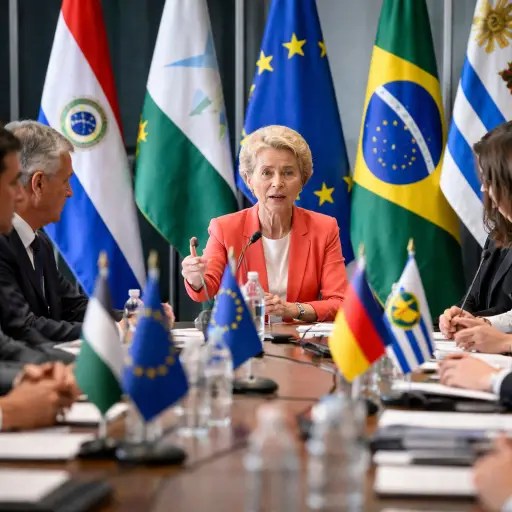
Commission advances contested South American pact before court scrutiny, stoking French anger and drawing German backing in a leap-year political reckoning
The European Union enters a rare leap-year crossroads as Commission President Ursula von der Leyen presses ahead with the long-negotiated Mercosur trade agreement, a move that has sharpened divisions among member states and reignited debate over how far Europe should go in opening its markets amid mounting political and economic strain.
By triggering provisional application of key sections of the pact before pending judicial reviews are concluded, the European Commission has signaled its determination to anchor the EU firmly within a shifting global trade landscape, arguing that delay would erode credibility with international partners and weaken Europe’s strategic leverage.
The agreement with the Mercosur bloc, encompassing Brazil, Argentina, Uruguay and Paraguay, would create one of the world’s largest free trade zones, lowering tariffs on industrial exports while granting expanded access for South American agricultural products to European consumers.
For von der Leyen and her allies in Brussels, the initiative represents more than a commercial accord, reflecting a broader ambition to demonstrate that the EU can still shape global economic rules at a time when protectionist currents and geopolitical fragmentation threaten multilateral cooperation.
France has emerged as the most forceful critic of the Commission’s timing, warning that advancing implementation ahead of court clarification risks sidelining democratic oversight and exposing European farmers to intensified competition from producers operating under different regulatory and environmental frameworks.
French officials contend that domestic agriculture, already burdened by stringent climate standards and rising production costs, could suffer irreversible damage if cheaper beef, poultry and sugar imports flood the market without enforceable guarantees of reciprocity.
Across rural regions, farmer organizations have mobilized with renewed urgency, staging high-visibility protests and demanding safeguards that would align import conditions with European sustainability norms, transforming a complex trade dossier into a symbol of deeper anxieties about sovereignty, fairness and rural survival.
Germany, by contrast, has largely welcomed the Commission’s assertive posture, viewing the Mercosur agreement as a gateway to expanded export opportunities for its manufacturing sector and a means of diversifying supply chains in an era marked by strategic competition and economic recalibration.
Berlin argues that tariff reductions on automobiles, machinery and chemical products could unlock significant growth potential for European industry, reinforcing the bloc’s competitiveness and providing fresh momentum at a time when traditional markets show signs of slowing demand.
Within the Council of the European Union, diplomats describe an atmosphere of cautious calculation as smaller member states weigh prospective economic gains against domestic political sensitivities, mindful that ratification battles in national parliaments could inflame already polarized electorates.
Environmental advocates have added further complexity to the debate, cautioning that expanded agricultural trade may heighten deforestation pressures in parts of South America unless strict monitoring and enforcement mechanisms accompany market access commitments.
The Commission maintains that sustainability chapters embedded within the agreement provide tools to address such concerns, insisting that engagement and structured cooperation offer more influence over environmental standards than isolation or stalled negotiations.
Legal experts note that provisional application is a recognized mechanism within EU treaty practice, yet they acknowledge that deploying it in politically sensitive circumstances amplifies scrutiny and may invite legal challenges that test institutional boundaries.
As leaders convene in this leap-year moment marked by symbolic extra time, the Mercosur dispute has evolved into a broader referendum on the Union’s economic direction, confronting policymakers with competing visions of openness and protection, integration and restraint.
Whether von der Leyen’s calculated gamble ultimately consolidates Europe’s standing in global trade or deepens fissures within the bloc remains uncertain, but the episode underscores a defining tension in contemporary European politics: reconciling collective ambition with national apprehension in an increasingly volatile world.

 The Tower Post