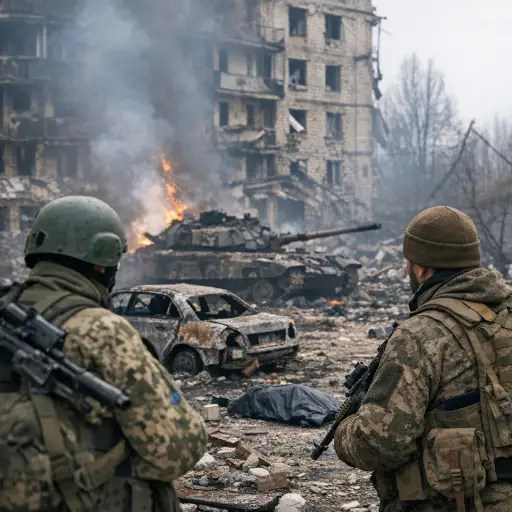
With external estimates suggesting roughly half a million killed, the Russia-Ukraine war stands as the bloodiest conflict on European soil in generations
As Europe marks a rare leap day that appears only once in several years, the war between Russia and Ukraine grinds on with a relentless intensity that has reshaped the continent’s security landscape and delivered a human toll unseen in Europe since the middle of the twentieth century.
External estimates compiled by Western intelligence services, independent research groups and defense analysts suggest that roughly half a million people have been killed since the full-scale invasion began, a figure that includes soldiers on both sides as well as Ukrainian civilians caught in bombardments, sieges and occupation.
Neither Moscow nor Kyiv publishes comprehensive casualty data, and both tightly control official disclosures, leaving outside observers to assemble a fragmented picture from satellite imagery, intercepted communications, battlefield reports and demographic analysis that together point to staggering losses.
The result is a conflict now widely regarded by military historians as the deadliest fought on European soil since World War II, surpassing the Balkan wars of the nineteen-nineties in both scale and sustained intensity, and shattering long-held assumptions that large interstate wars had become relics of a darker era.
In eastern and southern Ukraine, entire towns have been hollowed out by artillery barrages and drone strikes, their apartment blocks collapsed into concrete skeletons and their streets scarred by craters, while trench systems stretch across frozen fields in scenes reminiscent of earlier centuries of industrial warfare.
Civilian casualties remain particularly difficult to verify, especially in territories under Russian occupation where independent journalists face severe restrictions, communications are limited and local authorities answer to Moscow, making accurate documentation of deaths, disappearances and forced transfers a formidable challenge.
Human rights organizations warn that the true number of noncombatant victims may not be fully understood for years, as investigators will need access to contested regions, forensic teams and archival records before they can establish a definitive accounting of what transpired in besieged cities and rural communities.
The war’s brutality has unfolded alongside a technological transformation of the battlefield, where inexpensive drones scout enemy positions, precision-guided rockets strike logistics hubs and satellite data feeds commanders near real-time intelligence, compressing decision-making cycles and amplifying the lethality of each engagement.
Yet for all its modern features, the conflict has settled into a grinding war of attrition in which incremental territorial gains are measured in meters rather than miles, and where artillery shells, not sweeping maneuvers, often determine the outcome of weeks of fighting.
Ukraine’s armed forces continue to rely heavily on Western military assistance, including air defense systems, armored vehicles and ammunition supplies, support that has enabled Kyiv to blunt several Russian offensives even as questions mount in allied capitals about sustainability and stockpile depletion.
Russia, for its part, has leveraged its larger population base and expanded defense production to replenish equipment and personnel, framing the war domestically as a broader confrontation with the West and using that narrative to justify prolonged mobilization and economic reorientation.
The economic reverberations extend far beyond the battlefield, as sanctions imposed on Russia have redirected trade flows and accelerated Europe’s push to diversify energy supplies, reducing reliance on Russian gas while exposing households and industries to higher costs and persistent inflationary pressure.
Across the European Union and within NATO, defense budgets have risen sharply, long-neutral states have reconsidered their strategic alignments and policymakers speak openly of a new era defined by deterrence and preparedness rather than the peace dividend that characterized the decades after the Cold War.
Diplomatic efforts to secure a durable ceasefire have repeatedly faltered, with both sides accusing the other of inflexible demands and maximalist aims, and while limited prisoner exchanges and humanitarian corridors have been negotiated, no comprehensive settlement appears within immediate reach.
On the ground, ordinary Ukrainians navigate a daily reality shaped by air raid sirens, rolling blackouts and the constant awareness that front lines can shift, even as schools reopen in underground shelters and volunteer networks deliver food, medical supplies and generators to vulnerable communities.
Millions remain displaced, some having sought refuge in neighboring countries and others scattered within Ukraine itself, creating one of the largest population movements in Europe in decades and leaving families divided across borders and time zones.
In Russia, the social impact of mounting military casualties is less visible in official media but increasingly evident in regional communities where funerals have become more frequent and economic isolation has altered employment patterns, consumption and access to foreign goods.
Analysts caution that casualty figures, however high, capture only part of the conflict’s cost, as psychological trauma, environmental damage and the long-term burden of reconstruction will shape the region’s trajectory long after the guns fall silent.
Rebuilding shattered infrastructure, clearing unexploded ordnance and addressing allegations of war crimes will require sustained international engagement, legal scrutiny and financial commitments that could span generations.
As this additional day on the calendar offers a symbolic pause, there is little sense of suspension along the front lines, where artillery exchanges continue and commanders on both sides prepare for the next phase of operations in a war that has defied expectations of swift resolution.
For Europe, the conflict serves as a sobering reminder that the architecture built to prevent large-scale war remains vulnerable to rupture, and that peace, once assumed to be durable, can erode with alarming speed under the weight of geopolitical ambition and mutual mistrust.
Whether through negotiation, battlefield exhaustion or political change, the path to ending the war remains uncertain, but its grim distinction as the deadliest European conflict in generations is already etched into the continent’s history.
Behind every estimate and strategic assessment lies an accumulation of individual tragedies, from soldiers entrenched in frozen earthworks to civilians sheltering in basements, each life lost contributing to a toll that has redefined Europe’s understanding of security in the twenty-first century.

 The Tower Post