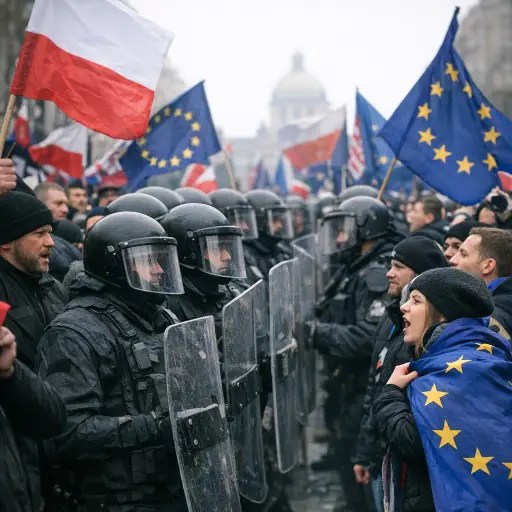
Migration pressures and geopolitical maneuvering deepen continental divides on a symbolic leap-year turning point
On this rare leap-year day at the close of winter, Europe finds itself in a state of political suspension, caught between institutional continuity and mounting centrifugal forces that are reshaping its electoral map with unusual speed and intensity.
A new cross-Atlantic policy analysis circulating among diplomats and security officials argues that the strategic postures of Washington and Moscow are, in different ways, reinforcing the rise of populist right-wing movements across the European Union at a moment of sustained migration pressure and economic unease.
The report does not claim orchestration or simple causality, but it draws a clear line between external power competition and the internal fragmentation now visible from Rome to Berlin, where sovereignty debates increasingly overshadow traditional left-right policy divides.
Migration remains the defining accelerant in this transformation, as southern entry points strain under reception demands while northern capitals wrestle with asylum backlogs, integration bottlenecks, and voter fatigue after years of crisis governance.
In Italy, Prime Minister Giorgia Meloni has consolidated her authority by framing border control as a question of civilizational continuity, while in France Marine Le Pen’s National Rally continues its steady normalization by pairing economic nationalism with promises of firmer migration limits.
In Germany, the Alternative for Germany has translated regional grievances, particularly in eastern states, into a broader critique of federal migration policy and European integration, capitalizing on perceptions that mainstream parties have struggled to articulate a cohesive response.
The analysis suggests that Washington’s strategic pivot toward competition in the Indo-Pacific has unintentionally thinned its traditional stabilizing presence in European political discourse, as repeated calls for higher defense spending and tougher economic alignment feed narratives of external pressure.
Populist leaders across the continent have seized on these dynamics to argue that national governments must reclaim greater autonomy, presenting American expectations as evidence that sovereignty can only be secured through political realignment at home.
Moscow’s approach, by contrast, is described as more deliberately disruptive, relying on energy leverage, digital amplification, and state-aligned media ecosystems to widen existing fissures within the Union without necessarily seeking outright ideological alignment.
Even as sanctions and the war in Ukraine have constrained Russia’s formal economic reach, European officials acknowledge that information operations continue to exploit contentious debates over inflation, security, and migration policy.
The result is a political environment in which domestic discontent and geopolitical rivalry intersect, creating space for parties that promise swift national solutions over multilateral compromise and procedural negotiation in Brussels.
European institutions insist that the narrative of irreversible decline is overstated, pointing to coordinated sanctions regimes, joint defense procurement initiatives, and collective recovery funding as evidence that integration retains practical resilience despite louder political discord.
Yet behind closed doors policymakers concede that consensus-building has grown slower and more fragile, as coalition governments face increasingly polarized electorates that reward confrontation more readily than incremental reform.
In Central and Eastern Europe, leaders long critical of Brussels interpret the present moment as validation of their warnings about overcentralization, while governments in Scandinavia and the Iberian Peninsula recalibrate rhetoric to address public anxiety without abandoning core commitments to European cooperation.
The leap-year symbolism resonates in policy circles as well, evoking the idea of institutional correction, a calendrical adjustment designed to prevent drift, and raising the question of whether the Union can recalibrate before fragmentation hardens into structural division.
Analysts caution that the rise of right-wing populism cannot be reduced to foreign influence alone, noting that inequality, demographic change, housing shortages, and bureaucratic opacity within EU governance structures remain powerful domestic drivers.
Nevertheless, the report concludes that both Washington and Moscow have adapted swiftly to Europe’s internal strains, recognizing that a divided continent alters the balance of global power in ways that serve their respective strategic calculations.
For the United States, a cohesive Europe is a more effective partner in burden-sharing and deterrence, yet American political volatility has introduced doubts about long-term predictability, doubts that nationalist parties use to bolster calls for self-reliance.
For Russia, a Europe preoccupied with internal discord represents a geopolitical advantage, limiting the Union’s capacity to project unity abroad and complicating coordinated responses to security crises on its eastern flank.
As winter recedes and the political calendar accelerates toward new electoral tests, Europe confronts a defining question on this additional day of the year: whether fragmentation will remain a transient phase of adjustment or solidify into a lasting feature of the continental order.



 The Tower Post