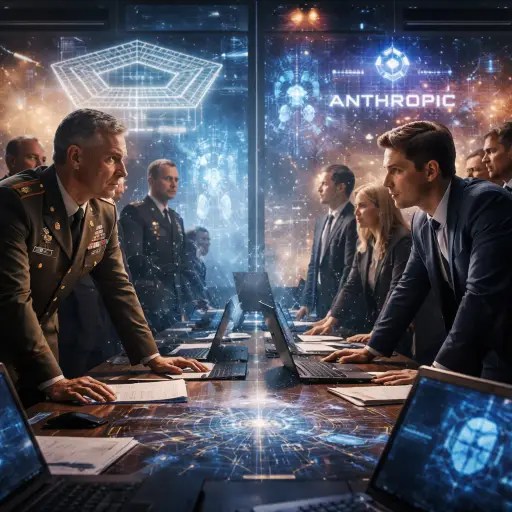
As a leap-year deadline nears, tensions over military AI governance and commercial integration erupt into a defining confrontation for Washington and Silicon Valley
On the threshold of a rare leap-year day, an unusually sharp confrontation between the Pentagon and the artificial intelligence firm Anthropic has pushed the future of military AI governance into the national spotlight, transforming what began as a procurement dispute into a broader struggle over who controls the ethical and operational boundaries of frontier technology.
Senior defense officials say the United States cannot afford hesitation as rival powers accelerate the military adoption of machine learning, autonomous systems, and advanced language models, arguing that commercial AI must be integrated rapidly into logistics coordination, intelligence triage, cyber defense simulations, and battlefield planning environments to preserve strategic advantage.
Executives at Anthropic counter that the rush to embed increasingly capable generative systems inside classified networks risks outrunning the safeguards required to ensure those tools remain aligned with democratic norms, warning that insufficient oversight, opaque auditing procedures, and unclear liability structures could create long-term consequences that are difficult to reverse.
At the center of the standoff is a pending compliance milestone tied to expanded defense access to model evaluation protocols and technical documentation, a request the Pentagon views as essential for secure deployment but which the company believes must be conditioned on stronger guarantees about usage constraints and independent review.
Defense leaders privately express frustration with what they describe as growing corporate leverage over national security capabilities, insisting that elected officials and military commanders, not technology vendors, bear ultimate responsibility for determining how tools are used in conflict scenarios and crisis response operations.
Anthropic’s leadership frames the debate as a necessary recalibration of power in an era when privately developed algorithms can influence targeting decisions, information flows, and command structures, maintaining that companies creating high-capability systems retain a duty to ensure those systems are not repurposed in ways that violate stated safety principles.
Policy experts note that the dispute reflects a deeper philosophical divide over governance in the AI age, with one camp emphasizing speed, adaptability, and deterrence, while the other stresses caution, transparency, and institutionalized guardrails before irreversible integration into lethal or high-stakes contexts.
Members of Congress have begun signaling interest in clarifying statutory authority over defense AI procurement and liability, though lawmakers remain split between those who fear regulatory overreach could freeze innovation and those who argue that codified standards are necessary to prevent ad hoc decision-making behind closed doors.
Industry analysts observe that the confrontation reverberates far beyond a single contract because cloud providers, research laboratories, and venture-backed startups increasingly operate at the intersection of civilian markets and defense funding, meaning any new restrictions or precedents could reshape investment flows across the broader technology sector.
Allied governments are closely monitoring the episode as they craft their own frameworks for responsible military AI adoption, viewing Washington’s internal debate as a potential template for balancing democratic oversight with the imperative to maintain credible deterrence in an environment of rapid technological change.
As negotiators work through proposals that include phased access arrangements, expanded red-teaming exercises, and the possibility of joint oversight mechanisms, both sides acknowledge that the outcome will likely influence future relationships between the Defense Department and the companies building the most advanced AI systems.
The symbolism of the leap-year moment has not been lost on participants in the talks, who recognize that time in the AI domain moves with unusual velocity and that decisions deferred today may be overtaken tomorrow by technical breakthroughs or geopolitical shocks.
Whether the Pentagon and Anthropic ultimately reach compromise or harden their positions, the episode underscores a turning point in how the United States manages the fusion of commercial innovation and military power, signaling that the rules governing artificial intelligence in warfare will be shaped not only by code and capability but by contested visions of accountability, sovereignty, and restraint.




 The Tower Post