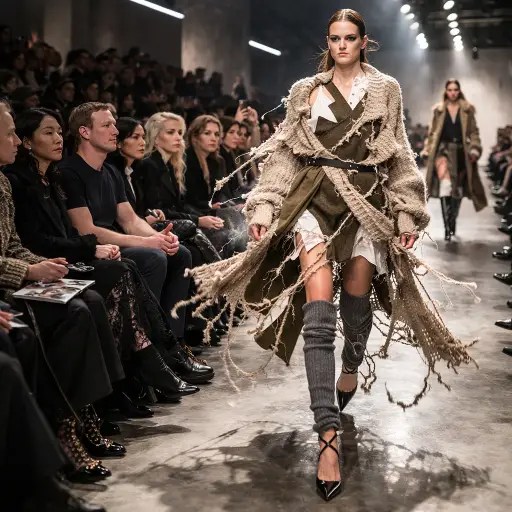
Layered knitwear is torn apart on the runway as celebrity power and cultural tension converge in a leap-year spectacle
On a night charged with anticipation and the rare symbolism of a leap-year finale, Prada transformed the runway into a living metaphor, sending out models wrapped in complex layers of knitwear that would not remain intact for long.
The show, staged in a stark industrial space during Milan Fashion Week, opened with what appeared to be a masterclass in construction: ribbed wool dresses stacked over translucent slips, oversized cardigans belted tightly over tailored skirts, and elongated sleeves falling deliberately past the wrists in a muted palette of slate, sand, oxblood and deep marine.
Then, halfway down the catwalk, the mood shifted as seams were pulled apart and threads deliberately snapped, with garments unraveling in full view of the audience to reveal sharply cut bodices, lean column dresses and flashes of bare skin concealed beneath the initial layers.
The destruction was not chaotic but choreographed, each tear exposing a second silhouette engineered into the look, proving that what appeared spontaneous had in fact been meticulously designed to maintain structure even as panels fell away.
In the front row, Meta chief executive Mark Zuckerberg watched intently alongside actors, editors and global buyers, his understated presence underscoring the growing intersection between technology power brokers and the luxury fashion establishment.
Gasps rippled through the room as strands of wool trailed behind the models like loose narratives, and smartphones rose in near unison to capture the spectacle of garments shifting from cocooning bulk to sculpted precision within seconds.
The leap-year timing lent symbolic weight to the presentation, positioning the collection as an interruption of routine and a deliberate break from predictable cycles, a theme reinforced by Prada’s decision to expose rather than conceal the mechanics of its craft.
Backstage, racks held sweaters pre-engineered with hidden reinforcement points that allowed knitwear, notoriously difficult to control once cut, to unravel in visually dramatic yet structurally coherent ways, ensuring that the theatrical gesture translated into wearable reality.
Critics quickly framed the collection as a meditation on fragility and agency, suggesting that in a moment defined by global uncertainty Prada was asserting control over the act of rupture itself, turning what might signal collapse into an opportunity for redesign.
Despite the runway theatrics, the commercial core remained evident in finely spun cashmere dresses, sharply tailored coats whose linings became focal points once outer shells were split, and knit trousers that retained polish even when edged with subtle slashes.
As the finale approached, models returned in varying states of deconstruction, threads scattering across the polished floor and transforming the pristine runway into a textured field of evidence that something deliberate and irreversible had occurred.
The applause was immediate and sustained, marking one of the most talked-about moments of the week and reinforcing Prada’s reputation for intellectual provocation delivered through precise craftsmanship rather than empty spectacle.
In a season crowded with maximalist statements and safe minimalism, Prada carved out a third path by allowing garments to come undone while proving that intention, not accident, lay behind every exposed seam.
As guests spilled into the cool Milan night, strands of wool clinging to heels and coat hems, conversation centered not simply on torn sweaters but on the broader suggestion that fashion, like the calendar’s rare extra day, can momentarily step outside the expected rhythm and redefine it.




 The Tower Post