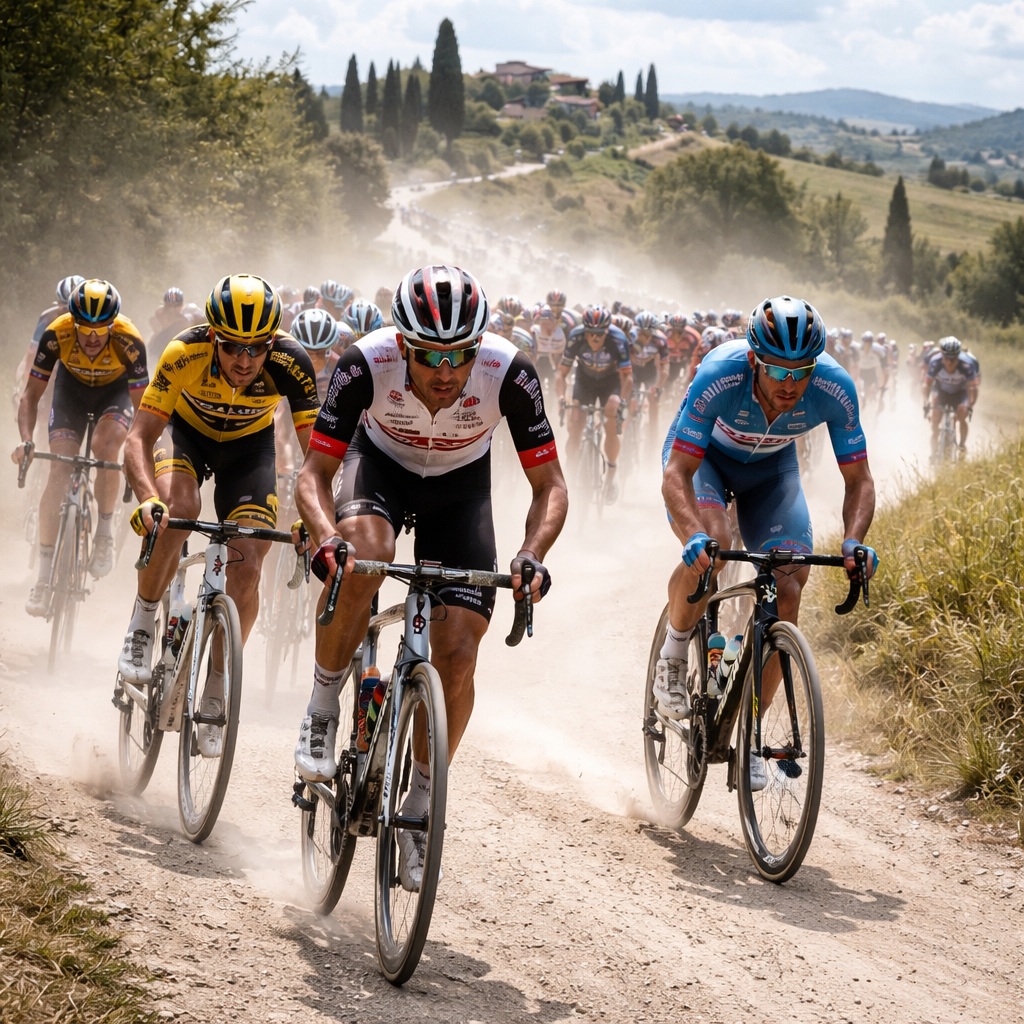
Extended gravel sectors and volatile skies raise the stakes for a leap-day battle on Tuscany’s white roads.
The pale gravel roads of Tuscany are set to host one of the most demanding early-season confrontations in modern cycling as Strade Bianche returns with a harder route, longer sterrato sectors, and weather forecasts that threaten to turn an already selective race into outright survival.
Organizers have subtly but decisively extended key gravel stretches, reshaping the rhythm of the contest and ensuring that positioning and resilience will matter long before the decisive ramps toward Siena, where the race traditionally reaches its fevered crescendo.
Riders arriving in Italy this week have not downplayed the challenge, with several European stars privately describing this edition as the toughest early-season classic in years, pointing to the relentless sequence of short climbs, technical descents, and exposed ridgelines that punish hesitation and magnify every mistake.
Unlike the cobbled monuments of northern Europe, the white roads demand a distinct blend of explosive climbing power and delicate bike handling, forcing contenders to float across loose surfaces while conserving energy for gradients that regularly surge into double digits.
The unpredictability of late-winter conditions adds another layer of tension, as unsettled skies hover over the Tuscan hills and meteorologists warn of scattered showers and gusting crosswinds capable of splitting the peloton into ragged fragments within moments.
In dry conditions the race unfolds in clouds of fine dust that cling to jerseys and blur visibility, turning the front of the bunch into a high-speed procession of shadowed figures, but when rain arrives the chalky surface transforms into slick mud that grips wheels and drains strength with equal cruelty.
Team directors have responded with meticulous preparation, debating tire pressures deep into the evening and instructing mechanics to balance grip against rolling resistance, aware that a single puncture or mistimed bike change can erase months of training in the space of a few unforgiving kilometers.
The extended gravel sectors are expected to provoke earlier aggression, with stronger squads likely to increase tempo from distance in an effort to isolate rivals before the race reaches its traditional decisive phase, while opportunists search for moments of collective hesitation to launch bold, long-range moves.
History suggests that reputation alone offers little protection on these roads, as Strade Bianche has repeatedly crowned unexpected winners who capitalized on chaos, seized narrow windows of opportunity, and resisted the temptation to wait for more decorated names to dictate the script.
The symbolic resonance of this leap-day edition has not been lost on the peloton, with riders speaking of the rare alignment of calendar and competition as an invitation to attempt something memorable, knowing that opportunities to etch one’s name into cycling folklore do not arrive on ordinary days.
Beyond the tactical intrigue lies the stark beauty of the Tuscan landscape, where rolling hills, cypress-lined lanes, and distant farmhouses frame a contest that juxtaposes pastoral serenity with the raw intensity of elite sport.
Spectators lining the sterrato expect spectacle as much as suffering, anticipating the sight of athletes coated in pale grit, chains grinding under torque, and team cars weaving carefully through narrowing corridors of fans who lean close enough to feel the rush of displaced air.
The race’s defining moment remains the final ascent into Siena’s Piazza del Campo, a steep, twisting ramp that forces contenders to summon one last explosive effort after hours of attrition, their legs trembling as medieval stone walls amplify the roar of the crowd.
By the time the leaders reach that historic square, the field is typically shattered into isolated figures and small, desperate groups, each rider locked in a private battle against fatigue while calculating whether to attack, defend, or simply endure.
Several pre-race favorites arrive in Tuscany carrying early signs of form from stage races and training camps, yet even the strongest among them acknowledge that Strade Bianche rewards audacity as much as condition, and that tactical misjudgment can undo physical superiority.
The accumulated gravel distance this year edges the race closer to the demands of a monument, compressing endurance, power, and technical skill into a compact but ferocious package that leaves little time for recovery once the pace accelerates.
Breakaways may find surprising latitude if the major teams hesitate, but cooperation on the white roads is fragile, as riders constantly weigh the risk of towing rivals toward the finish against the peril of waiting too long and allowing a decisive move to escape beyond recall.
As anticipation builds beneath unsettled skies, the mood among teams oscillates between confidence and caution, each squad aware that the margins separating triumph from disappointment are measured not only in watts but in split-second decisions made on unstable terrain.
When the winner eventually lifts his arms against the backdrop of Siena’s ancient architecture, the image will encapsulate more than personal success, it will reflect mastery over dust, climbs, uncertainty, and the subtle cruelty that defines this race.
On this rare leap-day gathering, with extended gravel awaiting and weather poised to intervene, Strade Bianche stands ready to reaffirm its reputation as cycling’s most compelling early-season crucible, a brutal test that promises drama from the first white road to the final echoing cheers in the heart of Tuscany.




 The Tower Post