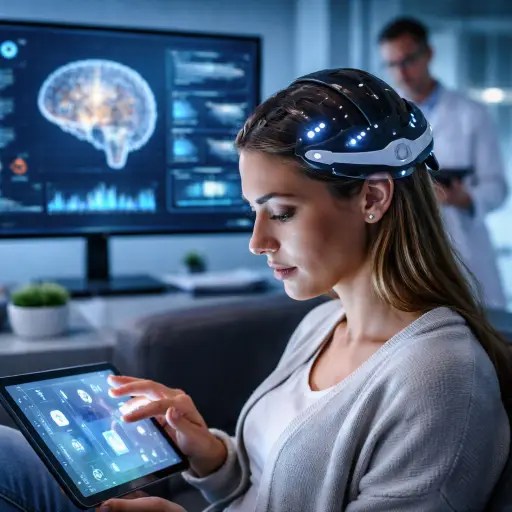
As U.S. neurotechnology firms expand human testing beyond medical need, investors and ethicists confront the promise—and peril—of a new digital frontier
A technological shift once confined to university laboratories and hospital rehabilitation units is now unfolding in living rooms and startup offices across the United States, as brain-computer interfaces move decisively from medical experimentation into early consumer trials.
Over the past year, several American neurotechnology companies have expanded human testing of non-invasive brain-computer interfaces, allowing participants to type messages, navigate digital menus, and control connected devices using neural signals captured from the scalp.
For decades, brain-computer interfaces were developed primarily to restore lost function, enabling patients with paralysis to communicate or helping individuals with severe motor impairments operate assistive technologies, but the latest wave of wearable headsets is being tested by healthy users seeking faster, hands-free interaction with machines.
These systems rely on electroencephalography sensors embedded in lightweight headbands that detect electrical activity generated by the brain, while machine-learning algorithms analyze patterns in real time and convert intention into digital commands on screens, smart home systems, or augmented environments.
Participants in pilot programs describe the experience as both exhilarating and demanding, noting that while typing speeds remain slower than conventional keyboards, the sensation of directing a cursor or composing a sentence through focused thought alone represents a striking leap in human-computer interaction.
Investors in Silicon Valley are responding with extraordinary enthusiasm, channeling billions of dollars into neurotechnology ventures amid growing speculation that brain-driven interfaces could mark a computing inflection point comparable to the earliest days of the smartphone revolution.
Executives and venture capitalists increasingly frame the technology as the foundation of a new platform economy in which screens fade into the background and artificial intelligence systems respond directly to cognitive intent rather than to taps, swipes, or voice commands.
Yet as the technology pivots from therapeutic necessity to consumer experimentation, ethicists and privacy advocates are raising urgent questions about how neural data will be collected, stored, protected, and potentially monetized in a rapidly commercializing marketplace.
Unlike traditional digital footprints such as browsing histories or location tracking, neural signals may reveal patterns of attention, emotional states, or cognitive responses, creating a category of biometric information that many experts argue demands stronger regulatory safeguards than existing consumer data protections provide.
Regulatory agencies are now grappling with how to classify and oversee non-invasive brain-computer interfaces that do not penetrate the body yet still interact directly with neural processes, a challenge complicated by the speed of private-sector innovation.
Companies involved in consumer trials emphasize that current devices capture relatively coarse electrical activity and that encryption, anonymization, and on-device processing are central to their data practices, but critics caution that competitive pressure could erode voluntary standards once products reach broader markets.
Bioethicists warn that the social implications extend beyond privacy to questions of equity and autonomy, asking whether employers might one day encourage cognitive monitoring for productivity gains or whether enhanced focus and faster communication could become premium advantages accessible only to those who can afford them.
International competition adds another dimension, as governments and corporations around the world invest heavily in neurotechnology research, viewing advances in brain-computer interfaces as strategically significant for economic growth and technological leadership.
For now, the consumer trials remain limited in scale, requiring careful calibration sessions and sustained concentration from users, with fatigue and environmental noise often affecting performance, but steady improvements in signal processing and hardware design are narrowing technical constraints.
Public demonstrations at major technology gatherings have drawn large audiences, reflecting both fascination and apprehension about a future in which thought-based control of digital systems may become commonplace rather than experimental.
The transition underway represents more than a hardware upgrade; it signals a redefinition of the boundary between cognition and computation, transforming the brain from a private organ of thought into an active participant in networked digital ecosystems.
As companies accelerate development and policymakers debate guardrails, the nation finds itself at a pivotal moment in which the promise of empowerment through direct brain-to-machine communication must be weighed against the profound ethical and societal risks it may carry.
What was once the domain of speculative fiction is now embedded in structured human trials across the United States, and the outcome of this early consumer phase may determine whether brain-computer interfaces emerge as a transformative tool of inclusion or a disruptive force that reshapes privacy, labor, and inequality in ways still difficult to foresee.




 The Tower Post