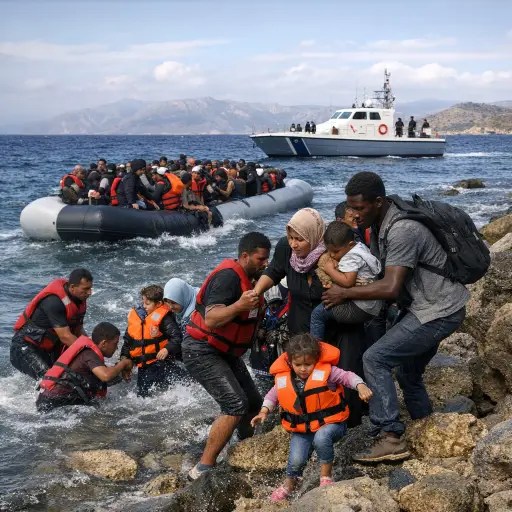
Tripling arrivals on Greek shores, especially Crete, test EU border strategy as humanitarian pressures mount along Europe’s southern flank
Early March finds Europe once again confronting a familiar yet intensifying challenge along its southern maritime frontier, as a sharp rise in migrant crossings across the Mediterranean places renewed pressure on Greece and reverberates through European capitals.
On the island of Crete, fishing boats and coast guard patrols have become first responders to a steady stream of overloaded vessels approaching from the south, carrying men, women and children who have risked everything on unpredictable seas in hopes of reaching European soil.
Greek authorities say arrivals on Crete have effectively tripled compared with the same period last year, transforming what was once a secondary landing point into a focal corridor of movement driven by instability stretching across North Africa and beyond.
Many of the boats depart from Libya’s fractured coastline, where rival authorities and armed groups leave vast stretches of shore vulnerable to smuggling networks that have adapted swiftly to enforcement patterns and seasonal weather shifts.
Others embark from Egypt or further west, following routes that converge south of Crete before turning north toward isolated coves and small harbors where exhausted passengers disembark under the watch of local police and volunteer responders.
For migrants, the journey often begins months earlier in drought-stricken villages or conflict-scarred towns in Sudan, the Sahel and parts of the Horn of Africa, where economic collapse, political violence and food insecurity have combined to narrow prospects for survival.
Interviews conducted after landings on Crete reveal accounts of extortion, detention in makeshift camps and weeks of uncertainty before boarding vessels ill-equipped for open-water travel, with little fuel and no reliable navigation systems.
Greek coast guard crews describe near-daily rescue operations in choppy waters south of the island, sometimes guided only by faint phone signals transmitted from overcrowded boats drifting far from designated shipping lanes.
Reception facilities on Crete, originally designed for short stays and modest inflows, are now accommodating migrants for longer periods as asylum procedures stretch under the weight of rising applications and limited administrative capacity.
Local officials walk a delicate line between humanitarian response and logistical strain, emphasizing solidarity while acknowledging the mounting costs of shelter, healthcare and security for communities preparing for the upcoming tourist season.
Across the European Union, the renewed surge arrives as policymakers implement a revamped migration framework aimed at tightening external borders, accelerating asylum screenings and expanding surveillance capabilities at sea.
Brussels has increased funding for maritime patrols, satellite monitoring and cooperation with transit countries, arguing that stronger coordination and rapid processing are essential to restore public confidence in border management.
Critics, however, contend that deterrence-heavy strategies cannot resolve displacement rooted in structural crises, warning that tougher asylum rules may push vulnerable people into prolonged legal limbo or force them back into unsafe environments.
Humanitarian organizations operating on Crete report rising cases of dehydration, untreated injuries and psychological trauma among new arrivals, underscoring the human cost behind policy debates unfolding far from the shoreline.
European governments remain divided over burden-sharing, with southern member states pressing for more robust relocation mechanisms while several northern capitals maintain a firm stance on enforcement and swift returns of those denied protection.
The debate echoes earlier migration crises yet unfolds in a more fragmented geopolitical landscape marked by conflicts on Europe’s eastern periphery and shifting alliances across Africa and the Middle East.
Security analysts caution that ongoing instability in Libya and Sudan, coupled with chronic drought and fragile governance in the Sahel, could sustain outward migration well beyond the current season, challenging assumptions that the surge is temporary.
Smuggling networks have demonstrated a capacity to reroute flows quickly in response to patrol concentrations, meaning that intensified surveillance near one corridor may redirect departures toward another stretch of coastline rather than halt them entirely.
For residents of Crete, the arrivals are both immediate and abstract, visible in rescue operations and temporary shelters yet embedded in broader forces that link local harbors to distant deserts and conflict zones.
Tourism operators voice concern about international perceptions even as municipal leaders stress that most reception activities occur away from major resorts and that visitor safety remains unaffected.
European institutions insist that the new approach balances solidarity with responsibility, combining financial support for frontline states with streamlined procedures intended to distinguish swiftly between those eligible for protection and those subject to return.
Yet migration scholars note that enforcement without parallel investment in legal pathways and development partnerships risks entrenching cycles of irregular movement, particularly when underlying drivers such as climate stress and political repression remain unresolved.
The Mediterranean continues to rank among the world’s deadliest migration routes, and each successful landing on Crete carries an unspoken awareness of journeys that ended in silence beneath the waves.
As early spring advances, the rhythm of arrivals shows little sign of slowing, leaving Europe’s southern flank braced for sustained pressure that could redefine the continent’s migration politics once again.

 The Tower Post