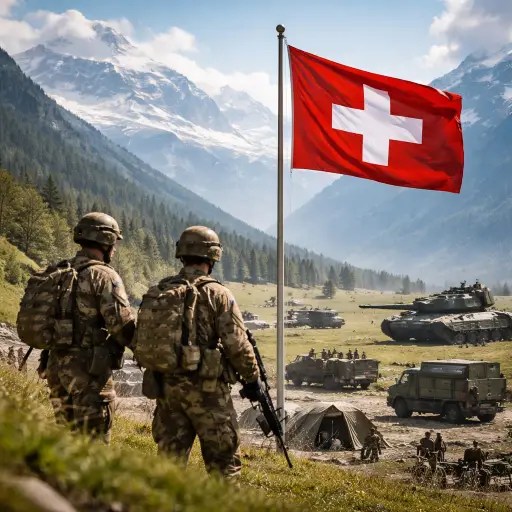
A historic push to recalibrate neutrality and boost military readiness collides with constitutional barriers and deep ideological divides
Switzerland’s ambitious attempt to reshape its defense posture has reached a political impasse, exposing deep fault lines within one of Europe’s most stable democracies. What began as a sweeping proposal to modernize the armed forces and expand military spending has now evolved into a constitutional standoff, pitting competing visions of neutrality, sovereignty, and social responsibility against one another.
The government’s reform package was presented as a strategic response to a deteriorating European security climate. Officials argue that shifting geopolitical realities and growing instability across the continent require a stronger, more agile Swiss military. For decades, Switzerland maintained a cautious defense profile rooted in strict neutrality and limited international engagement, but the new plan seeks to recalibrate that doctrine without formally abandoning it, a balance that has proven politically explosive.
At the center of the proposal lies a substantial increase in defense funding, deeper operational coordination with European partners, and accelerated procurement of advanced military systems. Supporters within the Federal Council describe the overhaul as a necessary modernization effort designed to preserve sovereignty while ensuring credible deterrence in an unpredictable era.
Resistance, however, has emerged swiftly and from opposite ideological poles. Conservative and nationalist factions warn that closer cooperation with neighboring states risks diluting Switzerland’s constitutionally anchored neutrality. They argue that incremental integration could entangle the country in external conflicts and erode a principle that has shaped its diplomatic identity for centuries.
For these critics, neutrality is not merely a policy instrument but a cornerstone of national self-understanding. Any perceived alignment with broader European defense frameworks is viewed as a step toward strategic dependency, potentially blurring the line between cooperation and alliance.
On the other side of the political spectrum, progressive parties and advocacy groups question the scale and fiscal priorities of the proposed spending increases. While not uniformly opposed to modernization, they demand binding safeguards to ensure that expanded military budgets do not undermine investment in social programs, climate initiatives, and public infrastructure.
Some lawmakers have proposed linking defense appropriations to parallel commitments in social policy, effectively framing security as a multidimensional concept that includes economic resilience and social cohesion. This conditional approach has complicated negotiations, transforming what began as a defense debate into a broader contest over national priorities.
Switzerland’s system of direct democracy adds another layer of uncertainty. Significant constitutional adjustments could trigger a nationwide referendum, a prospect that has heightened political caution and sharpened rhetoric on all sides. The mere possibility of a public vote has encouraged parties to solidify their bases rather than seek swift compromise.
Legal scholars are divided over whether elements of the reform would require formal constitutional amendments or could proceed through legislative revision alone. That ambiguity has slowed parliamentary progress and intensified scrutiny of the proposal’s legal foundations.
Beyond the legislative chambers, the debate has permeated civic life. Editorial boards, university forums, and town hall discussions have grappled with a fundamental question: how should Switzerland define neutrality in an era shaped by cyber threats, hybrid warfare, and deep economic interdependence?
Security analysts note that modern neutrality differs markedly from its historical origins. While Switzerland remains outside formal military alliances, it participates in numerous cooperative frameworks and shares intelligence and logistical coordination with European partners, raising questions about how symbolic independence aligns with practical security needs.
International observers are watching closely, recognizing that Switzerland’s geographic position and diplomatic stature grant its defense choices outsized symbolic weight. A more assertive Swiss military posture could subtly influence Europe’s broader security architecture, while a stalled reform effort might signal the limits of political consensus even within stable democracies.
Supporters of the overhaul argue that credible defense capacity strengthens rather than weakens neutrality, asserting that deterrence is essential to preserving independence. In their view, modernization is not a departure from tradition but an adaptation designed to ensure that Switzerland can defend itself without relying on external guarantees.
Opponents counter that redefining neutrality under external pressure risks setting a precedent that could gradually erode political autonomy. They emphasize Switzerland’s longstanding role as mediator and humanitarian actor, suggesting that moral authority flows from distance and restraint rather than military expansion.
For now, the reform remains in limbo as committees revise language and coalition-building efforts continue behind closed doors. The eventual outcome will depend on whether lawmakers can craft a compromise that reassures defenders of neutrality while addressing concerns about fiscal balance and social investment.
Whatever the resolution, the confrontation marks one of the most consequential domestic debates in Switzerland in recent years. It underscores the tension between tradition and transformation and highlights how even deeply entrenched political doctrines must confront the pressures of a changing strategic landscape.
As Europe navigates renewed uncertainty, Switzerland faces a defining moment in its modern history. Preserving neutrality may now require redefining it, yet whether that redefinition can overcome constitutional hurdles and ideological polarization remains uncertain, with implications that extend well beyond the country’s borders.
 The Tower Post