Macron Pushes for a Continental Deterrent as Faith in Washington Wavers
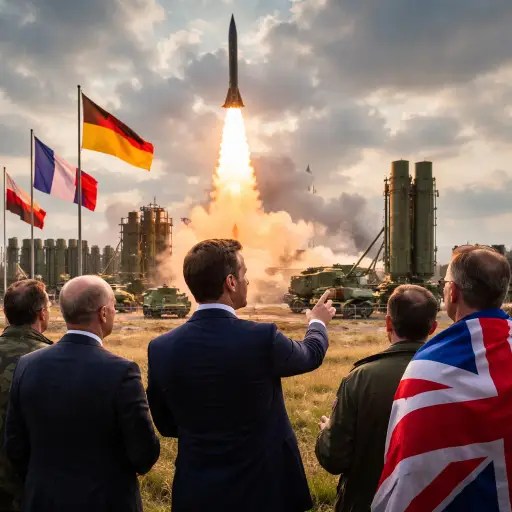
As European leaders convene in Brussels under mounting geopolitical strain, French President Emmanuel Macron has thrust a provocative proposal into the heart of the continent’s security debate: Europe must prepare to defend itself with its own nuclear deterrent, one that does not depend solely on the United States.
The initiative represents the most explicit attempt yet by a major European leader to redraw the strategic architecture that has anchored the transatlantic alliance for generations, signaling that reliance on Washington’s nuclear umbrella can no longer be treated as an unquestioned constant.
France is the European Union’s only nuclear-armed state, and while the United Kingdom retains its own arsenal outside the bloc, Paris has historically guarded its force de frappe as a strictly national guarantee of sovereignty, insulated from multinational control or shared authority.
Now Macron is proposing that France’s deterrent could serve as the backbone of a broader European strategy, opening structured consultations with partners and inviting Germany, Poland and even British officials to participate in nuclear exercises in what diplomats describe as a symbolic but unmistakable gesture toward deeper defense autonomy.
The move comes at a moment of renewed uncertainty in Washington, where the political climate has revived old questions about the durability of American commitments to NATO and the credibility of Article 5 guarantees in the event of aggression against European allies.
Former President Donald Trump, once again central to the U.S. political landscape, has previously cast doubt on the scale of America’s obligations to European partners, rhetoric that resonates uneasily in capitals closer to Russia’s borders and fuels concerns about strategic unpredictability.
Against the backdrop of the continuing war in Ukraine and Moscow’s formidable nuclear arsenal, the prospect of a less reliable American umbrella has prompted European policymakers to reconsider assumptions that have underpinned continental security since the end of the Second World War.
Macron’s argument is framed not as a rejection of NATO but as an insurance policy, insisting that a Europe capable of deterring threats independently would ultimately strengthen the alliance rather than fracture it.
France’s doctrine of strict sufficiency maintains a smaller arsenal than those of Washington or Moscow, relying primarily on submarine-launched ballistic missiles and air-delivered systems, yet it remains a credible and modern force designed to inflict unacceptable damage on any adversary.
Under the French president’s vision, control of nuclear weapons would remain national, but their strategic purpose would be clarified through regular consultation with European partners, potentially extending explicit deterrent assurances beyond France’s borders.
Berlin’s response has been cautious, reflecting Germany’s longstanding non-nuclear stance and its participation in NATO’s nuclear sharing arrangements, a framework that would require significant political recalibration were a distinctly European deterrent to emerge.
Poland, situated on NATO’s eastern flank and acutely aware of regional vulnerabilities, has signaled openness to discussing additional security guarantees, viewing Macron’s proposal as part of a broader effort to fortify deterrence against Moscow.
The United Kingdom’s involvement in French-led exercises underscores the complexity of the initiative, as London’s nuclear capabilities remain central to Europe’s overall military weight despite its departure from the European Union.
Critics warn that introducing a parallel nuclear structure could blur lines of command and weaken cohesion within NATO at a moment when clarity is essential, arguing that the alliance’s strength has always rested on overwhelming American strategic capacity.
Supporters counter that strategic autonomy has evolved from a slogan into a necessity, pointing to expanded European defense cooperation, joint procurement programs and new rapid deployment mechanisms as evidence that the continent is already assuming greater responsibility for its own security.
Beyond military logistics, the debate cuts to the psychological core of deterrence, raising fundamental questions about political resolve and whether European leaders would demonstrate unity and speed in a crisis demanding decisive action.
For France, the proposal reinforces its self-image as Europe’s strategic engine, positioning Paris as both initiator and guarantor at a time when the European project faces mounting external pressure.
Public opinion across the continent remains divided, particularly in countries where anti-nuclear sentiment runs deep, and persuading skeptical electorates that a European deterrent enhances stability rather than escalates risk will require careful political stewardship.
Whether Macron’s initiative produces immediate structural change or merely reshapes the contours of debate, it marks a significant moment in Europe’s strategic evolution, signaling that old certainties about transatlantic security are no longer immune from challenge.
As spring approaches, Europe finds itself navigating between an assertive Russia and an unpredictable American political climate, compelled to confront the possibility that its ultimate security guarantee may one day need to be anchored firmly on its own soil.


 The Tower Post