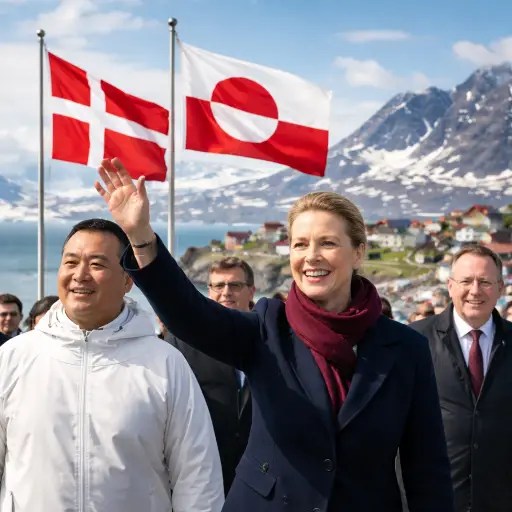
Prime Minister Mette Frederiksen seeks renewed mandate as national unity over Greenland and reform agenda lifts governing bloc in polls
Denmark’s Prime Minister Mette Frederiksen has called a snap general election, seeking to capitalize on a surge in public support fueled by national solidarity over Greenland and a wave of domestic reforms that have reshaped the political landscape.
The announcement places Denmark at the center of an intensifying transatlantic debate after renewed signals from Washington highlighting strategic interest in Greenland, the vast Arctic territory within the Kingdom of Denmark, stirred political reaction and public emotion across the country.
Rather than splintering Denmark’s traditionally complex coalition politics, the controversy appears to have consolidated backing behind Frederiksen’s Social Democratic-led government, producing what analysts describe as a “Greenland bounce” in opinion surveys.
Standing outside the Prime Minister’s Office, Frederiksen said the country requires clarity and unity in the face of mounting geopolitical pressure, declaring that Denmark stands firmly with Greenland and that decisions about the island’s future belong to its people within the constitutional framework of the realm.
Greenland’s immense reserves of rare earth minerals and its pivotal Arctic location between North America and Europe have long attracted global attention, but recent rhetoric from prominent American political figures has revived debate about sovereignty, defense arrangements and the pace of resource development.
In Nuuk, Greenlandic leaders reiterated that cooperation with allies remains essential while underscoring that self-determination is not negotiable, a position echoed in Copenhagen and widely supported by voters who see the issue as one of national dignity as much as foreign policy.
Political observers say the moment has tapped into a broader conversation about Denmark’s identity and its evolving role in the rapidly changing Arctic, where melting sea ice is opening new shipping lanes and intensifying competition for influence and resources.
Frederiksen’s decision to call early elections surprised some opposition figures who expected the government to serve closer to a full term, but advisers suggest the timing reflects confidence that the current mood of cohesion can translate into a renewed mandate.
Over the past year, the government has pushed forward labor market reforms designed to increase workforce participation, expanded investments in renewable energy and introduced welfare adjustments aimed at addressing demographic pressures and long-term fiscal sustainability.
Business leaders have cautiously welcomed signs of economic stabilization and policy continuity, while trade unions have praised expanded training initiatives linked to green industry, even as critics argue that inflationary strain and housing affordability continue to weigh on households.
Opposition parties accuse the prime minister of opportunism, contending that the election call seeks to harness a temporary spike in patriotic sentiment, and they promise to challenge elements of the reform agenda while offering alternative strategies on competitiveness and social cohesion.
Public opinion trends nevertheless suggest that many Danes view the government’s handling of international tensions as steady and pragmatic, reinforced by cross-party parliamentary statements and visible civil society support emphasizing solidarity with Greenland.
Denmark’s Arctic posture has gained prominence within NATO as security dynamics shift and global powers recalibrate their northern strategies, prompting Copenhagen to pledge sustained defense investment in the North Atlantic while reaffirming alliance commitments.
Frederiksen’s campaign is expected to center on experience and stability, framing the election as a choice between continuity in uncertain times and a potential drift in leadership at a moment she characterizes as decisive for the kingdom’s future.
As campaigning intensifies, candidates across the spectrum are recalibrating their messages to match a public mood that blends caution with resolve, and the coming vote will test whether the so-called Greenland bounce represents a fleeting rally effect or the foundation of a strengthened governing mandate.


 The Tower Post