From $16,000 Australia routes to cascading cancellations, global tensions reshape mobility and test the resilience of the continent’s aviation economy
Europe’s travel sector enters early March under intensifying strain as geopolitical fallout from the Middle East triggers cascading disruption across global aviation networks, pushing long-haul fares to extraordinary levels and exposing how quickly distant instability can unsettle the continent’s mobility and economic balance.
Fares between Europe and Australia have surged to eye-watering highs, with some economy-class round trips climbing toward $16,000, a spike that has stunned travelers and corporate mobility planners alike and revived memories of pandemic-era volatility despite an otherwise strong demand environment.
The surge is rooted in airspace restrictions, security alerts, rising insurance premiums and abrupt route redesigns linked to escalating instability across key Middle Eastern corridors that traditionally function as critical arteries for Europe-Asia-Pacific connectivity.
Aircraft that once crossed established Gulf transit hubs are now being rerouted along longer and more fuel-intensive paths, adding hours to journey times, increasing crew costs and disrupting tightly calibrated aircraft rotation schedules that underpin airline profitability.
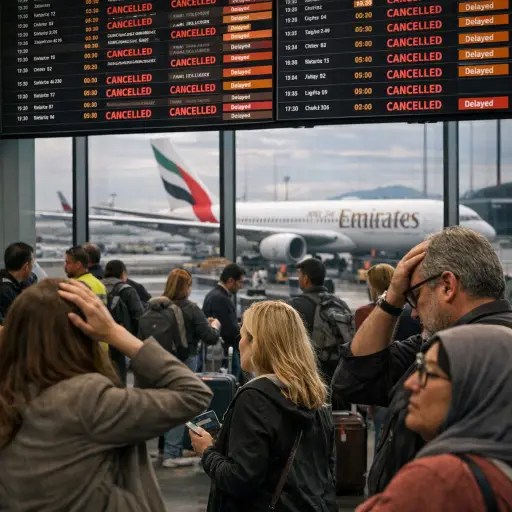
The ripple effects are visible in Europe’s largest hubs, where departure boards reflect mounting cancellations and gate changes, and where passengers scramble to rebook complex itineraries that no longer resemble the streamlined connections they originally purchased.
For routes to Australia in particular the impact has been severe because much of the traffic depends on stopovers in the Gulf region, meaning that any instability there reverberates immediately through European carriers and their alliance partners.
Airlines maintain that safety remains paramount, yet industry executives acknowledge privately that each additional nautical mile carries a tangible financial penalty in fuel burn, staffing and maintenance planning, costs that are rapidly transferred to consumers in the form of higher ticket prices.
Travel agencies report a sharp increase in anxious inquiries as families reconsider long-haul vacations and some travelers pivot toward intra-European journeys reachable by rail or short-haul flights that feel less exposed to geopolitical crosswinds.
Corporate travel managers face even tougher calculations because essential trips to Australia and Southeast Asia cannot simply be deferred, forcing companies to expand travel budgets while accounting for extended travel times that erode productivity and complicate scheduling.
Insurance markets have reacted swiftly, with premiums for flights operating near designated risk zones climbing markedly, while energy traders monitor supply uncertainty that keeps jet fuel prices volatile even for carriers avoiding contested airspace altogether.
Aviation economists warn that although fare spikes could moderate if tensions ease, structural shifts may persist as airlines diversify routing strategies and accelerate investment in ultra-long-range aircraft capable of bypassing vulnerable transit corridors entirely.
European policymakers are watching closely because long-haul connectivity supports tourism, hospitality and business investment across the continent, and any prolonged disruption to intercontinental flows risks spilling into broader economic sectors.
At airports from Frankfurt to Paris and Amsterdam the atmosphere reflects both resilience and strain, as airlines deploy larger aircraft on alternative routes where feasible and digital platforms attempt to anticipate disruptions earlier in the booking cycle.
For many travelers the experience has become a lesson in the fragility of modern mobility, as once routine intercontinental journeys now require contingency planning, flexible tickets and constant monitoring of alerts.
The turmoil unfolding this week underscores a deeper reality that in a tightly interconnected aviation system crises rarely remain confined to their origin, and the economic shock waves from distant instability can manifest swiftly in boarding queues thousands of miles away.
As Europe navigates this volatile chapter the central question is whether the current upheaval represents a temporary spike tied to geopolitical turbulence or the beginning of a more durable realignment in how airlines map the world and price the privilege of crossing it.


 The Tower Post