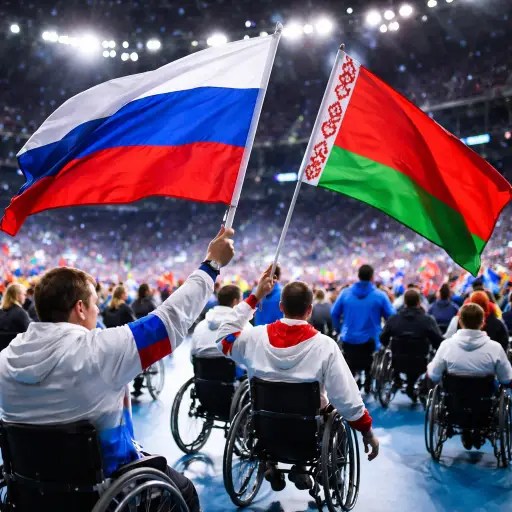
Paralympic leaders defend inclusion under strict neutrality rules as several delegations opt out of the opening ceremony in protest
As the Paralympic movement gathers for the opening of the Games, the International Paralympic Committee has reaffirmed its decision to allow Russian and Belarusian athletes to compete as neutrals, resisting mounting pressure from a bloc of member nations that had urged a full suspension and prompting several delegations to skip the opening ceremony in protest.
The IPC leadership has framed the decision as a defense of individual rights within sport, arguing that athletes should not be held directly responsible for the actions of their governments and that the Paralympic Charter obliges the organization to provide access to competition wherever possible under clear and enforceable conditions.
Under the current framework, Russian and Belarusian competitors are permitted to participate without national flags, anthems, or symbols, and they must undergo enhanced vetting procedures, sign declarations of neutrality, and refrain from public expressions that could be interpreted as support for the war in Ukraine.
Several European nations had publicly called for a complete ban, contending that even neutral participation risks diluting the moral clarity that sport can project during times of conflict, while Ukrainian officials have argued that inclusion under any status sends a troubling signal to athletes whose training facilities and communities have been directly affected by the war.
In response to the IPC’s stance, a small but vocal group of national committees confirmed they would not take part in the opening ceremony, describing the move as a symbolic gesture rather than a full boycott, and emphasizing that their athletes would still compete in scheduled events throughout the Games.
The absence of certain delegations from the ceremonial parade created a subdued undercurrent during final rehearsals, though organizers stressed that competition schedules, security protocols, and athlete services remain unaffected and that the focus should remain on performance and inclusion.
Sports governance analysts note that the IPC’s approach aligns with policies adopted by other international federations over the past year, reflecting a broader effort within global sport to balance geopolitical realities with the principle that individual athletes deserve pathways to compete under neutral status when strict safeguards are in place.
Critics maintain that neutrality on paper cannot fully separate athletes from the broader symbolism attached to national identity, arguing that international competitions inevitably carry political weight, particularly during periods of active conflict and diplomatic strain.
Supporters of the IPC decision counter that excluding athletes solely on the basis of nationality would undermine the inclusive ethos that has defined the Paralympic movement and could set a precedent with long-term consequences for how global sport responds to political crises.
Inside the athletes’ village, competitors from dozens of countries continue to share training spaces and dining halls, and many have expressed a desire to concentrate on their events rather than the surrounding controversy, underscoring the personal sacrifices and years of preparation that culminate in these Games.
For Russian and Belarusian athletes competing under neutral designation, the experience will be marked by the absence of familiar national markers and the knowledge that any podium appearance will unfold without anthem or flag, a visible reminder of the extraordinary political circumstances surrounding this edition of the Games.
As competition begins, attention is expected to shift toward performances in athletics, swimming, wheelchair basketball, and other marquee events, yet the debate over inclusion and accountability is likely to persist beyond the closing ceremony, shaping discussions about governance and values within international sport for years to come.


 The Tower Post