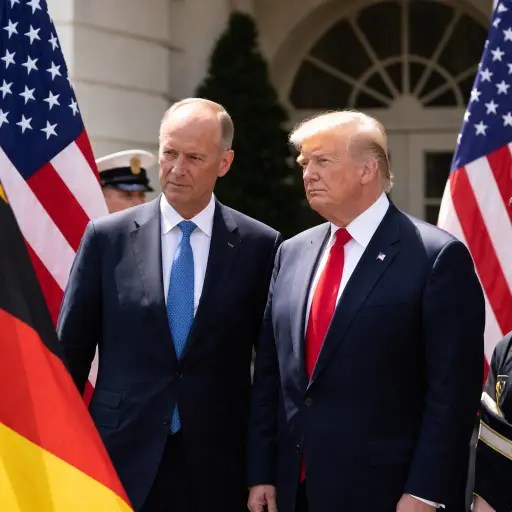
German Chancellor seeks transatlantic unity after Iran strike deepens global rifts
German Chancellor Friedrich Merz arrives in the United States at a moment of acute geopolitical tension, seeking urgent coordination with President Donald Trump after a controversial strike killed Iran’s supreme leader and rattled global capitals.
The visit, unfolding in early March, comes as fears of a wider Middle East conflict cast a long shadow over transatlantic relations and expose deep divisions between Washington and several European Union member states.
While the White House has defended the strike as a decisive act of deterrence aimed at preventing further attacks against American interests, reactions across Europe have been markedly more cautious, with some leaders warning that the operation risks triggering a destabilizing cycle of retaliation.
For Merz, who took office pledging to restore Germany’s strategic weight within Europe, the trip represents an early and defining foreign policy test, balancing solidarity with the United States against mounting unease within the European bloc.
Diplomats in Berlin describe the chancellor’s approach as one of disciplined coordination, emphasizing the need for close consultation with Washington while pressing for clear guardrails to prevent escalation into open war.
The killing of Iran’s top leader has reshaped the regional landscape almost overnight, sparking demonstrations inside Iran, prompting vows of revenge from aligned militias, and sending tremors through global energy markets already sensitive to instability.
Oil prices have reacted sharply, underscoring Europe’s continued vulnerability to supply disruptions despite years of diversification efforts following previous energy crises, and raising concerns about renewed inflationary pressures across the continent.
In Brussels, officials acknowledge privately that forging a unified European response has proven difficult, with eastern member states broadly echoing Washington’s security rationale while several western capitals call for restraint and renewed diplomatic engagement.
These internal differences have complicated the European Union’s messaging and heightened expectations that Berlin, as the bloc’s largest economy, will play a bridging role between Washington and more skeptical European partners.
At the White House, discussions are expected to center on crisis containment, deterrence strategy, and the parameters of any future diplomatic initiative aimed at preventing further regional spillover.
President Trump has framed the strike as a necessary demonstration of strength, arguing that credible deterrence is essential to safeguard American personnel and allies, and administration officials insist that decisive action has restored strategic clarity.
Critics on both sides of the Atlantic counter that removing Iran’s highest authority could unleash unpredictable consequences, potentially empowering hardline factions and accelerating proxy confrontations across an already volatile region.
The stakes extend well beyond the Middle East, as NATO allies assess the implications for alliance cohesion and consider how miscalculation could draw additional actors into the fray.
German security officials have intensified consultations with partners in Europe and North America, mindful that cyber threats, maritime disruptions, and refugee flows could accompany any sustained escalation.
At home, Merz faces political scrutiny from opposition parties wary of entanglement in another prolonged conflict and cautious about aligning too closely with Washington without clearer assurances regarding long-term strategy.
Public sentiment in Germany remains shaped by a postwar tradition of restraint, reinforcing pressure on the chancellor to prioritize de-escalation even as he reaffirms Germany’s commitment to NATO obligations.
Energy security will loom large in the talks, with Berlin seeking assurances that contingency planning is robust enough to cushion potential supply shocks and stabilize markets in the event of further regional turmoil.
European diplomats continue to argue that channels of communication with Tehran should remain open, contending that diplomatic off-ramps are essential to prevent retaliatory actions from spiraling beyond control.
The Trump administration has signaled conditional openness to negotiation but maintains that any diplomatic track must be grounded in credible deterrence and clear red lines.
Analysts warn that the most immediate danger lies not in deliberate escalation but in miscalculation, as proxy actors and regional rivals test boundaries in the aftermath of the strike.
For Merz, the Washington visit presents both risk and opportunity, offering the chance to reinforce transatlantic unity at a moment of crisis or, if differences persist, to expose deeper strategic divergence between Europe and the United States.
As he steps into meetings at the White House, the broader question confronting both leaders is whether the transatlantic partnership can adapt swiftly and cohesively enough to manage a rapidly shifting geopolitical landscape without sliding into open confrontation.
In Berlin and Brussels alike, officials await signs that coordination rather than fragmentation will define the Western response in the days ahead, aware that markets, allies, and adversaries are watching closely.


 The Tower Post