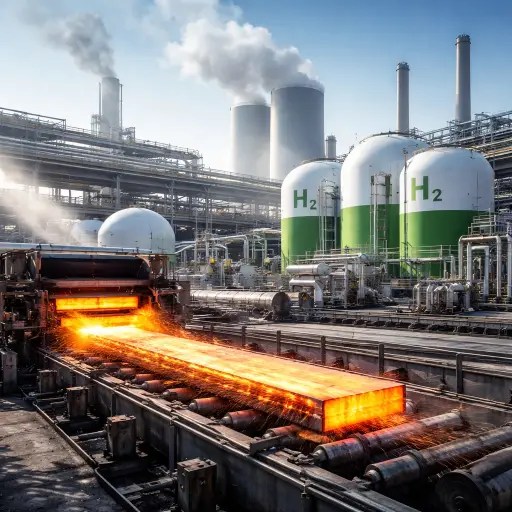
Hydrogen-based production is central to Europe’s climate drive, but limited output and high costs test industrial reality
As Europe advances its climate agenda this spring, policymakers are intensifying efforts to accelerate the shift toward so-called green steel, a hydrogen-based alternative to traditional coal-powered production that officials argue is essential to meeting the bloc’s emissions targets and reshaping its industrial base.
Steelmaking remains one of Europe’s most carbon-intensive industries, historically dependent on blast furnaces fueled by coking coal to extract iron from ore, a process that releases vast quantities of carbon dioxide and accounts for a significant share of the continent’s industrial emissions.
Green steel aims to replace coal with hydrogen produced through renewable electricity in a method known as direct reduced iron, where hydrogen separates oxygen from iron ore and produces water vapor rather than carbon dioxide, offering the prospect of dramatically lower lifecycle emissions.
European authorities see this technological pivot as indispensable to their broader climate strategy, particularly as automakers face tightening supply-chain emissions standards and are encouraged to account not only for tailpipe emissions but also for the embedded carbon in materials such as steel used in vehicle frames, battery enclosures, and structural components.
Yet while the political momentum is strong, the industrial rollout remains cautious and constrained, with only a handful of facilities across northern Europe producing limited quantities of hydrogen-based steel compared with the bloc’s conventional output.
Industry executives acknowledge that pilot plants and early commercial installations mark meaningful progress, but they also emphasize that current production volumes are far from sufficient to supply Europe’s vast automotive and construction sectors at scale.
Cost pressures pose an equally formidable challenge, as green steel commands a substantial premium over conventionally produced material due to elevated electricity prices, capital-intensive facility upgrades, and the still-developing hydrogen market that underpins the process.
Automakers, already investing heavily in electrification, battery development, and digital manufacturing systems, warn that absorbing higher raw material costs could squeeze margins at a time when global competition is intensifying and demand remains uneven.
Supporters of the transition counter that early-stage premiums are typical of emerging technologies and argue that long-term policy certainty combined with investment in renewable energy infrastructure will gradually narrow the cost gap as production scales and supply chains mature.
Massive infrastructure development is required to make that vision viable, including expanded renewable power generation, cross-border hydrogen pipelines, storage networks, and upgraded port facilities capable of handling new energy flows and raw material logistics.
Without synchronized expansion of these supporting systems, analysts caution that green steel projects risk bottlenecks that could delay scale-up and undermine investor confidence, particularly if hydrogen supply remains inconsistent across member states.
The European Union has sought to address these concerns through climate funding instruments, targeted subsidies, and regulatory measures designed to stimulate demand, including carbon pricing mechanisms and border adjustments intended to prevent cheaper, high-emission imports from undercutting domestic producers.
Critics argue that while protective measures may shield European manufacturers in the short term, they do not eliminate the structural challenge of competing with regions that benefit from lower energy costs and less stringent environmental rules.
Questions also persist about certification standards and traceability systems that would allow automakers and other buyers to verify the carbon intensity of steel products across complex cross-border supply chains.
Policymakers insist that delaying the transition would only prolong dependence on fossil-based production and expose European industry to future carbon costs, stranded assets, and reputational risk in a global market increasingly focused on sustainability credentials.
The debate underscores a broader tension at the heart of European climate policy, where ambitious environmental objectives must be reconciled with the operational realities of heavy industry and the economic pressures facing manufacturers.
For now, green steel stands as both a symbol of Europe’s determination to lead in industrial decarbonization and a test case for whether technological innovation, infrastructure investment, and market incentives can align quickly enough to preserve competitiveness.
As discussions intensify between regulators, steelmakers, energy providers, and automakers, the coming phase will determine whether hydrogen-based steel production evolves from a promising niche into a foundational pillar of Europe’s low-carbon economy or remains constrained by the practical limits of cost and scale.



 The Tower Post