Cross-border demonstrations after the death of Quentin Deranque raise security concerns amid mounting geopolitical strain
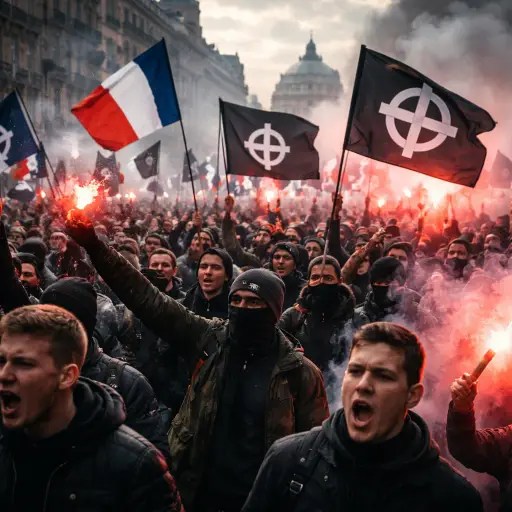
Demonstrators carrying black and national flags gathered in several European cities in early March after the killing of 23-year-old French activist Quentin Deranque, an incident that far-right groups have rapidly transformed into a rallying cause stretching beyond France’s borders.
Deranque, who was known within nationalist circles in eastern France, died following a violent confrontation that remains under investigation by French authorities, who have urged restraint while prosecutors work to establish the circumstances and potential motives behind the attack.
Within hours of news of his death spreading, far-right influencers and activists circulated messages portraying him as a symbol of what they describe as a broader struggle over identity and sovereignty, prompting calls for vigils, marches and coordinated actions across multiple countries.
In Lyon, several hundred demonstrators marched through the city centre under heavy police presence, lighting flares and chanting slogans that framed the killing as politically charged, while officers reported minor clashes and a limited number of arrests.
The mobilisation quickly extended beyond France, with gatherings reported in Vienna, Brussels, Berlin and Milan, where small but vocal groups assembled outside government buildings and public squares, some displaying symbols associated with pan-European nationalist movements.
Security officials in several capitals said they were monitoring online channels where activists shared graphics, coordinated messaging and encouraged synchronized demonstrations, suggesting a level of cross-border communication that has intensified in recent years.
A senior European security official said the speed of the mobilisation reflected a broader pattern in which local incidents are rapidly reframed as continental causes, amplifying their political impact through digital networks that transcend national boundaries.
Governments are watching for potential security repercussions as Europe navigates economic uncertainty, migration debates and heightened geopolitical tension linked to conflicts on its eastern flank, conditions that analysts say can create fertile ground for extremist narratives.
Mainstream political leaders in France have condemned attempts to instrumentalise Deranque’s death, calling for calm and warning against speculation, while emphasising that the investigation must proceed without interference or politicisation.
At several rallies, speakers invoked themes of cultural preservation and alleged institutional failure, and torchlit processions accompanied by stylised gestures drew criticism from anti-extremism groups who warned that such imagery risks normalising radical symbolism.
Experts caution that while turnout at many demonstrations has remained limited, the broader significance lies in the transnational solidarity being projected, as statements of support have circulated among nationalist organisations in Central and Eastern Europe.
European law enforcement agencies have stepped up information-sharing as a precaution, mindful of the risk that inflammatory rhetoric could inspire isolated acts of violence, a threat that has featured prominently in recent security assessments.
In cities where rallies have taken place, daily life has largely continued uninterrupted, though shopkeepers in some areas chose to close early and police maintained visible patrols to prevent confrontations between opposing groups.
As investigations into the killing continue, far-right organisers have signalled plans for further gatherings, aiming to sustain momentum and maintain visibility in public debate, while authorities balance the right to protest with the need to prevent escalation.
The events unfolding in early March underscore how swiftly a single violent episode can reverberate across Europe’s interconnected political landscape, transforming a local tragedy into a focal point for broader ideological mobilisation.


 The Tower Post