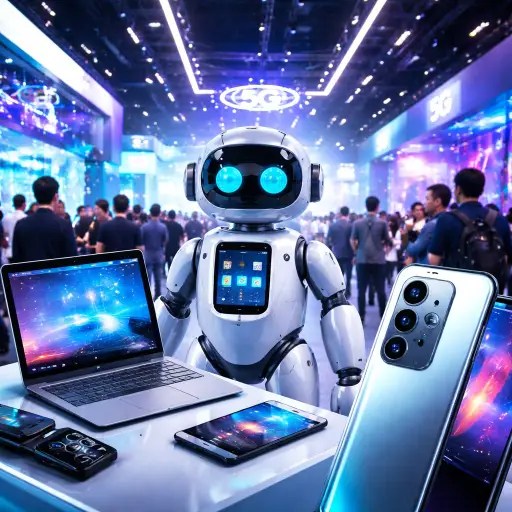
AI Devices, Modular Machines, and Futuristic Robotics Signal the Next Era of Everyday Technology
Barcelona is once again the epicenter of the global technology industry as Mobile World Congress 2026 fills its vast exhibition halls with a restless energy that signals the year ahead will be anything but incremental. As early March sunlight filters through the glass structures at Fira Gran Via, executives, engineers, startups, and investors converge around glowing stages and prototype tables where the next generation of mobile innovation is not teased but fully demonstrated.
This year the defining theme is intelligence embedded directly into hardware, with artificial intelligence no longer treated as a distant cloud function but as a native capability pulsing inside chips, sensors, and cameras. Device makers are emphasizing on-device AI engines that process data locally, promising faster response times, tighter privacy controls, and a new level of personalization that feels immediate rather than mediated by remote servers.
Smartphones on display anticipate user needs with startling accuracy, reorganizing home screens dynamically, adjusting battery performance based on behavioral patterns, and filtering notifications depending on context and location. Demonstrations show digital assistants that do not merely answer questions but initiate actions, draft messages, summarize meetings in real time, and adapt visual interfaces according to how and when the device is used.
Augmented reality glasses are staging a confident return, shedding their experimental aura in favor of sleek frames and practical utility. Lightweight headsets perform live language translation, object identification, and navigation overlays without tethering to bulky external hardware, suggesting that ambient computing may finally be ready to blend seamlessly into daily life.
Among the most discussed hardware breakthroughs are modular laptops designed to challenge the disposable upgrade cycle that has defined consumer electronics for years. Manufacturers are presenting systems with swappable storage modules, replaceable graphics components, detachable displays, and batteries that can be upgraded independently, allowing users to refresh performance without discarding an entire machine.
The modular approach carries environmental implications that resonate strongly with both regulators and consumers, as extended device lifespans could significantly reduce electronic waste. Live demonstrations on the show floor reveal technicians replacing internal components within moments using simple mechanisms, reinforcing the argument that repairability and customization can coexist with premium industrial design.
Perhaps the most attention-grabbing innovation is a robot phone mounted on a compact motorized base that autonomously follows its owner while maintaining precise camera framing. Powered by advanced visual tracking and obstacle detection, the device glides smoothly across demonstration spaces, adjusting angles in real time for video calls, livestreams, and presentations without requiring manual control.
The robot phone does more than move; it interprets context by detecting when a user begins speaking, optimizing lighting exposure, and repositioning itself based on room acoustics. In an era defined by hybrid work and constant content creation, the blending of robotics and mobile communication hints at a future where personal devices become physically interactive companions rather than static tools.
Photography has also taken a dramatic leap forward with the unveiling of ultra-high-resolution smartphone sensors that capture extraordinary detail while preserving strong low-light performance. Larger sensor architectures combined with sophisticated computational photography enable zoom capabilities that retain clarity at distances once considered impractical for mobile cameras.
Integrated editing tools powered by neural processors allow users to remove unwanted elements, alter depth of field, and refine lighting conditions directly on the device within seconds. The distinction between professional imaging equipment and consumer smartphones continues to narrow, empowering creators to produce studio-quality content from a device that fits in a pocket.
Behind these headline-grabbing gadgets lies a deeper transformation driven by advances in next-generation connectivity that support low-latency streaming, immersive collaboration, and real-time cloud gaming. Exhibitors demonstrate ecosystems in which smartphones communicate fluidly with vehicles, home automation systems, wearables, and enterprise platforms, forming networks that respond intelligently rather than merely connect.
Walking through the exhibition floor at this year’s gathering, it becomes clear that the industry is entering a phase where adaptability, sustainability, and autonomy define competitive advantage. Mobile World Congress 2026 does not simply present new products; it sketches a portrait of everyday technology that is more responsive, more customizable, and more alive than anything seen before, offering a tangible preview of how devices will look and feel in the year ahead and beyond.



 The Tower Post