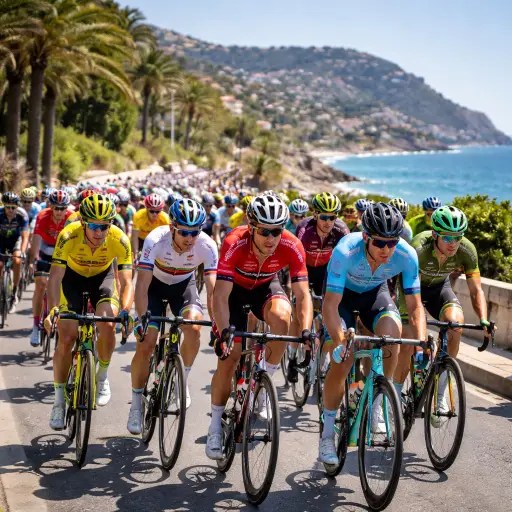
Early Time-Trial Drama and Shifting Winds Reshape the General Classification
The peloton rolled out beneath a pale northern sky this week as Paris–Nice 2026 began its traditional journey from late-winter chill toward Mediterranean light, and from the opening kilometers it was clear that this edition of the Race to the Sun would waste no time in challenging assumptions.
An early individual time trial, positioned strategically in the first phase of the race, delivered immediate drama and fractured the general classification before the contenders had fully settled into rhythm, forcing riders to confront wind, pressure and tactical calculation far sooner than many had anticipated.
The course, short but technically demanding, ran across exposed farmland where crosswinds swept laterally across the tarmac, unsettling aerodynamic positions and punishing those who misjudged their pacing, and while several favorites aimed for measured negative splits others launched aggressively only to fade in the final sector as the effort caught up with them.
When the provisional standings were posted the hierarchy had shifted in subtle but significant ways, with a pair of versatile all-rounders capitalizing on the conditions to claim valuable seconds while one or two pre-race favorites conceded time that, in a race historically decided by narrow margins, could yet prove decisive.
The following road stages compounded the uncertainty as biting northern winds fractured the peloton into echelons across open plains, transforming what might have been transitional days into tense tactical battles where positioning and teamwork mattered as much as raw strength.
Teams equipped with powerful rouleurs surged to the front whenever the road turned sideways to the wind, deliberately increasing tempo and stretching the bunch into thin lines, and those caught inattentive or poorly placed found themselves chasing in smaller groups, expending precious energy in the cold air.
Despite the early turbulence, the principal contenders for overall victory have shown notable restraint, choosing calculation over spectacle and instructing teammates to control tempo rather than ignite unnecessary attacks, mindful that the true reckoning awaits in the mountains later this week.
Sports directors across the convoy have emphasized energy conservation, encouraging their leaders to avoid panic in crosswinds and to limit losses rather than seek risky gains, a strategy rooted in the understanding that sustained climbs will ultimately reveal who has managed their resources most wisely.
Breakaway specialists, liberated from the burden of defending general classification ambitions, have animated the race with long-range moves that briefly seized headlines and forced the favorites’ squads into disciplined chases, adding layers of complexity to stages that might otherwise have unfolded predictably.
As the route arcs progressively southward the atmosphere is beginning to shift, the air softening and the light brightening, reinforcing the symbolic migration that defines Paris–Nice, yet beneath the warmer sun the competition remains taut and delicately balanced.
The early time-trial gaps, though measured in seconds rather than minutes, have injected psychological pressure into the leading contenders, who now navigate each stage with the awareness that small miscalculations in wind or positioning could widen those margins before the decisive climbs even begin.
Riders who invested heavily in protecting teammates during the crosswind battles may find themselves carrying hidden fatigue into the hillier terrain, while those who conserved strength and avoided unnecessary exposure could hold a subtle but meaningful advantage when gradients steepen.
The mountains looming later this week promise a more traditional selection, stripping away the chaotic variables of wind and placing emphasis on climbing efficiency, recovery capacity and team cohesion, yet the groundwork laid in these early days has already shaped the strategic landscape.
Paris–Nice has long rewarded resilience as much as brilliance, and this opening chapter underscores that identity, revealing a race where tactical nuance and environmental conditions intertwine to test versatility across disciplines.
As the peloton continues its luminous migration toward southern horizons, the general classification remains compact but fragile, its equilibrium susceptible to both sudden attacks and subtle accumulations of fatigue.
The Race to the Sun has begun not with a gentle warm-up but with a calculated jolt, and as the week unfolds the interplay between wind, ambition and restraint will determine whether the early surprises mark a prelude to upheaval or the foundation of a carefully managed triumph.



 The Tower Post