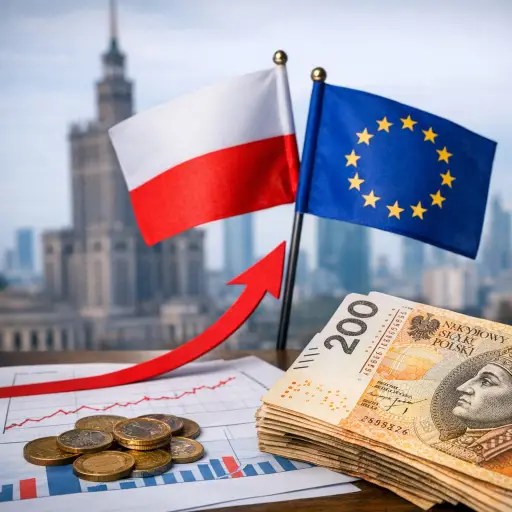
Economic forecasts suggest national liabilities could outpace annual output within the next decade, sharpening debates over fiscal discipline, growth strategy, and eurozone stability
Poland’s public finances are entering a decisive phase as economic analysts intensify warnings that the country’s national debt could surpass the size of its entire economy within the coming decade, a scenario that would mark a profound shift for one of Central Europe’s most resilient growth stories and send ripples through European financial markets.
For years Poland was celebrated inside the European Union as a model of expansion and stability, combining strong domestic demand with industrial competitiveness and substantial EU funding inflows, but a combination of rising defense expenditure, expansive social commitments, higher borrowing costs and demographic pressure is steadily reshaping the fiscal outlook.
Medium-term projections compiled by independent research institutes and market economists point to a gradual yet persistent increase in the debt-to-GDP ratio, reflecting structural imbalances between public spending and revenue generation that economic growth alone may no longer be able to offset.
Although Poland continues to post comparatively solid growth figures, analysts caution that momentum has moderated compared with earlier expansion cycles, reducing the economy’s ability to dilute accumulated liabilities and increasing the sensitivity of public finances to interest rate fluctuations and external shocks.
The implications extend well beyond domestic accounting frameworks, because a sustained climb in debt levels in one of the European Union’s largest member states in Central and Eastern Europe could influence investor sentiment toward the broader region and feed into ongoing debates over fiscal governance within the bloc.
Bond markets have so far maintained confidence in Polish sovereign paper, supported by the country’s diversified industrial base and established institutional architecture, yet investors are acutely aware that perceptions can change rapidly if fiscal projections begin to suggest an unsustainable trajectory.
Higher financing costs would compound the challenge by increasing the share of budgetary resources devoted to servicing existing obligations, potentially crowding out investment in infrastructure, energy transition projects and innovation strategies that are widely regarded as essential for sustaining long-term competitiveness.
At the political level, the debate in Warsaw has sharpened as policymakers weigh difficult trade-offs between maintaining social cohesion and restoring fiscal balance, with proposals ranging from recalibrating benefit programs to broadening the tax base and accelerating structural reforms aimed at productivity gains.
Demographic trends add a structural layer of complexity, as an aging population places mounting pressure on pension and healthcare systems while the working-age cohort gradually contracts, narrowing the revenue base and intensifying the arithmetic of debt sustainability.
European institutions are observing developments closely, particularly as discussions over revised fiscal rules gain prominence and several member states grapple with elevated debt burdens, making Poland’s policy direction a potentially influential factor in shaping perceptions of cohesion and discipline across the union.
Economists stress that the outlook is not predetermined and that decisive policy action, credible medium-term budget planning and growth-enhancing reforms could stabilize the debt ratio before it breaches psychologically significant thresholds that often shape market narratives.
Poland retains notable strengths including a competitive manufacturing sector, expanding technology industries and deep trade integration with Western Europe, assets that could underpin a renewed growth cycle if matched with prudent fiscal management and targeted investment strategies.
The coming policy decisions therefore carry unusual weight, as choices on defense procurement pacing, energy infrastructure sequencing and the structure of social expenditures may determine whether the country’s debt path levels off or continues its upward climb toward parity with annual economic output.
For a nation long associated with economic ascent and resilience, the challenge now centers on credibility and balance, as leaders seek to reassure markets, European partners and domestic constituencies that fiscal sustainability can be secured without sacrificing growth momentum or strategic ambition.




 The Tower Post