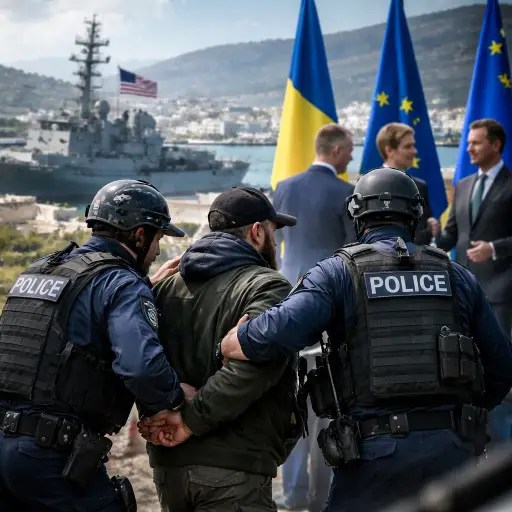
Spy Arrest in Crete and Ukraine’s Fast-Track EU Bid Expose Europe’s Strategic Fault Lines
Greek authorities have detained a man suspected of spying on a United States naval base on the island of Crete, a move that has sent ripples through European security circles at a moment of heightened geopolitical strain.
Security officials in Athens confirmed that the suspect had allegedly been conducting surveillance linked to operations at Souda Bay, one of the most strategically significant military facilities in the eastern Mediterranean and a critical hub for NATO logistics.
Investigators have released few operational details, citing national security concerns, but sources familiar with the case describe the arrest as part of a broader pattern of intensified espionage activity targeting allied infrastructure since the war in Ukraine reshaped Europe’s security landscape.
Souda Bay’s importance has grown steadily over the past several years, serving as a key refueling and transit point for naval and air assets operating across the Black Sea region, the Middle East, and North Africa, and its prominence has only deepened as NATO recalibrates its posture in response to Russia’s aggression.
Greek officials were quick to stress that base security remains uncompromised, yet diplomats privately acknowledge the symbolic weight of the arrest, underscoring how even peripheral theaters have become entangled in the strategic contest between Moscow and Western capitals.
Athens finds itself navigating a delicate balance, strengthening defense ties with Washington and reinforcing its NATO credentials while simultaneously managing regional tensions, migration pressures, and energy disputes that complicate the eastern Mediterranean equation.
Across Europe, intelligence agencies have warned of an uptick in covert operations ranging from cyber intrusions to surveillance of transport corridors and energy installations, reinforcing concerns that the conflict’s shadow war extends well beyond the front lines.
While authorities have not publicly attributed the alleged Crete surveillance to a specific foreign actor, analysts note that monitoring ship movements, aircraft rotations, and supply chains can yield valuable insight into alliance readiness and strategic intent.
As the espionage case unfolds, European leaders are grappling with another contentious issue that strikes at the heart of the Union’s future: whether Ukraine should be granted an accelerated path to European Union membership.
Kyiv continues to press for fast-track accession, arguing that its defense of European security and its ongoing reform efforts warrant a political response that goes beyond military aid and symbolic solidarity.
Ukrainian officials point to judicial reforms, anti-corruption measures, and legislative alignment undertaken under wartime conditions as evidence that the country is prepared to move decisively toward full integration into the European project.
Support for acceleration is strongest among several Central and Eastern European member states, where leaders contend that Ukraine’s battlefield sacrifices demand a strategic commitment that anchors the country irreversibly within Europe’s institutional framework.
However, key Western capitals including Paris, Berlin, and The Hague have urged caution, emphasizing that enlargement is a rules-based process designed to preserve institutional coherence and financial sustainability within the bloc.
Concerns center on the economic implications of admitting a large country facing massive reconstruction needs, as well as the political ramifications of extending voting rights and agricultural subsidies in ways that could reshape internal balances.
Some policymakers warn that bending accession criteria under geopolitical pressure could weaken the credibility of the Union’s standards, while others counter that excessive rigidity risks projecting hesitation at a moment demanding strategic clarity.
Public opinion across member states remains broadly sympathetic to Ukraine, yet domestic pressures linked to inflation, energy costs, and migration have made governments wary of commitments that opponents might portray as open-ended or fiscally burdensome.
For countries along the Union’s eastern flank, delaying Ukraine’s accession trajectory carries its own dangers, including the possibility of reform fatigue in Kyiv and a perception that Europe’s promises are conditional rather than enduring.
The arrest in Crete and the enlargement debate in Brussels may appear disconnected, yet both reflect a continent reassessing its security architecture under sustained external pressure and internal scrutiny.
Espionage cases highlight the immediacy of covert threats targeting critical infrastructure, while the argument over Ukraine’s future tests Europe’s capacity to transform solidarity into structural and institutional change.
Greece occupies a particularly sensitive position in this evolving landscape, hosting vital alliance infrastructure even as it participates in deliberations that will shape the Union’s long-term geopolitical trajectory.
As European leaders weigh vigilance against vision, the events unfolding in the Mediterranean and the corridors of Brussels illustrate the twin challenges confronting the Union: safeguarding its present security while defining the contours of its future expansion.
Between the quiet maneuvering of intelligence services and the public negotiation of political commitments, Europe stands at a pivotal juncture, confronted by decisions that will reverberate far beyond the current crisis.




 The Tower Post