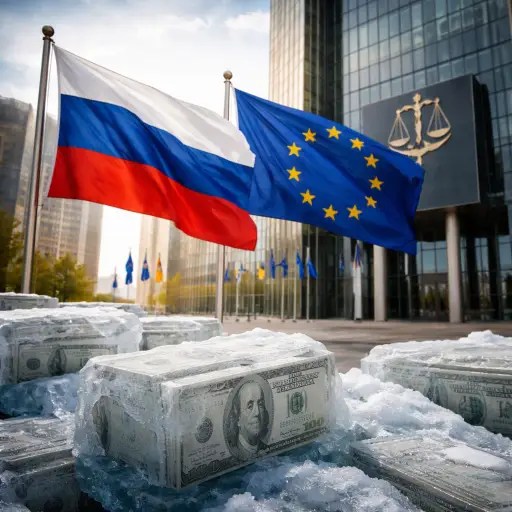
Russia’s central bank challenges Brussels before Europe’s top court, testing the future of sanctions, state immunity, and financial power politics
In a dramatic escalation of the legal confrontation between Moscow and Brussels, Russia’s central bank has filed suit before the General Court of the European Union, contesting the bloc’s decision to freeze roughly $300 billion in sovereign assets held in European jurisdictions and transforming a geopolitical standoff into a defining courtroom battle.
The action targets one of the most consequential sanctions measures adopted after Russia’s invasion of Ukraine, when the European Union, acting in coordination with G7 partners, immobilized a substantial portion of Russia’s foreign currency reserves in an effort to limit the Kremlin’s financial flexibility and signal the economic costs of military aggression.
In its legal filing, the central bank argues that the asset freeze was adopted without proper procedural safeguards and infringes upon core principles of international law, including state sovereignty, property protections, and the right to effective judicial review, contending that the European Council failed to provide adequate individualized reasoning or meaningful opportunity for defense before imposing the restrictions.
European officials maintain that the freeze was lawful, proportionate, and grounded in the EU’s established sanctions framework, emphasizing that the assets have been immobilized rather than confiscated, even as political debate continues within the bloc over whether profits generated from the frozen reserves could be directed toward Ukraine’s reconstruction.
The lawsuit raises complex questions about the treatment of central bank reserves under international custom, as such assets have traditionally enjoyed strong protections reflecting their role in safeguarding monetary stability, and legal scholars note that targeting them represents a significant departure from past practice focused largely on individuals and private entities.
By bringing the case before an EU court, Moscow is engaging directly with the legal order it frequently criticizes, a move analysts interpret as both strategic and symbolic, designed to demonstrate to global markets and non-Western partners that Russia is prepared to contest sanctions through institutional mechanisms rather than rely solely on retaliatory measures.
The General Court, tasked with reviewing the legality of EU acts, has previously annulled sanctions listings when procedural standards were found lacking, but this dispute stands apart because it concerns the reserves of a sovereign monetary authority, raising sensitive questions about the balance between collective security objectives and respect for sovereign immunity.
For Russia, the frozen reserves represent more than a legal principle, as they constitute a substantial portion of the financial buffer accumulated before the war, and although the domestic economy has adapted through capital controls, redirected trade flows, and sustained energy revenues, the immobilized funds remain a constraint on long-term monetary policy flexibility.
For the European Union, the stakes are equally significant, since a judicial setback could expose vulnerabilities in the legal architecture underpinning its sanctions regime and embolden other targeted states to mount similar challenges, while a ruling upholding the freeze would reinforce the bloc’s authority to deploy financial measures as a central instrument of foreign policy.
The case unfolds amid broader scrutiny of the growing weaponization of finance in international relations, as reserve freezes, export controls, and payment system restrictions become defining tools of modern power politics, even though the legal frameworks governing these instruments continue to evolve under pressure.
Observers expect the court to focus on procedural compliance rather than geopolitical narratives, examining whether the EU institutions articulated sufficient reasoning, respected rights of defense, and ensured proportionality, technical determinations that may nonetheless shape the future contours of sanctions law.
As hearings approach in early March, governments and central banks worldwide are watching closely, reassessing assumptions about the security and neutrality of foreign reserves held in Western jurisdictions, while the General Court finds itself at the intersection of law and geopolitics in a dispute that could influence the global financial order for years to come.




 The Tower Post