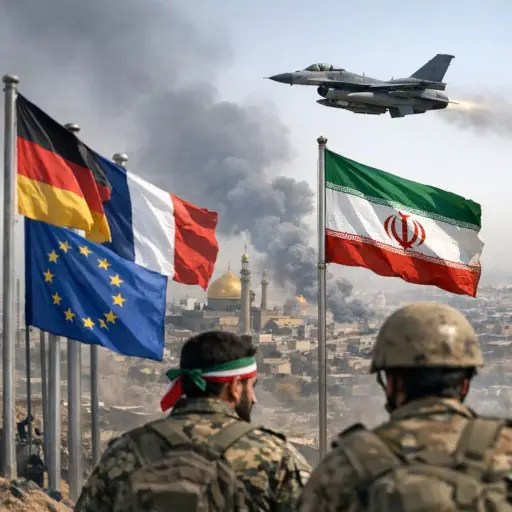
Iran signals that European defensive support for U.S. or Israeli operations would trigger retaliation, raising the risk of a broader geopolitical rupture.
As tensions deepen across the Middle East, Iran has issued its most direct warning yet to European governments, declaring that any military coordination with the United States or Israel will be considered an act of war against the Islamic Republic.
The statement from Tehran’s foreign ministry comes amid intensifying exchanges between Iranian forces and Israeli targets, alongside expanded American deployments designed to protect regional assets and deter further escalation.
Iranian officials argue that Europe can no longer claim neutrality if it provides defensive systems, intelligence sharing, or logistical backing that could influence battlefield outcomes, insisting that such measures effectively place European states inside the conflict.
Several European capitals have recently reinforced naval patrols and missile defense cooperation in the region, describing the moves as precautionary steps to safeguard shipping lanes, diplomatic personnel, and energy infrastructure critical to global markets.
Tehran, however, has drawn a sharper distinction, warning that interception of Iranian projectiles, engagement with Iranian naval units, or real-time intelligence assistance to adversaries would be treated as direct participation rather than passive defense.
The rhetoric marks a significant escalation in tone and reflects growing anxiety in Iran that Western coordination is tightening at a moment when the regional balance is already under strain from strikes, counterstrikes, and proxy confrontations stretching across multiple fronts.
Security analysts note that the warning appears calibrated to deter European involvement by raising the political and economic costs of deeper alignment, particularly at a time when European economies remain vulnerable to energy disruptions and market volatility.
Behind closed doors, diplomats acknowledge that the line between defensive support and active engagement is increasingly difficult to define, especially when shared radar data, cyber capabilities, and integrated command structures can shape operational outcomes without a single European missile being fired.
European leaders have publicly emphasized de-escalation and reiterated calls for restraint from all sides, while privately weighing alliance commitments against the risks of entanglement in a widening confrontation.
Iran’s leadership has simultaneously framed Europe’s posture as evidence of strategic dependency on Washington, arguing that decisions taken in Brussels, Berlin, and Paris are no longer insulated from U.S. and Israeli operational planning.
The broader geopolitical stakes are considerable, with any direct clash involving European forces carrying implications for NATO cohesion, cyber retaliation across continents, and the stability of already fragile global supply chains.
Energy markets have responded nervously to the rising tension, as shipping insurers adjust risk calculations and traders factor in the possibility of disruptions in key maritime corridors linking the Gulf to Europe and Asia.
Military planners across the region are reportedly reviewing rules of engagement in an effort to prevent accidental escalation, yet the density of forces operating in close proximity increases the danger that a defensive maneuver could be misinterpreted as aggression.
Domestic political pressures are also shaping calculations in multiple capitals, where leaders face the competing imperatives of demonstrating resolve, protecting economic interests, and avoiding a war that could spiral beyond their control.
For now, the situation remains fluid, with rhetoric escalating faster than diplomacy and strategic ambiguity giving way to sharper red lines, as Tehran seeks to deter European involvement and European governments attempt to prevent a regional conflict from becoming a continental one.




 The Tower Post