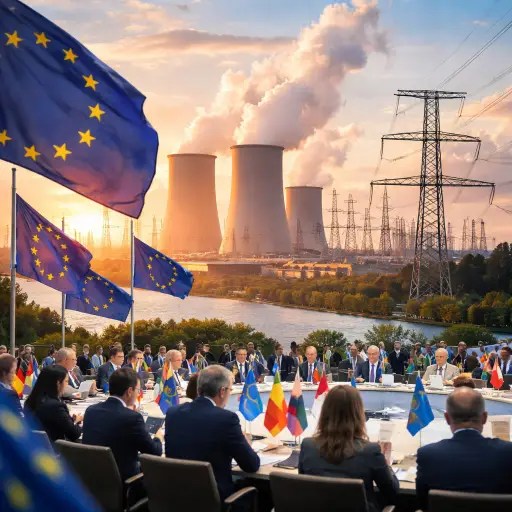
European governments push for rapid reforms and support measures as energy costs strain industry and households
European Union leaders are intensifying discussions over emergency measures aimed at lowering electricity prices across the bloc as governments confront mounting pressure from industry groups and households struggling with persistent energy costs. Several member states are urging the European Commission to outline immediate policy options that could stabilize power markets and prevent long‑term damage to the continent’s economic competitiveness.
High electricity prices have become one of the most pressing economic concerns in Europe, particularly for energy‑intensive industries such as steel, chemicals, and manufacturing. Business leaders warn that sustained cost disadvantages compared with competitors in North America and parts of Asia risk accelerating factory closures, reducing investment, and weakening Europe’s industrial base at a time when global competition is intensifying.
Officials involved in the discussions say governments want the Commission to consider short‑term interventions as well as structural reforms to the electricity market. The current system, which links wholesale power prices to the cost of the most expensive generation source needed to meet demand, has faced criticism for allowing spikes in gas prices to drive electricity costs across the entire market even when cheaper renewable power is widely available.
Several governments are calling for adjustments that would better reflect the growing share of renewable energy in Europe’s power mix. Policymakers argue that separating the pricing of low‑cost renewable generation from more volatile fossil fuel sources could help stabilize electricity costs and provide clearer price signals for investment in clean energy infrastructure.
In parallel with market reforms, EU leaders are also examining the possibility of expanded subsidies or state support mechanisms designed to shield key industries from extreme price fluctuations. Some governments are advocating targeted relief programs for sectors considered strategically important, while others warn that generous subsidies could distort competition within the single market if not carefully coordinated at the European level.
The debate reflects broader tensions between the urgency of economic relief and the long‑term goals of Europe’s energy transition. While renewable energy deployment has accelerated across the continent, policymakers acknowledge that the transition period has exposed vulnerabilities in energy markets that were originally designed around fossil fuel generation and predictable supply patterns.
Energy ministers from several member states have argued that coordinated action at the European level is essential to prevent a fragmented policy response in which national subsidies create unequal advantages for companies depending on their country of operation. A harmonized framework, they say, would allow governments to support industries while maintaining the integrity of the single market.
The European Commission has already been studying potential adjustments to electricity market rules as part of broader energy policy reviews, but growing political pressure from capitals is accelerating the timetable. Officials familiar with the process say policymakers are now examining a range of options that could be implemented quickly while longer‑term reforms are negotiated.
Beyond industrial concerns, high electricity prices have also fueled public frustration in several countries where households continue to face elevated energy bills despite declining wholesale gas prices compared with the peaks seen during earlier phases of the energy crisis. Governments fear that prolonged energy inflation could undermine public support for climate policies if voters associate the green transition with higher living costs.
Analysts note that Europe’s energy landscape is undergoing one of its most significant transformations in decades as renewable capacity expands rapidly, electrification spreads across transport and heating, and geopolitical shifts reshape energy supply chains. In this environment, policymakers are under pressure to ensure that the electricity market evolves quickly enough to support both economic competitiveness and climate ambitions.
While no single proposal has yet secured consensus among member states, the momentum behind emergency discussions underscores the scale of the challenge facing European leaders. Decisions taken in the coming period could reshape how electricity is priced and regulated across the European Union, potentially influencing investment patterns, industrial policy, and consumer energy costs for years to come.
 The Tower Post