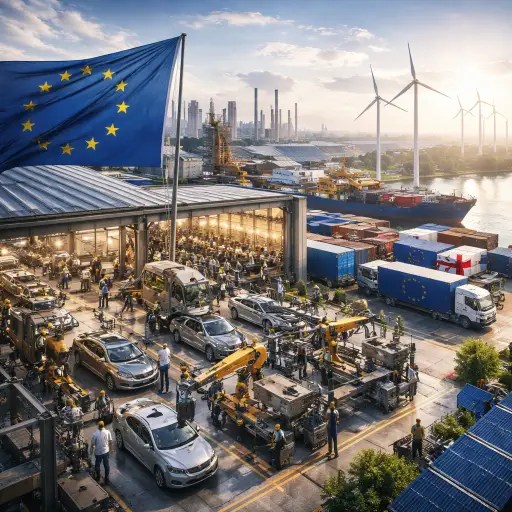
Commission proposal ties public funding to European manufacturing while leaving room for trusted partners that open their markets reciprocally
The European Union is moving toward a significant shift in industrial policy as policymakers seek to reinforce the continent’s manufacturing base amid intensifying global competition. A proposal from the European Commission would introduce rules that favor European production when public money finances major industrial and infrastructure projects. The initiative, often described in Brussels as a ‘Buy European’ approach, is designed to ensure that taxpayer-funded investment strengthens domestic industry rather than boosting overseas manufacturing capacity.
Officials argue that the new framework reflects a broader transformation in global economic strategy in which governments are increasingly willing to intervene to protect strategic industries. Over the past several years, European leaders have watched major economies adopt assertive industrial policies that combine subsidies, domestic production incentives, and procurement preferences. Against this backdrop, the Commission believes the EU must adopt similar tools if it wants to maintain a competitive manufacturing base in critical sectors.
Under the proposed rules, projects that receive public funding from European or national programs would be encouraged to prioritize equipment, components, and technologies produced within the European Union. The measure would apply particularly to sectors considered strategic for economic resilience and technological leadership, including renewable energy systems, advanced batteries, digital infrastructure, semiconductors, and defense-related manufacturing.
The Commission stresses that the initiative is not intended to close Europe’s markets but to align public spending with long-term industrial strategy. Rather than imposing an outright ban on foreign suppliers, the rules would introduce incentives and criteria that reward companies manufacturing a substantial portion of their products within the EU. Companies seeking to compete for publicly funded contracts may therefore face growing pressure to expand production facilities on European soil.
The debate surrounding the proposal highlights growing anxiety among European policymakers about the bloc’s position in the global industrial landscape. In sectors such as solar panels, wind turbines, and electric vehicle components, European manufacturers have struggled to compete with lower-cost imports supported by extensive government subsidies abroad. Many industry leaders warn that without stronger policy support the EU risks losing key industrial capabilities that are essential for the green and digital transitions.
A central element of the Commission’s approach is the principle of reciprocity in international trade relations. While the rules would prioritize European manufacturing, companies from outside the EU would not automatically be excluded. Instead, access to publicly funded projects could remain open to suppliers from countries that allow European firms similar participation in their own government-backed procurement markets.
This provision is expected to shape the EU’s economic relationships with several close partners. Countries such as the United Kingdom and Japan are widely viewed in Brussels as potential participants under the reciprocal framework, provided their procurement systems remain open to European companies. By offering conditional access to trusted partners, the EU hopes to maintain cooperation while still protecting its strategic interests.
The proposal is also closely linked to concerns about China’s expanding industrial presence across global markets. European manufacturers have repeatedly warned that massive production capacity and state-backed support in China are driving down prices in sectors ranging from solar technology to electric mobility components. By linking public spending to European manufacturing, policymakers hope to prevent domestic industries from being weakened during the continent’s shift toward clean technologies.
Supporters within the European industrial community argue that the measure could provide long-term stability for manufacturers considering new investments. Public procurement represents a major share of spending in sectors such as energy infrastructure, transportation systems, and digital networks. If these projects prioritize European-made equipment, companies may gain the confidence needed to build factories, develop supply chains, and invest in innovation within the EU.
At the same time, the initiative has sparked debate among economists and trade specialists who warn about potential side effects. Critics note that strict local production requirements could increase project costs if European suppliers cannot yet meet demand or match global price levels. Others caution that trading partners might respond with similar measures, potentially triggering new tensions in international trade relations.
European officials insist that the legislation will be carefully calibrated to avoid unnecessary disruption while still achieving its strategic objectives. The Commission is expected to design flexible thresholds that recognize the complexity of modern global supply chains while encouraging companies to locate key stages of manufacturing within Europe. In practice, this could mean that products assembled in Europe using a significant share of regional components would receive preference in procurement processes.
The ‘Buy European’ proposal forms part of a wider effort by Brussels to strengthen the continent’s industrial ecosystem. Recent initiatives have targeted semiconductor production, battery manufacturing, and the development of renewable energy supply chains, reflecting a broader push for economic resilience. By aligning procurement rules with these investments, policymakers aim to ensure that public spending reinforces the same strategic priorities.
For workers and regional economies across Europe, the stakes are considerable. Manufacturing remains a cornerstone of employment in many areas of the EU, and policymakers increasingly view industrial capacity as a key element of economic security. Supporters of the initiative argue that linking public investment to domestic production could stimulate job creation, technological development, and stronger industrial clusters across the continent.
As negotiations among member states and lawmakers move forward, the proposal is likely to become one of the most closely watched elements of Europe’s evolving economic strategy. Advocates see it as a necessary adaptation to a world in which major powers openly support their industries, while critics urge caution to preserve the EU’s longstanding commitment to open markets. Whatever the outcome, the debate underscores a growing consensus that Europe must rethink how public spending can be used to safeguard its industrial future.


 The Tower Post