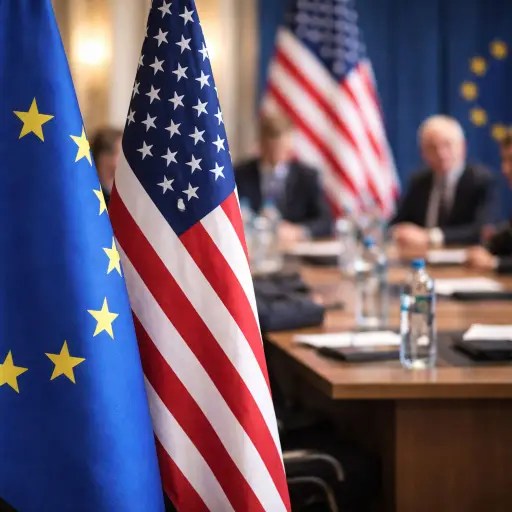
Brussels signals readiness for countermeasures as tensions rise over Washington’s warnings targeting Spain and the wider transatlantic economic relationship
European leaders warned that the European Union is prepared to defend its economic interests after the United States issued trade threats directed at Spain, a dispute that officials in Brussels say risks deepening tensions between two of the world’s largest economic partners and testing the resilience of the long standing transatlantic trade relationship.
Officials from several EU member states said the bloc remains open to dialogue with Washington but made clear that any measures perceived as unfairly targeting Spanish industries would trigger a coordinated European response designed to protect the integrity of the EU single market.
The dispute has emerged amid growing concern in Brussels that global trade policy is increasingly being shaped by strategic competition and domestic political pressure rather than the cooperative frameworks that have traditionally guided economic relations between Western allies.
According to European officials familiar with the discussions, Washington has raised objections related to regulatory and commercial issues affecting certain Spanish sectors, arguing that some policies could place American companies at a disadvantage in international markets.
European policymakers strongly reject that interpretation and insist that Spain operates fully within the legal framework of the European Union, emphasizing that measures directed at a single member state inevitably affect the entire bloc and must therefore be addressed collectively.
Senior figures in the European Commission indicated that technical teams have already begun reviewing potential responses should the United States translate its warnings into concrete trade restrictions affecting Spanish exports or broader EU economic interests.
Possible countermeasures under consideration include targeted tariffs, regulatory reviews involving U.S. firms operating in the European market, or diplomatic initiatives intended to bring both sides back to the negotiating table before tensions escalate into a wider trade confrontation.
Economic analysts note that disputes between the European Union and the United States carry particular significance because of the scale of the economic relationship linking the two sides, which encompasses hundreds of billions of euros in trade each year and extensive investment across multiple industries.
Even limited trade measures could reverberate across sectors such as automotive manufacturing, agriculture, energy technology, pharmaceuticals and digital services, industries that rely heavily on stable regulatory cooperation and open markets across the Atlantic.
In Madrid, Spanish officials expressed confidence that European institutions will stand firmly behind the country if the situation intensifies, arguing that unity within the bloc is essential in responding to external economic pressure.
The Spanish government has also emphasized that it remains willing to engage constructively with Washington in order to avoid escalation, but officials warned that unilateral trade threats could undermine the spirit of cooperation that has historically defined relations between the two allies.
Across the Atlantic, U.S. officials have framed their concerns as part of a broader effort to address perceived imbalances in international trade while strengthening domestic industrial competitiveness and safeguarding strategic supply chains.
European leaders acknowledge that many countries are reassessing economic vulnerabilities following recent global disruptions, yet they caution that unilateral trade actions between partners risk weakening coordination among democratic economies at a time of growing geopolitical uncertainty.
Diplomats involved in the discussions say negotiations between European and American officials are continuing quietly in an effort to prevent the dispute from escalating further and to identify possible compromises that could ease tensions before any formal trade measures are implemented.
Trade experts note that many transatlantic disputes in the past have ultimately been resolved through negotiation and technical adjustments rather than retaliatory tariffs, reflecting the deep economic interdependence linking companies and workers on both sides of the Atlantic.
For European policymakers the current situation underscores a broader challenge facing the global economy, where traditional alliances are increasingly tested by competition in advanced technologies, industrial policy and strategic supply chains.
Officials in Brussels say the European Union will continue to pursue dialogue with Washington while preparing for the possibility that stronger action may be required to protect European industries and maintain fair competition within the single market.
For now the message from European leaders remains measured but firm that cooperation remains the preferred path forward, yet the European Union stands ready to defend its interests if the dispute moves beyond rhetoric and into concrete trade restrictions.




 The Tower Post