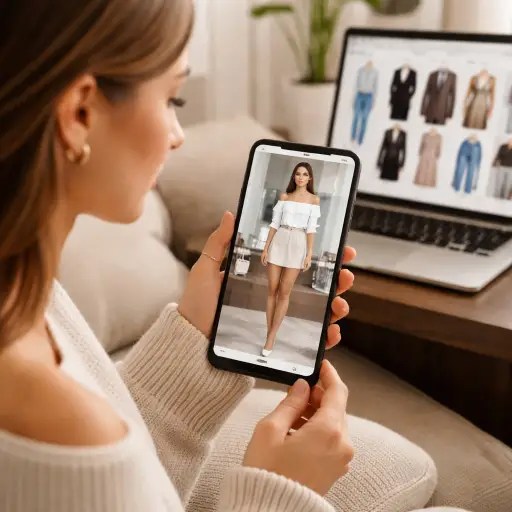
New photorealistic technology lets customers upload a photo and see a lifelike digital avatar modeling outfits from every angle, a move retailers hope will reshape online fashion and reduce costly returns.
Zara is rolling out a new artificial intelligence powered virtual try-on system designed to transform how customers shop for clothing online, introducing personalized digital avatars that allow shoppers to preview garments on their own likeness before completing a purchase. The feature enables customers in the United States to upload a photograph that is converted within seconds into a realistic three dimensional avatar capable of modeling outfits from Zara’s catalog, marking one of the most ambitious attempts yet by a global fashion retailer to close the gap between physical fitting rooms and digital commerce.
At the center of the new system is a machine learning model trained on thousands of garment simulations and human body shapes, allowing the platform to map clothing onto an individualized avatar that reflects a shopper’s posture, proportions, and movement. Once generated, the avatar can rotate in a full 360 degree view while wearing selected items, letting users examine fabric drape, fit around the shoulders and waist, and how different pieces coordinate as complete outfits. The preview aims to replicate the experience of seeing oneself in a mirror, but inside a mobile phone or laptop screen.
For fashion retailers, the technology addresses a long standing challenge that has grown alongside the rise of online shopping: the uncertainty of fit. Clothing remains one of the most frequently returned product categories in e commerce because customers cannot try items on before buying. Each return triggers additional shipping, inspection, and restocking costs, creating a logistical burden that cuts into profit margins and increases environmental impact through transportation and packaging waste.
Industry analysts say virtual try-on tools powered by artificial intelligence could significantly reduce those returns by helping customers make more confident purchasing decisions. When shoppers can visualize how a jacket hangs on their shoulders or how a pair of trousers sits on their hips, the likelihood of ordering multiple sizes or sending items back declines. Retailers are betting that improved visualization will not only lower return rates but also encourage larger shopping baskets as customers experiment with styling combinations suggested by the system.
Zara’s approach focuses on photorealism, a step beyond earlier virtual fitting room tools that often relied on simplified or cartoon-like avatars. The new avatars are designed to resemble the shopper closely, with accurate skin tones, body proportions, and subtle movement that mimics how clothing shifts as a person turns. The effect aims to create a digital twin capable of presenting garments in a way that feels authentic rather than abstract, allowing customers to imagine how they might appear in everyday situations.
The system also integrates an AI styling assistant that recommends complementary pieces based on the selected garment and the user’s browsing history. If a shopper tries on a blazer through the avatar, for example, the platform may suggest trousers, shoes, and accessories that match the look. The digital stylist continuously adapts its suggestions by analyzing customer interactions, seasonal trends, and popular combinations emerging across the retailer’s global online platform.
Behind the scenes, engineers combined computer vision, generative AI, and cloth simulation models to produce the visual previews. After a user uploads a photo, the system constructs a three dimensional body model and applies garment physics that approximate how fabric folds, stretches, and moves. The simulation must process complex variables including material type, stitching structure, and gravity effects, all while delivering results quickly enough for a seamless shopping experience.
Fashion companies have been experimenting with digital try-on technologies for years, but many struggled to achieve realism or scale across large product catalogs. Advances in generative AI and graphics processing have accelerated progress, making it possible to produce lifelike renderings with far less computing time. As these systems mature, analysts expect them to become a standard feature across major e commerce platforms, particularly in fashion where visual presentation strongly influences purchasing behavior.
For Zara, the rollout reflects a broader push by parent company Inditex to invest in digital tools that complement its fast fashion supply chain. The retailer has spent the past several seasons expanding online features such as real time inventory tracking, integrated store pickup, and app based styling suggestions. The avatar system represents the next step in blending data science with fashion merchandising, offering a glimpse of how artificial intelligence could reshape the customer journey from discovery to checkout.
Early reactions from shoppers testing the feature suggest that the novelty of seeing a personalized avatar model clothing creates a more engaging browsing experience than static product photos alone. Some users report spending longer exploring different combinations simply to watch their digital counterpart change outfits in real time. That extended interaction may translate into stronger brand engagement and higher sales conversion rates if the technology proves reliable and easy to use.
Retail experts caution that virtual fitting technology is unlikely to eliminate returns entirely, since factors such as comfort, fabric texture, and personal preference remain difficult to convey digitally. Even so, they believe tools that narrow the uncertainty gap could reshape consumer expectations for online fashion shopping. As shoppers grow accustomed to interactive previews and AI styling guidance, traditional product pages with flat images may begin to feel outdated.
The debut of Zara’s avatar based try-on system signals how rapidly artificial intelligence is becoming embedded in everyday retail experiences. What once required a trip to a store fitting room can now unfold through a smartphone camera and a cloud based simulation running in the background. If the experiment succeeds, it may mark a turning point where digital avatars become as common in fashion commerce as mannequins once were in shop windows.




 The Tower Post