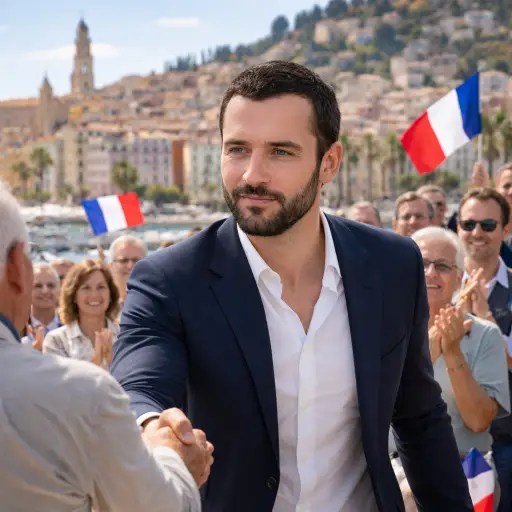
In the Mediterranean town of Menton, the son of a former French president launches a mayoral bid shaped by American experience and conservative ambition
Along the sunlit streets of Menton, where pastel buildings descend toward the Mediterranean and citrus trees line the hills above the harbor, a familiar political surname has returned to public life. Louis Sarkozy, the son of former French president Nicolas Sarkozy, is entering the mayoral race in the seaside town near the Italian border, presenting himself not only as a newcomer but as a figure attempting to redefine what a young conservative voice might look like in contemporary France. His campaign is drawing national attention, as observers weigh whether the moment marks the first step in the emergence of a new political dynasty.
Still in the early phase of his political life, Louis Sarkozy is campaigning with a mixture of confidence and caution, acknowledging the powerful legacy attached to his family name while insisting that his ambitions are personal rather than inherited. In public appearances across Menton’s markets, cafés, and waterfront promenades, he speaks about local governance, municipal identity, and the need for what he calls practical conservatism. For many residents the candidacy is both intriguing and unfamiliar, since the young candidate spent much of his formative years outside the traditional pathways of French political life.
A defining feature of his story is the long period he spent in the United States, where he studied, worked, and immersed himself in a political culture that differs sharply from that of France. Those years abroad, he argues, gave him a broader view of how conservative ideas can evolve, particularly in a media environment shaped by rapid debate and ideological polarization. Friends and advisers say he returned to France convinced that a new generation of right‑leaning politicians must adapt their message to voters who are skeptical of both traditional parties and political dynasties.
In speeches delivered during the opening weeks of the campaign, Louis Sarkozy often frames his candidacy as an experiment in renewal rather than continuity. He speaks about encouraging local entrepreneurship, improving municipal services, and strengthening the town’s identity as both a French and Mediterranean gateway. The message aims to resonate with voters who see Menton as a place balancing tourism, heritage, and the pressures of economic change. Campaign aides say the goal is to keep the focus on local priorities rather than the national controversies that surrounded his father’s presidency.
Nevertheless the shadow of Nicolas Sarkozy remains impossible to ignore. The former president continues to occupy a complicated place in French political memory, admired by supporters for his energy and criticized by opponents for the divisions of his era. For some voters the appearance of his son on the ballot inevitably revives those debates. Analysts in Paris note that the younger Sarkozy faces the delicate task of acknowledging his lineage without allowing it to dominate the narrative of his campaign.
In Menton itself, reactions among residents vary from curiosity to cautious optimism. Shopkeepers along the old town streets describe encountering the candidate during informal walkabouts, while retirees gathered near the harbor discuss whether the town could benefit from the visibility that a high‑profile mayor might bring. Others remain uncertain, wondering whether a candidate associated with national politics can fully understand the everyday concerns of a municipality whose rhythms revolve around tourism seasons, local commerce, and cross‑border movement.
The campaign team surrounding Louis Sarkozy appears aware of those doubts and has structured its strategy accordingly. Instead of large rallies, the campaign has emphasized smaller conversations with neighborhood groups and local associations, a format intended to demonstrate accessibility and attentiveness. Advisers say the candidate wants to present himself less as a political heir and more as a civic participant discovering the realities of municipal administration alongside the residents he hopes to represent.
Political observers across France are watching closely because the Menton race carries significance beyond the boundaries of the Riviera town. If Louis Sarkozy succeeds in establishing himself as a credible local leader, the victory could provide a platform for a broader role within the conservative movement. Some analysts speculate that a successful mayoral term might serve as a testing ground for ideas and alliances that could shape the future direction of the French right.
At the same time the candidacy raises broader questions about the role of family legacy in democratic politics. France has long been cautious about the appearance of dynastic power, yet political families have repeatedly resurfaced across generations. Supporters of Louis Sarkozy argue that voters ultimately judge candidates on their proposals and character, not merely their surnames. Critics counter that recognition and networks associated with famous families inevitably confer advantages in visibility and influence.
As the campaign unfolds along the Mediterranean coast, Louis Sarkozy continues to emphasize that his ambitions are rooted in the local scale of governance rather than national symbolism. Whether discussing urban planning, small business development, or the preservation of Menton’s historic identity, he presents the mayoral contest as a proving ground for a new style of conservative politics shaped by international experience and generational change.
For the voters of Menton, the decision will ultimately rest on whether the young candidate can transform curiosity into trust. The town’s narrow streets and seaside squares now serve as the stage for a political debut watched far beyond the Riviera. Regardless of the outcome, the campaign has already reopened a conversation in France about inheritance, ambition, and the evolving face of political leadership.



 The Tower Post