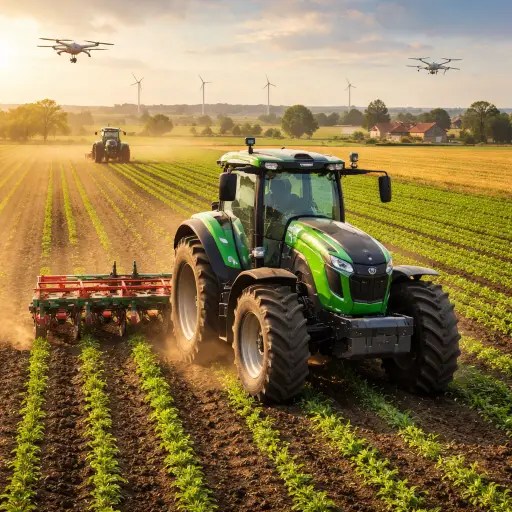
Automation spreads across farms in France, Germany and the Netherlands, boosting productivity while raising questions about the future of seasonal agricultural jobs
Across wide stretches of farmland in western Europe a quiet technological shift is underway as autonomous tractors guided by artificial intelligence move methodically through fields that once required teams of seasonal workers. Farmers in France Germany and the Netherlands are increasingly deploying self driving agricultural machinery capable of planting fertilizing and cultivating crops with minimal human supervision. Equipped with satellite positioning sensors and machine learning software these vehicles navigate farmland with remarkable precision analyzing soil conditions crop growth and terrain patterns as they operate.
Manufacturers and agricultural technology companies describe the new generation of AI tractors as one of the most important changes in farming since the widespread introduction of GPS guidance systems. The machines can follow detailed digital maps of fields avoid obstacles and automatically adjust their work patterns as conditions change. Many can operate through the night guided by data and sensors rather than human drivers allowing farmers to take advantage of short weather windows that are critical during planting and cultivation seasons.
Farmers who have already adopted the technology say the impact on productivity can be immediate. By applying fertilizer seeds and crop treatments with near surgical accuracy autonomous tractors reduce waste while covering more land in less time. Several growers report that the machines allow them to manage larger fields with fewer labor hours a benefit that has become increasingly attractive as labor shortages affect agricultural regions across Europe.
In parts of rural France and eastern Germany farmers say finding enough seasonal workers has become a growing challenge in recent years. Younger workers often leave agricultural regions for urban jobs while cross border labor flows have become less predictable. Autonomous machinery is being presented by technology developers as a solution that can stabilize production while reducing dependence on temporary labor during the busiest months of the farming calendar.
Yet the rapid spread of AI powered equipment is also prompting concern among labor organizations and rural advocacy groups. Farm unions warn that widespread automation could gradually erode the pool of seasonal agricultural jobs that many communities rely on for income. These jobs often support migrant workers students and residents of small villages where other employment opportunities can be limited.
Union representatives argue that agriculture has always evolved through mechanization but that the speed and scale of digital automation may create sharper disruptions. Instead of replacing individual tools or machines artificial intelligence systems can now manage entire field operations with limited human oversight. Labor groups fear that if adoption accelerates too quickly the transition could leave many workers without realistic alternatives in rural economies already struggling with demographic decline.
Technology developers counter that automation is not eliminating agricultural work but transforming it. Operating fleets of autonomous tractors requires technicians data specialists and farm managers capable of interpreting complex digital information about crops and soil conditions. Some agricultural colleges in Europe have already begun expanding training programs in precision farming robotics and data driven agriculture in anticipation of new types of farm employment.
The tractors themselves represent the convergence of several technological advances including robotics environmental sensing and artificial intelligence. Cameras radar lidar and satellite navigation systems allow the machines to interpret their surroundings and adjust their behavior in real time. Advanced algorithms can detect variations in soil moisture plant health and field density enabling tractors to apply treatments only where needed which can reduce environmental impact as well as operating costs.
In the Netherlands where farms are often smaller but technologically advanced the integration of AI tractors is unfolding particularly quickly. Dutch farmers already rely heavily on sensor networks automated irrigation systems and digital crop monitoring tools. Autonomous tractors fit naturally into this data driven environment allowing farmers to coordinate planting fertilizing and cultivation with unprecedented precision.
Across France and Germany adoption is spreading among larger grain and sugar beet farms where the economic benefits of automation can scale rapidly across hundreds of hectares. Some farmers report that a single operator can now supervise multiple machines simultaneously using remote monitoring systems from a control room or even a tablet device. This shift is gradually changing the image of agricultural work from physical field labor toward technology based management.
Still the appearance of driverless tractors in European fields has become a powerful symbol of the broader debate surrounding artificial intelligence and employment. Rural leaders policymakers and agricultural groups are increasingly discussing how to balance the need for innovation with the need to sustain local communities. The question is not only how farms will operate in the future but also how rural regions can adapt as technology reshapes traditional labor patterns.
For many farmers the decision to adopt AI tractors ultimately comes down to economic survival in an increasingly competitive global food system. Rising fuel prices volatile crop markets and stricter environmental regulations are forcing producers to seek greater efficiency wherever possible. Automation promises to reduce costs improve yields and help farms remain viable in a rapidly changing agricultural landscape.
At the same time the debate unfolding across Europe reflects a deeper tension between technological progress and social stability. Supporters argue that artificial intelligence can make agriculture more sustainable efficient and resilient while critics warn that rural livelihoods must not be overlooked in the rush toward automation. Policymakers are now facing growing pressure to consider training programs transition support and rural investment strategies as part of the technological shift.
For now autonomous tractors continue to move steadily across European farmland guided by algorithms rather than steering wheels. Their quiet progress signals both opportunity and uncertainty promising higher productivity while raising difficult questions about the future of work in rural communities. As more farmers experiment with artificial intelligence in the fields the balance between innovation and employment is likely to remain at the center of Europe’s evolving agricultural story.




 The Tower Post