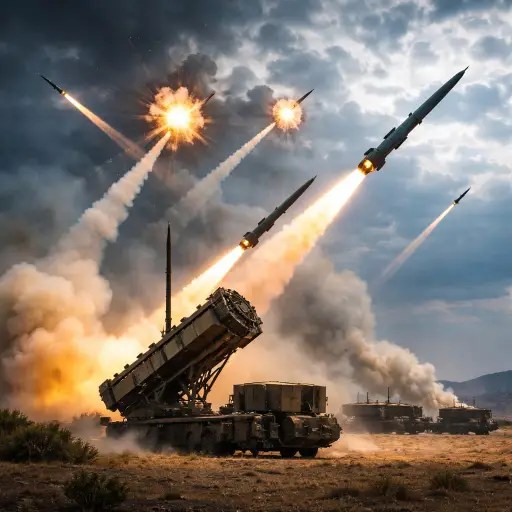
Western stockpiles stretched by intensive strikes against Iran and its proxies risk weakening Ukraine’s shield against Russian missile attacks, analysts warn.
Western air-defense stockpiles are coming under mounting strain as military resources are diverted to counter escalating threats linked to Iran, raising concerns among defense planners that Ukraine may soon face greater vulnerability to Russian missile and drone attacks. Military officials and analysts say the intense pace of intercept operations in the Middle East has consumed large quantities of advanced interceptor missiles, many of the same systems used to defend Ukrainian cities. As a result, governments that once prioritized deliveries to Kyiv are increasingly balancing competing security demands across two volatile regions.
Recent waves of long‑range strikes and retaliatory launches across the Middle East have required extensive use of Western‑supplied missile defense systems positioned to protect bases, shipping corridors, and allied infrastructure. These operations rely heavily on sophisticated interceptors designed to defeat ballistic missiles, cruise missiles, and armed drones, weapons that Iran and its regional partners have employed in increasing numbers. Each interception may prevent catastrophic damage, but it also consumes a missile that can take months or even years to replace, creating pressure on inventories that were already stretched before the latest escalation.
For Ukraine, the consequences of this shift could be significant. Since the beginning of Russia’s full‑scale invasion, Ukrainian air defenses have depended on a patchwork of Western‑provided systems capable of intercepting high‑speed missiles and aerial drones targeting energy infrastructure, industrial facilities, and residential areas. These interceptors have allowed Ukrainian forces to blunt many of the most destructive strikes. However, maintaining that protective shield requires a steady supply of replacement missiles, and Western capitals are increasingly acknowledging that global demand now exceeds production capacity.
Defense officials privately concede that manufacturing output for advanced interceptors has not kept pace with the intensity of modern conflicts. Production lines in Europe and North America were originally sized for limited contingency operations rather than sustained multi‑theater missile warfare. As a result, governments are forced to allocate existing stockpiles carefully while expanding industrial capacity, a process that involves complex supply chains, specialized components, and long certification cycles. The surge in demand triggered by Middle Eastern hostilities has therefore amplified an already challenging supply environment.
Analysts say the situation highlights a fundamental transformation in modern warfare, where missile defense has become a central pillar of national security rather than a niche capability. Ballistic and cruise missiles, once associated mainly with major powers, are now widely deployed across multiple regions. In response, countries are deploying layered defense systems designed to detect, track, and intercept incoming threats at different stages of flight. Yet these networks rely on a finite number of interceptor missiles, and sustained combat operations can quickly erode available reserves.
The strategic implications are particularly acute for Ukraine, where air defense has become essential for protecting civilian populations and critical infrastructure. Russian forces continue to employ large barrages combining drones with high‑speed missiles intended to overwhelm defensive systems. Ukrainian operators have repeatedly demonstrated their ability to intercept many of these threats, but each successful defense consumes valuable ammunition. Should supplies diminish, the effectiveness of Ukraine’s defensive umbrella could gradually erode, exposing cities and energy networks to greater damage.
Western governments insist that support for Ukraine remains a core priority, yet the emerging resource competition illustrates the complexity of managing simultaneous security crises. Military planners must now consider how best to distribute limited defensive assets among allies facing different types of threats. The Middle East escalation, involving direct missile exchanges and threats to international shipping routes, has demanded immediate deployments that draw from the same arsenals supporting Ukraine. Balancing these requirements is becoming an increasingly delicate strategic calculation.
Some analysts warn that the perception of dwindling interceptor supplies could influence battlefield dynamics. Russia has already demonstrated a willingness to launch large coordinated strikes designed to saturate defenses. If Ukrainian stockpiles shrink or if delivery schedules slow, Moscow may see an opportunity to intensify missile campaigns in hopes of overwhelming the remaining systems. Even a modest reduction in interception rates could have disproportionate effects by increasing damage to energy infrastructure that Ukraine relies on to sustain both its civilian economy and its military operations.
In response to these concerns, Western defense industries are accelerating efforts to expand missile production. Governments have signed new contracts, increased funding for manufacturing facilities, and sought ways to streamline procurement procedures. Some companies are exploring modular production methods intended to shorten delivery timelines, while others are investing in new supply chains for critical electronic and propulsion components. These initiatives aim to ensure that both Ukraine and regional allies can maintain robust air defenses despite the rising tempo of global missile threats.
Nevertheless, industry experts caution that rebuilding missile inventories is not a rapid process. Advanced interceptors incorporate sophisticated guidance systems, high‑performance rocket motors, and precision manufacturing techniques that cannot be scaled overnight. Even with expanded budgets and political support, increasing output will likely take sustained effort over multiple years. During that transition period, governments may be forced to make difficult choices about how to allocate the missiles already in storage.
The overlapping crises have therefore exposed a broader vulnerability within Western defense planning: the assumption that high‑intensity missile warfare would remain geographically limited. Instead, simultaneous conflicts are now testing the resilience of global defense supply chains. The experience is prompting renewed debate among policymakers about the need for deeper stockpiles, diversified manufacturing bases, and cooperative production agreements between allied nations.
For Ukraine, the outcome of that debate carries immediate consequences. The country’s ability to protect its skies has become one of the defining factors shaping the trajectory of the war. If interceptor deliveries continue at sufficient levels, Ukrainian defenses may remain capable of blunting Russia’s most destructive attacks. But if global demand continues to outpace supply, the growing competition for air‑defense resources could gradually shift the strategic balance, turning missile stockpiles into one of the most critical variables in the conflict.




 The Tower Post