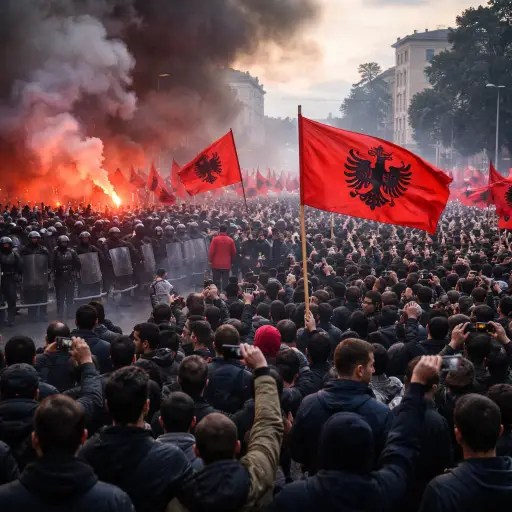
Mass demonstrations and clashes with police deepen political crisis as citizens demand accountability over alleged corruption in infrastructure contracts
Large anti-corruption protests have erupted across Albania, sending thousands of demonstrators into the streets and intensifying pressure on the government amid allegations that senior officials were involved in irregularities tied to major infrastructure contracts. The demonstrations, driven by anger over claims of favoritism and misuse of public funds, have transformed into one of the most serious political challenges the country’s leadership has faced in recent years. Protesters have gathered in the capital and other urban centers, chanting slogans, waving flags, and calling for immediate resignations from top government figures.
Public outrage surged after investigative reports and political accusations suggested that lucrative infrastructure projects had been awarded under opaque conditions to companies with close ties to influential officials. Opposition groups, civil society organizations, and student movements quickly mobilized, accusing the administration of enabling a culture of corruption that undermines democratic institutions and public trust. The allegations have dominated national debate, prompting calls for independent investigations and forcing authorities to respond to mounting scrutiny from citizens and international observers.
As crowds expanded in size, demonstrations evolved from peaceful rallies into confrontational scenes in several areas of the capital. Protesters marched toward key government buildings, blocking streets and gathering in large squares as riot police formed defensive lines around official institutions. In some instances tensions escalated, with protesters throwing objects and security forces responding with crowd-control measures intended to disperse the gatherings. Images of smoke, flashing lights, and scuffles between demonstrators and police quickly circulated across social media and television broadcasts.
Organizers say the demonstrations reflect a broader frustration with political elites rather than a single scandal. Many protesters argue that the alleged corruption surrounding infrastructure contracts symbolizes deeper structural problems within Albania’s political system. They claim that successive administrations have failed to deliver transparency and accountability despite repeated promises of reform. The protests therefore carry a message that extends beyond the immediate allegations, expressing widespread dissatisfaction with governance and economic inequality.
Government officials have rejected accusations of wrongdoing and insist that procurement procedures for infrastructure projects followed legal requirements. Leaders have urged the public to remain calm and allow institutions to examine the claims through established channels. However, critics argue that internal investigations alone cannot restore confidence, demanding independent oversight and the resignation of officials implicated in the allegations. The widening gap between the government’s defensive stance and the opposition’s demands has further polarized the political landscape.
The opposition has seized the moment to intensify its campaign against the administration, calling for early elections and urging supporters to maintain pressure through continued demonstrations. Party leaders have addressed crowds during rallies, accusing the government of ignoring citizens’ concerns and failing to confront corruption decisively. While organizers insist that protests should remain largely peaceful, some gatherings have turned volatile as emotions run high and confrontations with police increase in frequency.
Security forces have maintained a visible presence throughout the protests, deploying riot units and erecting barriers near government buildings in an effort to prevent demonstrators from entering restricted areas. Authorities say the measures are necessary to protect public institutions and maintain order, yet critics contend that the heavy security posture risks inflaming tensions rather than calming them. Reports of injuries among protesters and police officers have added to the sense that the crisis is escalating.
Political analysts note that the unrest comes at a delicate moment for Albania as the country seeks to reinforce its democratic institutions and strengthen its international reputation. Allegations of corruption and scenes of street clashes have drawn attention from regional observers who view the developments as a test of Albania’s political resilience. Some experts argue that the government’s ability to respond transparently and constructively to public demands will determine whether the crisis leads to meaningful reforms or deepens divisions.
Civil society groups have attempted to channel public anger into broader calls for institutional change. Activists emphasize the need for stronger anti-corruption frameworks, judicial independence, and mechanisms that allow citizens to monitor how public funds are used. They warn that without credible reforms the current unrest could evolve into a prolonged cycle of political instability, eroding trust not only in government but also in the wider democratic process.
Within the crowds, protesters express a mixture of frustration, determination, and cautious hope that their mobilization could produce tangible results. Many participants say they joined demonstrations because they believe corruption has affected daily life through weakened public services and limited economic opportunities. For younger protesters in particular, the rallies represent an attempt to reshape the political future of their country by demanding greater accountability from those in power.
As the protests continue, the possibility of early elections has become a central point of debate. Opposition leaders argue that a renewed mandate from voters is necessary to restore legitimacy, while government representatives maintain that elections should proceed according to the existing political timetable. The standoff has created uncertainty about how the crisis might evolve, with both sides seeking to frame the demonstrations as evidence supporting their political arguments.
The coming days are expected to be decisive as authorities weigh their response and protest organizers plan additional rallies. Whether through negotiations, institutional investigations, or continued street pressure, the unfolding events have already reshaped Albania’s political atmosphere. What began as anger over alleged corruption in infrastructure contracts has grown into a wider movement demanding accountability, transparency, and a renewed commitment to democratic governance.



 The Tower Post