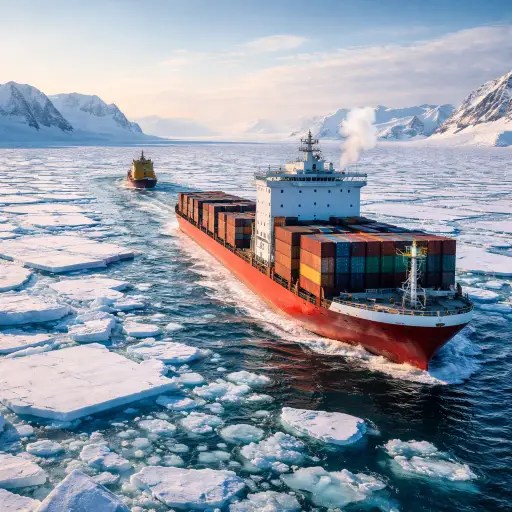
Melting sea ice is opening northern passages that could reshape trade between Europe and Asia, while raising environmental concerns about fragile polar ecosystems.
European shipping companies are once again turning their attention north as the gradual retreat of Arctic sea ice begins to redraw the map of global maritime trade. Industry analysts say a growing number of carriers and logistics groups are examining whether emerging Arctic passages could become commercially viable shipping corridors linking Europe and Asia, offering a dramatically shorter alternative to traditional routes through the Suez Canal or around the Cape of Good Hope.
As climate change alters conditions across the far north, seasonal navigation through waters that were once locked in ice for most of the year is becoming increasingly possible. Shipping executives say the prospect of sailing across the top of the world has moved from distant speculation to serious strategic planning, prompting feasibility studies, pilot voyages and discussions with insurers and regulators about the risks and rewards of Arctic operations.
For European exporters, the attraction lies primarily in distance. The northern sea routes that skirt the Arctic coastline can reduce voyages between northern European ports and major Asian trading hubs by thousands of kilometers. Shorter journeys can mean lower fuel consumption, faster delivery times and potentially lower shipping costs, advantages that have become particularly appealing as global supply chains search for resilience after years of disruption.
Several major shipping companies based in Northern Europe have begun quietly assessing the commercial implications of Arctic navigation. Industry insiders say firms are studying seasonal ice data, satellite monitoring technology and new ice‑class vessel designs that can operate safely in colder and more unpredictable waters. The goal is not yet large‑scale deployment but rather preparation for a future in which Arctic transit may become a regular option for certain cargo flows.
Interest is also being fueled by broader geopolitical and economic shifts. Governments across Europe are paying closer attention to northern maritime corridors as competition intensifies over shipping lanes, energy resources and strategic influence in the Arctic region. Analysts note that maritime infrastructure investments, including upgraded ports and improved ice monitoring systems, are increasingly being discussed as part of long term European trade planning.
Supporters of Arctic shipping argue that technological advances could make navigation safer than in earlier decades. Modern ice forecasting systems, improved hull engineering and sophisticated navigation tools allow captains to track changing ice conditions with far greater precision than before. Shipping companies say these innovations could reduce some of the operational uncertainty that historically discouraged commercial traffic in polar waters.
Despite these developments, the Arctic remains one of the planet’s most challenging maritime environments. Weather conditions can shift rapidly, visibility is often poor and search and rescue capabilities remain limited across vast stretches of ocean. Insurance providers and maritime safety authorities are therefore approaching the expansion of Arctic shipping cautiously, emphasizing that any growth in traffic must be accompanied by robust safety standards.
Environmental organizations warn that the renewed interest in Arctic trade routes carries serious ecological risks. The polar region hosts fragile ecosystems that support unique wildlife ranging from seabirds to marine mammals, and conservation groups fear that increased shipping could raise the likelihood of fuel spills, underwater noise and habitat disruption in waters that have remained relatively undisturbed for centuries.
Critics also argue that the very phenomenon enabling Arctic shipping, the loss of sea ice due to rising global temperatures, underscores the broader climate crisis. Environmental advocates say that treating melting ice primarily as a commercial opportunity risks overlooking the profound environmental consequences unfolding across the polar regions, including shifting ecosystems and accelerating warming.
Shipping companies respond that careful regulation and international cooperation could allow limited Arctic navigation while minimizing environmental harm. Industry representatives say new standards for cleaner fuels, slower vessel speeds and strict routing rules could reduce ecological impacts while still allowing some economic benefits from shorter global trade corridors.
For now, the Arctic shipping future remains uncertain. Seasonal conditions still vary widely from year to year, and commercial viability depends on a complex mix of ice patterns, insurance costs, geopolitical stability and environmental regulation. Yet the growing number of studies commissioned by European shipping groups suggests that the industry is preparing for a scenario in which northern passages become a more visible part of the global logistics network.
As the world watches the transformation of the Arctic, the debate over its future is intensifying. What was once a frozen barrier at the top of the planet is gradually becoming a contested frontier for trade, technology and environmental stewardship. Whether Arctic shipping evolves into a major commercial highway or remains a limited seasonal route may ultimately depend on how governments, industry and environmental advocates balance economic ambition with the need to protect one of Earth’s most vulnerable regions.



 The Tower Post