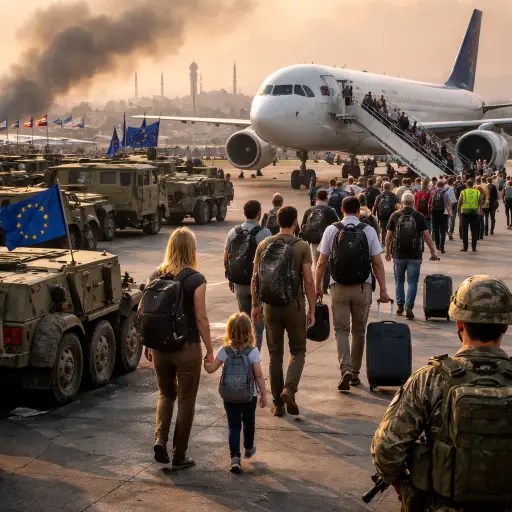
Rising regional tensions push governments to draft contingency operations as diplomats warn of potential wider conflict
European governments are quietly preparing emergency evacuation plans for thousands of their citizens living and working across the Middle East as diplomatic concern grows over escalating tensions surrounding Iran and Israel. Officials say the preparations are precautionary, but the scope of the planning reflects how seriously European capitals are treating the possibility that the regional confrontation could expand rapidly and place foreign nationals at risk.
According to diplomats and security officials familiar with the discussions, contingency planning is underway in several European ministries covering scenarios ranging from limited air evacuations to large scale civilian extractions coordinated with military forces. The measures are not being publicly advertised in order to avoid causing panic among expatriate communities, but internal preparations have accelerated as political and military signals in the region grow increasingly volatile.
European citizens are spread widely across the Middle East in sectors including energy, construction, humanitarian work, shipping, aviation, and diplomacy. In countries around the Gulf as well as Israel, Lebanon, Jordan, and parts of North Africa, tens of thousands of Europeans live either permanently or on temporary assignments. Governments are now reassessing how quickly they could move these people out should commercial travel routes suddenly close.
Officials involved in the planning say the current effort is shaped by lessons learned from previous crises, including evacuations during conflicts in Lebanon, Libya, Afghanistan, and Sudan. Those operations revealed how quickly civilian airports can become overwhelmed or shut down entirely, forcing governments to rely on military aircraft, naval vessels, and chartered transport to move citizens to safer locations.
Several European foreign ministries have recently updated internal registries that allow nationals abroad to voluntarily register their presence with embassies and consulates. Diplomatic staff are also reviewing communication systems designed to alert citizens in emergencies and provide instructions about assembly points, transport arrangements, and potential evacuation corridors.
Military planners across Europe have also begun examining logistics that could support evacuation operations if they were ordered. This includes identifying aircraft capable of long distance transport, assessing naval assets already deployed in nearby waters, and coordinating with allies on possible staging locations where evacuees could be temporarily received before being returned to Europe.
In diplomatic circles the planning is described as a prudent safeguard rather than a signal that evacuation orders are imminent. Officials stress that embassies continue to operate normally and that travel advisories have not fundamentally changed. Nevertheless, the behind the scenes activity reveals how carefully European governments are watching the evolving strategic environment.
Tensions across the region have risen steadily as the confrontation between Iran and Israel sharpens through military posturing, proxy activity, and increasingly direct warnings exchanged between the two sides. Analysts say that even a limited clash could quickly spread across borders through allied armed groups, missile strikes, or disruption of shipping lanes and airspace.
Such a scenario could make commercial flights difficult or impossible in parts of the region, complicating the ability of foreign nationals to leave independently. During past crises, airspace closures and airport congestion have forced governments to organize complex evacuation missions under tight timelines while coordinating with host nations and international partners.
European officials say cooperation between governments would be essential if a major evacuation were required. Shared aircraft, coordinated transport hubs, and joint naval escorts are among the options being considered to ensure that citizens from multiple countries could be moved efficiently even if infrastructure on the ground were under severe pressure.
Humanitarian organizations operating in the region are also watching developments closely, as many of their staff members hold European passports. Aid agencies often rely on diplomatic coordination to move personnel out of conflict zones safely, particularly when security conditions deteriorate faster than anticipated.
For now, diplomats emphasize that the planning remains precautionary and that governments hope it will never need to be activated. But as uncertainty across the Middle East grows, European capitals appear determined to ensure that if the situation deteriorates suddenly, they will be ready to move quickly to protect their citizens.



 The Tower Post