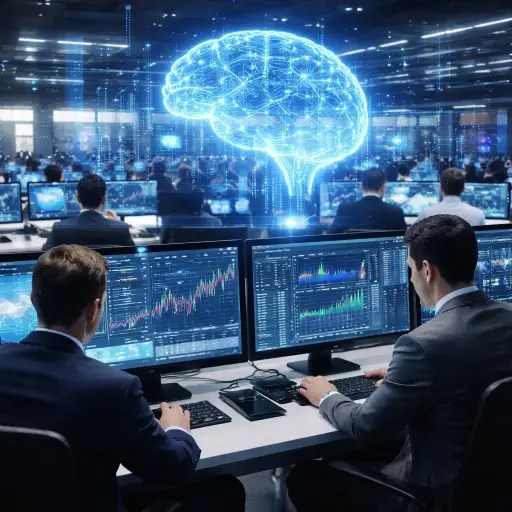
Investment bank restructures around machine‑learning trading platforms and automated risk systems as technology reshapes global finance
Morgan Stanley is cutting roughly 2,500 jobs as the investment bank accelerates a sweeping shift toward artificial intelligence driven systems that are rapidly changing how trading, research and risk management operate across the financial industry.
The layoffs come as the bank restructures large parts of its internal operations around automated trading engines, machine learning based analytics and new technology platforms designed to process massive amounts of financial data faster than traditional human driven workflows.
Senior executives say the transition reflects a fundamental shift in how modern investment banks function, with algorithms increasingly responsible for tasks that once required teams of analysts, operations staff and research assistants working across global offices.
At the center of the overhaul are AI powered trading systems capable of scanning market signals, liquidity flows and economic indicators in real time, allowing automated platforms to identify opportunities and execute strategies with speed that human traders cannot match.
Alongside these trading tools the bank is deploying machine learning models that analyze portfolio risk continuously, running thousands of stress scenarios across multiple asset classes to identify potential vulnerabilities long before they become visible through conventional monitoring systems.
Executives say these platforms allow the firm to integrate trading activity, risk analysis and research insights into a unified data environment where algorithms constantly update forecasts and recommendations as new information enters the market.
Many of the positions being eliminated are concentrated in back office operations, internal research support and administrative functions where automation now performs tasks such as trade reconciliation, report generation and data verification that previously required extensive manual oversight.
Industry analysts note that the decision reflects a wider transformation underway across the global financial sector as banks race to modernize their technological infrastructure in response to both rising competition and the growing availability of advanced artificial intelligence tools.
Large financial institutions have invested billions in data infrastructure and machine learning capabilities in recent years as improvements in computing power and modeling techniques made it possible to apply AI to increasingly complex financial processes.
For firms that manage vast portfolios and execute millions of trades each day even small gains in efficiency can produce significant financial advantages, creating powerful incentives to replace slower manual processes with automated analytical systems.
Inside Morgan Stanley the modernization program has been under development for several years and involves collaboration between internal engineering teams and external technology partners specializing in artificial intelligence, cloud computing and large scale data architecture.
The transformation is also reshaping the skill profile of the financial workforce as banks recruit more software engineers, data scientists and quantitative developers capable of designing and maintaining the complex algorithms that now sit at the heart of trading and risk management.
Economists say the shift toward AI driven finance could lead to a long term rebalancing of employment within the industry as routine analytical roles decline while demand rises for specialists in machine learning, cybersecurity, data governance and algorithm oversight.
Despite concerns about job losses many executives argue that automation ultimately strengthens financial institutions by enabling faster analysis, more precise risk monitoring and better informed investment decisions in markets that move at increasing speed.
Regulators are also paying close attention to the rapid adoption of artificial intelligence within global finance as supervisors seek to understand how automated decision systems influence market stability and whether similar algorithms used across institutions could amplify volatility during periods of stress.
The workforce reduction at Morgan Stanley therefore highlights more than a single corporate restructuring and instead reflects the broader arrival of an era in which artificial intelligence is becoming embedded in nearly every layer of modern banking.
As investment banks continue integrating machine learning into trading, risk modeling and client advisory services the balance between human judgment and automated analysis will remain one of the defining challenges shaping the future structure of global finance.




 The Tower Post