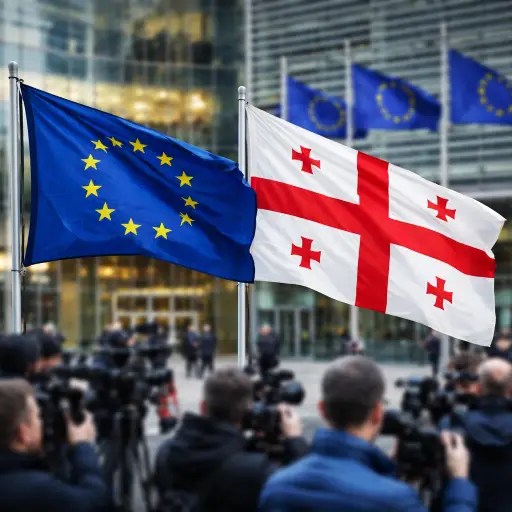
Brussels blocks visa-free access for diplomats after crackdown on protests raises concerns over democratic backsliding
The European Union has suspended visa-free travel privileges for Georgian government officials and diplomats, signaling growing concern in Brussels about political developments in the South Caucasus country and what European leaders describe as signs of democratic backsliding following a wave of protests and a government crackdown that has drawn criticism across the continent.
Under the measure, holders of Georgian diplomatic and official passports will no longer benefit from visa-free access to the Schengen area, a move European officials say is intended to send a clear political message while avoiding direct restrictions on ordinary Georgian citizens who continue to travel to the European Union without visas under the existing mobility agreement.
The decision comes after months of tension in Georgia where large demonstrations have taken place in the capital and other cities, with protesters accusing authorities of undermining democratic institutions, restricting political freedoms and applying pressure on independent media and civil society organizations.
European policymakers say the suspension reflects a growing sense of unease within EU institutions that the political trajectory of Georgia, once widely viewed as one of the region’s most committed reformers, may be shifting away from the democratic standards expected of countries seeking deeper integration with the European bloc.
The visa restriction will remain in place for at least one year while European institutions monitor developments inside Georgia, and officials in Brussels say the measure could be reconsidered if the government takes clear steps to restore dialogue with opposition forces and ensure the protection of basic democratic rights including freedom of assembly and expression.
Despite the new restriction, European officials emphasized that the broader relationship between the European Union and Georgia remains intact, noting that economic cooperation, development assistance and regional partnerships in areas such as infrastructure and energy will continue as part of the EU’s long-term engagement in the Black Sea region.
The decision to target diplomats rather than the wider population reflects a strategy often used by the European Union when responding to political crises among partner countries, aiming to apply pressure on governing elites while preserving people-to-people connections that have been a cornerstone of EU relations with Georgia.
Images of police confronting demonstrators and detaining activists have circulated widely across European media in recent months, intensifying debate within the European Parliament and among member states about whether the EU should take a stronger stance in defense of democratic norms in neighboring countries.
Georgian government representatives have rejected accusations of democratic decline and argue that the protests represent internal political disputes rather than systemic threats to democratic governance, while insisting that the country remains committed to maintaining close relations with European partners.
Opposition leaders and several civil society groups inside Georgia have welcomed the EU’s decision, saying international scrutiny could help encourage greater accountability and push authorities toward renewed political dialogue aimed at reducing tensions that have dominated the country’s public life.
In Brussels the announcement also carries symbolic significance as European institutions highlight the importance of democratic participation and civic rights at a moment when public debate across the continent increasingly focuses on the resilience of democratic systems both within and beyond the EU’s borders.
For now the suspension stands as a reminder that political partnership with the European Union is closely linked to adherence to democratic standards, and European officials say the coming year will be an important period during which Georgia’s leadership will have an opportunity to demonstrate whether it intends to reaffirm those principles.

 The Tower Post