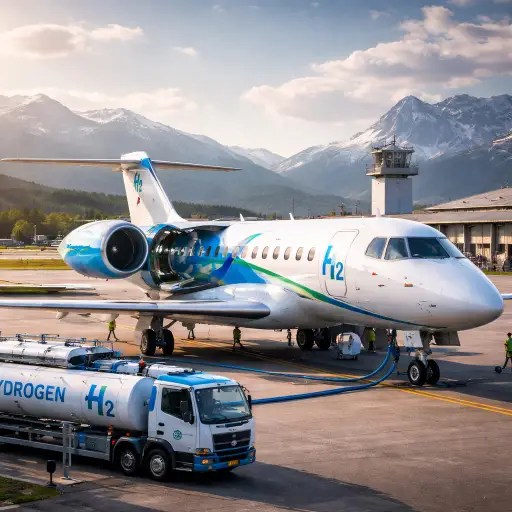
Engineers across the continent push forward with zero-emission aviation prototypes that could transform commercial flight within the coming decade
Across Europe a new generation of experimental aircraft is quietly taking shape as engineers test propulsion systems powered not by conventional jet fuel but by hydrogen, a technology that many aviation experts believe could reshape the environmental future of global air travel, offering the possibility of dramatically reducing emissions from one of the world’s most difficult sectors to decarbonize while maintaining the speed and connectivity that modern economies depend on.
Research teams working in wind tunnels laboratories and flight test centers are developing hydrogen powered prototypes designed to demonstrate that commercial aviation can operate with little or no carbon output, an effort that has intensified as European governments and aerospace companies accelerate their commitments to climate targets and seek practical pathways to cleaner transportation technologies.
The current wave of experiments includes modified regional aircraft equipped with hydrogen combustion engines as well as advanced designs that rely on hydrogen fuel cells to generate electricity for electric propellers, and while the engineering approaches vary the goal remains the same, to prove that hydrogen can safely power aircraft while delivering performance comparable to today’s short and medium haul flights.
Hydrogen offers several advantages for aviation because when used as fuel it produces water vapor rather than carbon dioxide, but the challenge lies in storing the gas efficiently at extremely low temperatures and integrating the necessary tanks and fuel systems into aircraft structures without compromising safety weight distribution or aerodynamic efficiency.
European aerospace engineers say that progress in cryogenic storage lightweight composite materials and high efficiency electric propulsion has made hydrogen aircraft concepts far more viable than they were even a decade ago, and multiple prototype programs are now entering critical testing phases that could determine how quickly the technology moves from experimental demonstrations to real commercial aircraft.
Test flights conducted with modified demonstration aircraft have already shown that hydrogen combustion engines can function reliably in aviation environments, and parallel programs focusing on fuel cell propulsion are exploring quieter electric driven propellers that could further reduce both emissions and noise around airports.
The push toward hydrogen aviation is supported by collaborations between major aerospace manufacturers startup technology firms research universities and public agencies, creating a continent wide innovation network that reflects both the scale of the challenge and the growing urgency to decarbonize aviation as passenger demand continues to rise globally.
Airports across Europe are also preparing for a possible hydrogen future by studying how to safely store distribute and refuel liquid hydrogen on the ground, since the infrastructure required for hydrogen aviation differs significantly from the fueling systems used by traditional jet aircraft and will require coordinated investment and regulatory planning.
Industry analysts say the timeline for hydrogen powered commercial aviation will depend not only on technological success but also on certification standards supply chain development and the availability of large scale green hydrogen production, yet many experts believe that the first generation of zero emission regional passenger aircraft could begin entering service within the next decade.
The testing programs now underway represent one of the most ambitious transformations in the history of aviation and researchers say the results emerging from European laboratories and flight test centers are beginning to suggest that a future of cleaner flight is technically achievable, offering the possibility that passengers boarding aircraft in the years ahead could travel across the continent with far lower environmental impact than today.




 The Tower Post