Knife-edge race between CDU and Greens in a key southern state could shape the authority of Germany’s new conservative chancellor
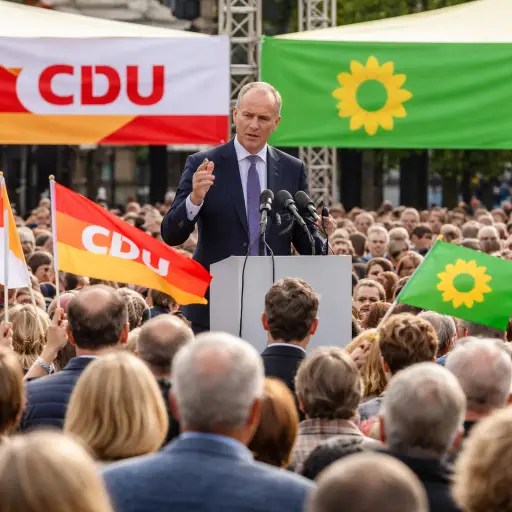
Germany is heading into a pivotal regional election in the prosperous southwestern state of Baden-Württemberg, a contest widely viewed as the first serious political test for Chancellor Friedrich Merz since he took office at the head of a conservative-led federal government.
The campaign has tightened dramatically in its final stretch, with the Christian Democratic Union and the Greens polling at roughly the same level, each hovering around the high twenties and separated by little more than statistical margins.
For Merz, who returned the CDU to power nationally after years in opposition, the vote carries symbolic and strategic importance that reaches far beyond the boundaries of the state.
Baden-Württemberg, home to major industrial groups, advanced manufacturing hubs and one of Europe’s strongest regional economies, has long been a bellwether for Germany’s broader political mood.
The Greens have governed the state for years and remain deeply rooted in its political culture, particularly in urban centers and among younger, highly educated voters who view environmental policy as central to economic modernization.
At the same time the CDU senses an opportunity to reclaim influence in a region historically associated with conservative strength, arguing that stability, economic competitiveness and pragmatic energy policy should guide the next phase of Germany’s development.
Merz has repeatedly appeared alongside regional CDU leaders during the campaign, framing the contest as a moment to confirm public confidence in his government’s direction after a turbulent period in German politics marked by coalition disputes and economic uncertainty.
Opponents, particularly the Greens, have sought to portray the election as a referendum on whether Germany should accelerate its transformation toward a greener industrial model or shift toward the more market-oriented priorities championed by the conservative chancellor.
The result could therefore influence the tone of national policymaking, including debates over energy strategy, climate investment and the balance between fiscal discipline and large-scale industrial subsidies.
Political analysts note that Baden-Württemberg’s electorate is uniquely sensitive to these issues because the state’s economic success is closely tied to sectors undergoing rapid technological change, including the automotive industry and advanced engineering.
If the CDU manages to pull ahead it would strengthen Merz’s authority inside his own party and reinforce the argument that conservative leadership can broaden its appeal in regions where environmental politics have traditionally dominated.
A strong Green performance, by contrast, would demonstrate that ecological modernization remains a potent political force and could embolden opposition parties to challenge the federal government more aggressively on climate and industrial policy.
Beyond the immediate numbers the contest is being watched closely across Germany for clues about voter sentiment after the formation of the new government, offering the first real measurement of how Merz’s leadership resonates outside the federal stage.
Whatever the final balance of power in Stuttgart, the narrow race underscores how fluid the country’s political landscape has become and how regional elections continue to shape the authority of leaders in Berlin.


 The Tower Post