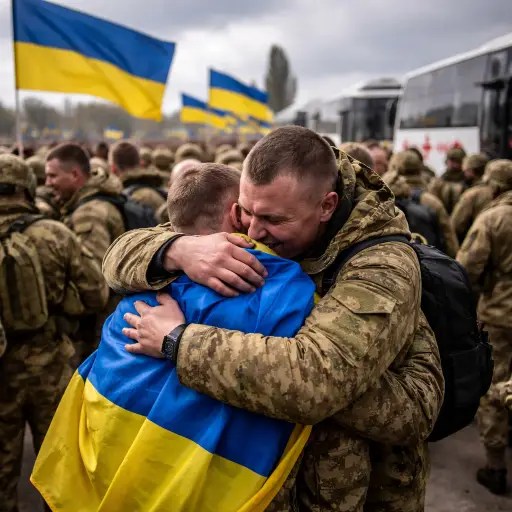
Large-scale exchange returns servicemen and civilians amid renewed negotiations and symbolic moment of resilience
Ukraine has brought home three hundred servicemen and two civilians in one of the largest prisoner exchanges since the full scale war with Russia began, officials in Kyiv said, marking a rare moment of relief for families who have waited months or years for news of missing loved ones. The exchange took place as delegations from both countries met again for negotiations, highlighting how humanitarian issues surrounding prisoners remain one of the few areas where limited cooperation between the two sides continues despite the broader conflict that still dominates the region.
Authorities said the returning Ukrainians include soldiers captured during some of the most intense phases of fighting across the eastern and southern fronts, many of whom had been held in Russian controlled facilities for extended periods. Images released by Ukrainian officials showed exhausted but smiling servicemen stepping off buses wrapped in national flags while medics and military staff stood nearby to provide immediate care, a scene that has become a powerful symbol for Ukrainians as prisoner exchanges periodically reunite families separated by war.
The exchange unfolded during the second day of talks between Kyiv and Moscow, where negotiators have focused primarily on humanitarian concerns such as prisoner returns and the repatriation of bodies from the battlefield. Although the broader political and military divisions between the two governments remain vast, prisoner swaps have continued intermittently throughout the war, often mediated through complex diplomatic channels involving international partners and humanitarian organizations that help verify detainees and facilitate the transfers.
For many Ukrainians the return of prisoners carries deep emotional significance because the fate of captured soldiers has become one of the most painful uncertainties of the conflict. Families frequently rely on sparse information, social media rumors, or unofficial reports as they wait for confirmation that relatives are alive. Each exchange therefore represents more than a logistical operation between rival states; it becomes a moment of collective attention across the country as names are announced and reunions begin.
Ukrainian officials said the newly released servicemen will undergo medical examinations, psychological support programs, and debriefings with the armed forces before eventually reuniting with their families. Some are reported to have endured harsh detention conditions and long periods without contact with relatives, underscoring the humanitarian dimension of prisoner exchanges that both Kyiv and international observers continue to emphasize when calling for expanded swaps.
Russia has also received prisoners in the exchange, according to officials involved in the negotiations, though details about those individuals have been limited. Both sides typically confirm the number of people transferred without disclosing full identities immediately, citing security and privacy concerns. The exchanges are often arranged through confidential negotiations that can take weeks or months to finalize, involving verification of prisoner lists and agreements on logistics along designated transfer routes.
The latest swap arrives at a moment when the war remains largely defined by grinding front line battles and missile strikes far from the negotiating table. Analysts say humanitarian arrangements such as prisoner exchanges sometimes serve as fragile communication channels between adversaries who otherwise refuse direct political concessions. Even limited cooperation, they note, can help maintain a minimal line of contact that reduces uncertainty surrounding detainees and missing personnel.
The timing of the exchange has also resonated symbolically with many Ukrainians as the country marks a global day that highlights resilience, solidarity, and the role of women during times of hardship. Across Ukraine countless mothers, partners, and daughters have organized campaigns advocating for the return of captured soldiers, holding public rallies, coordinating information networks, and pressing officials to prioritize prisoner negotiations whenever diplomatic opportunities arise.
In cities across the country families gathered near military hospitals and reception centers awaiting confirmation that loved ones were among those returning. Emotional reunions were reported as buses carrying former prisoners arrived under tight security, with relatives embracing soldiers who appeared thinner but determined. For many families the moment represented the end of a long period of uncertainty that has become a defining emotional strain of the war.
Officials in Kyiv emphasized that efforts to bring back additional prisoners will continue, stating that many Ukrainians remain in captivity and that negotiations for further exchanges are ongoing. Human rights organizations have repeatedly called on both sides to expand such efforts and ensure that detainees receive treatment consistent with international conventions governing prisoners of war.
While the broader conflict shows little sign of an immediate resolution, the return of hundreds of prisoners has offered a rare moment of cautious optimism within Ukraine. Each exchange demonstrates that even amid a prolonged and brutal war, humanitarian agreements can still be reached when both sides recognize the human cost carried by soldiers and civilians alike.
As the released servicemen begin medical recovery and prepare to reconnect with their families, their return stands as a reminder of the personal stories behind the geopolitical struggle. For the families waiting at home, the sight of buses arriving with freed prisoners represents something more profound than diplomacy or negotiation: it signals the restoration of lives interrupted by war and the enduring hope that more reunions will follow.

 The Tower Post