Investigators probe possible hybrid sabotage after telecom and gas connections between Finland and Estonia are damaged
Authorities around the Baltic Sea are facing mounting pressure to determine how critical underwater infrastructure linking Finland and Estonia was damaged, as the captain of a Chinese cargo vessel has pleaded not guilty to charges connected to the incident and denied responsibility for harming the region’s telecommunications and gas connections.
The case has quickly drawn international attention because the damaged cables are considered part of the backbone of Northern Europe’s digital and energy networks, carrying communications traffic and gas supply routes that support businesses, governments, and everyday life across the Baltic region.
Investigators say the damage occurred in a busy maritime corridor where commercial shipping traffic regularly crosses sensitive seabed infrastructure, yet the scale and pattern of the disruption has raised suspicions that the incident may not have been accidental.
Prosecutors argue that the cargo vessel passed directly over the cable route shortly before the faults were detected and that the ship’s equipment could have struck the seabed infrastructure, while the captain’s legal team insists that the vessel followed normal navigation procedures and that there is no evidence of deliberate or negligent damage.
The captain’s plea has intensified scrutiny of the investigation, with maritime authorities, telecommunications companies, and energy operators working together to reconstruct the sequence of events that led to the failure of the links beneath the Baltic Sea.
The cables at the center of the case form a vital digital bridge between Finland and Estonia, enabling high capacity data traffic between the Nordic region and continental Europe while also supporting redundancy in international communication networks that rely on stable underwater connections.
In parallel, a gas pipeline running along a similar route plays an important role in regional energy security, providing an alternative supply corridor that helps balance fluctuations in demand and reduces dependence on a single infrastructure route.
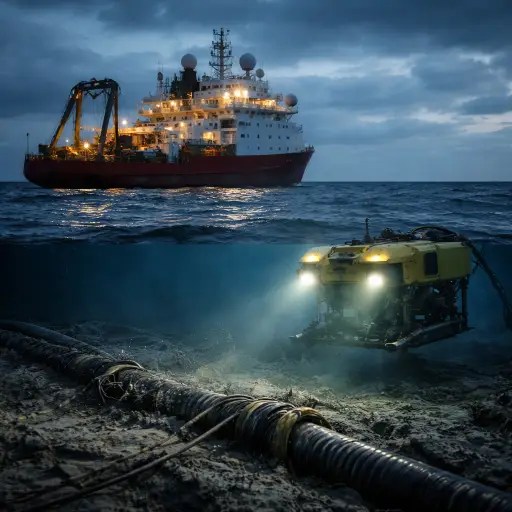
When the disruptions were first detected, network operators reported sudden signal loss and pressure irregularities that suggested physical damage on the seabed, prompting rapid deployment of repair vessels and remotely operated vehicles to inspect the affected sections.
Underwater imagery gathered during the early stages of the investigation revealed deformation and scraping along parts of the cable corridor, evidence that analysts say could be consistent with a heavy object or anchor dragging across the seabed.
Maritime tracking data has since become a central piece of the inquiry, with investigators reviewing ship transponder records, satellite imagery, and voyage logs in an effort to determine which vessels were operating near the cables at the time the damage occurred.
The Chinese cargo vessel quickly emerged as a vessel of interest because of its proximity to the infrastructure corridor and the timing of its transit, but the captain’s defense has argued that dozens of ships cross the same area regularly and that proximity alone does not prove responsibility.
Legal representatives for the captain say their client cooperated with authorities and provided navigation records showing the ship maintained a steady course through the shipping lane, suggesting that any cable damage may have resulted from an earlier or unrelated event.
Meanwhile telecommunications providers in Finland and Estonia have warned that incidents involving underwater infrastructure are becoming more concerning as geopolitical tensions increase and critical systems face growing exposure to disruption.
European officials have repeatedly stressed that subsea cables are among the most vulnerable elements of modern infrastructure because they stretch across thousands of kilometers of open seabed and are difficult to monitor continuously.
Although accidental cable breaks have occurred throughout the history of undersea communications, the possibility that infrastructure could be intentionally targeted has become a recurring topic in security discussions across Europe.
Analysts often describe such incidents as potential examples of hybrid tactics, a term used to describe activities that fall between conventional warfare and routine accidents, creating ambiguity that complicates diplomatic responses.
Security experts say that even minor disruptions can have disproportionate effects because many networks rely on redundancy systems that reroute traffic through alternative cables, and simultaneous failures can quickly strain the capacity of those backup routes.
Energy analysts share similar concerns about pipelines, noting that while gas flows can sometimes be redirected through other routes, unexpected interruptions may still create supply imbalances or trigger volatility in regional energy markets.
Repair crews working in the Baltic Sea have already begun technical assessments of the damaged sections, deploying specialized vessels capable of lifting cables from the seabed and installing replacement segments once the precise points of failure are confirmed.
Such repair operations are complex and often take place in difficult conditions, requiring precise navigation, robotic vehicles, and careful handling of delicate fiber optic lines that carry vast quantities of digital information.
Officials in both Finland and Estonia have emphasized that essential services remain operational because network traffic has been redirected through alternate routes, but they acknowledge that restoring full redundancy is an urgent priority.
Regional cooperation has intensified as investigators share findings with European maritime authorities and NATO partners who are increasingly focused on the protection of critical underwater infrastructure.
Naval patrols and monitoring initiatives have expanded in parts of the Baltic Sea in response to the incident, reflecting broader concerns about the security of cables, pipelines, and offshore energy facilities.
For the shipping industry, the case has also sparked debate about how commercial vessels should navigate areas where dense infrastructure networks lie hidden beneath busy sea lanes.
Some maritime experts have suggested that improved mapping systems and automated alerts could help captains avoid sensitive seabed zones, while others argue that stricter anchoring rules and enhanced monitoring may be necessary.
Legal proceedings involving the cargo ship captain are expected to examine technical evidence in detail, including the condition of the vessel’s anchors and hull as well as data recorded by onboard navigation systems.
The outcome could carry implications beyond a single vessel because it may help clarify how responsibility is assigned when underwater infrastructure is damaged in international waters.
Diplomats are also watching closely because the case unfolds against a backdrop of rising geopolitical friction and growing awareness that infrastructure beneath the sea has become strategically significant.
Across Europe, policymakers have begun discussing new frameworks for protecting cables and pipelines, including proposals for surveillance systems, coordinated patrols, and stricter reporting requirements for ships operating near sensitive routes.
Yet even as attention turns to long term security measures, investigators remain focused on answering the most immediate question surrounding the Baltic Sea incident: whether the damage was the result of an unfortunate maritime accident or part of a more deliberate and troubling pattern.



 The Tower Post