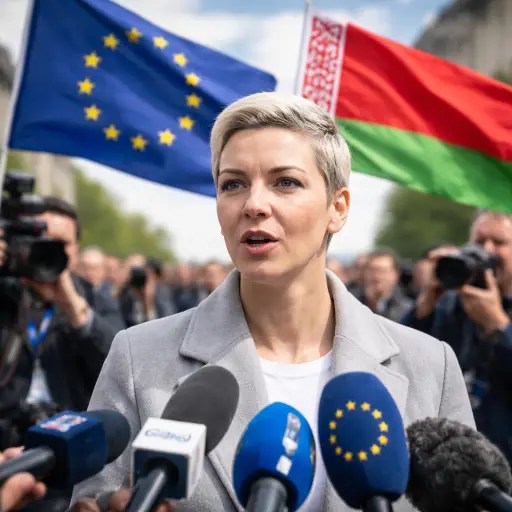
Maria Kalesnikava warns isolation could push Belarus further toward Russia and ignites debate across European capitals
Belarusian opposition figure Maria Kalesnikava has reappeared in public discussion after years of imprisonment, delivering a message that has unsettled political circles across Europe by urging governments to reconsider their strategy of isolating Minsk and warning that continued disengagement could push Belarus even deeper into Russia’s orbit.
Once one of the most recognizable leaders of the protest movement that challenged President Alexander Lukashenko, Kalesnikava became an international symbol of resistance after the mass demonstrations that followed disputed presidential elections and the sweeping crackdown that sent many activists, journalists and political figures to prison.
Her sudden reemergence, conveyed through statements shared with regional contacts and policy observers, has drawn immediate attention because it departs from the firm isolationist stance that many European policymakers have maintained toward Belarus in the years since the political crisis.
Kalesnikava did not defend the Belarusian authorities or downplay the repression that followed the protests, but she argued that a strategy relying solely on sanctions and diplomatic distance may be producing unintended consequences by increasing Minsk’s reliance on Moscow for economic, political and security support.
Belarus already maintains close ties with Russia through energy agreements, trade relations and military cooperation, and analysts say the country’s geopolitical room for maneuver has narrowed considerably as relations with the European Union and other Western partners have deteriorated.
According to Kalesnikava’s argument, keeping some form of engagement with Belarus could preserve limited space for independence in the country’s foreign policy and prevent it from becoming fully absorbed into Russia’s political and strategic structures.
The proposal has triggered mixed reactions among European diplomats who acknowledge the strategic dilemma but remain wary of easing pressure on the Belarusian government without clear signs of political reform, the release of prisoners and improvements in civil liberties.
In several European capitals the discussion has revived an older debate about whether isolation is the most effective way to influence authoritarian governments or whether a combination of pressure and selective engagement might produce greater long term leverage.
Some policy analysts argue that Belarus’s growing dependence on Russia demonstrates the limits of sanctions alone, noting that the longer diplomatic channels remain frozen the more Moscow is likely to shape Minsk’s economic and security decisions.
Opposition activists and members of the Belarusian diaspora have responded with a mixture of interest and concern, with some welcoming the renewed voice of a prominent opposition figure while others fear that calls for engagement could weaken international pressure on Lukashenko’s government.
Inside Belarus the political environment remains tightly controlled, and public debate over foreign policy or relations with Europe is limited, yet the strategic direction of the country remains a subject of intense concern among analysts and policymakers in the wider region.
Kalesnikava’s warning therefore touches on a broader question facing Europe about how to influence the future of Belarus without strengthening the very geopolitical forces that many European leaders seek to counter.
As discussions quietly resume among diplomats and policy experts, the reappearance of one of Belarus’s best known opposition figures has reopened a debate that had largely fallen silent, forcing governments to reconsider whether isolation alone can shape the country’s trajectory.
Whether her appeal leads to concrete policy changes remains uncertain, but the debate sparked by Kalesnikava’s message highlights the difficult balance Europe faces between defending democratic principles and preventing Belarus from drifting irreversibly into Russia’s strategic sphere.

 The Tower Post