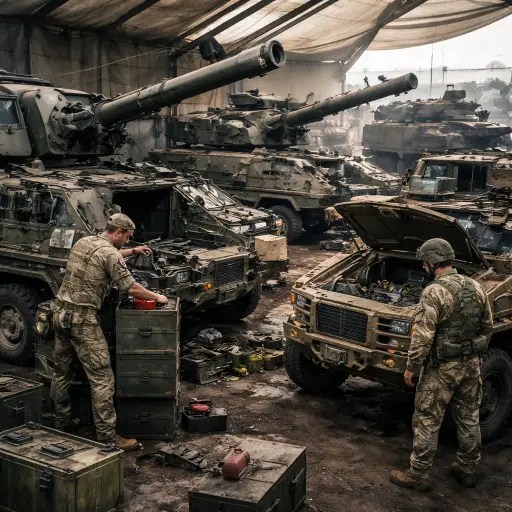
Hidden maintenance facilities near the front lines keep donated artillery and armored vehicles operational as London signals enduring commitment to Kyiv’s war effort
Britain has disclosed the existence of a discreet network of military maintenance hubs operating inside Ukraine, confirming for the first time that British personnel and specialists are helping repair Western supplied equipment closer to the battlefield. The revelation sheds light on a largely hidden logistical effort that has been quietly sustaining Ukrainian combat power while the war grinds on, with officials in London presenting the program as a practical step to ensure that donated weapons remain operational in the demanding conditions of modern warfare.
According to British defense officials, four maintenance facilities are now functioning across different areas of Ukraine, strategically positioned to reduce the time needed to recover and return damaged equipment to service. The hubs focus on repairing complex systems supplied by the United Kingdom and its allies, including AS-90 self propelled artillery pieces and Husky armored support vehicles, which play key roles in logistics, troop mobility, and frontline firepower.
The repair centers were established after months of planning between British military planners and Ukrainian commanders who faced a growing challenge: advanced Western weapons were proving highly effective but required specialized maintenance infrastructure. Sending damaged systems back across Europe for repair was slow and costly, often keeping crucial equipment out of action for extended periods while battles continued to evolve.
By moving technical expertise closer to the front lines, the United Kingdom has effectively shortened the maintenance chain, allowing damaged vehicles and artillery to be restored in a matter of days rather than weeks. Defense officials say the hubs are staffed by a combination of British contractors, Ukrainian technicians, and international specialists trained to work on NATO standard systems that are unfamiliar to many legacy Ukrainian maintenance units.
British officials describe the network as one of the most significant but least visible aspects of the international military assistance effort. While headlines often focus on deliveries of tanks, missiles, and artillery shells, sustaining those systems once they reach the battlefield has become an equally critical task as the conflict continues into another demanding phase.
Ukrainian officers familiar with the program say the repair hubs have already had a measurable effect on battlefield readiness. Artillery systems that previously might have been sidelined for lengthy repairs can now be restored quickly, allowing Ukrainian units to maintain consistent fire support during periods of intense combat activity.
The AS-90 artillery system in particular has required careful maintenance due to the heavy operational tempo in which Ukrainian forces are using Western supplied guns. Designed for precision and sustained firepower, the vehicles operate under conditions far harsher than those anticipated during their original service life in Western armies, making rapid repair capacity essential for maintaining their effectiveness.
Similarly, Husky armored vehicles used for logistics, transport, and support missions have become indispensable for moving supplies and personnel across dangerous terrain near contested areas. Frequent exposure to shelling, debris, and rough terrain places constant stress on these vehicles, creating a steady stream of maintenance work for the newly revealed repair hubs.
British officials emphasize that the initiative reflects a broader shift in Western military support from emergency deliveries toward long term sustainment. Maintaining a functioning arsenal, they say, requires not only weapons and ammunition but also the technical ecosystem capable of keeping complex machines running through months and years of continuous combat.
The disclosure of the repair network also sends a political message about the durability of Britain’s support for Ukraine. By placing maintenance infrastructure inside the country, London is signaling that its assistance is not limited to short term shipments but is instead designed to help sustain Ukraine’s defense capabilities over an extended period.
Security considerations remain paramount, and details about the exact locations of the hubs have not been made public. British officials acknowledge that the facilities operate under strict confidentiality, with layered security measures intended to protect both personnel and equipment from potential targeting.
Military analysts note that the strategy mirrors logistical approaches used by NATO forces during previous conflicts, where forward repair capability proved vital for sustaining high intensity operations. In Ukraine’s case, the integration of Western equipment into a largely Soviet era military structure has made such forward maintenance networks particularly valuable.
Ukrainian defense leaders have welcomed the effort, describing it as another example of practical cooperation between Kyiv and its international partners. They argue that the ability to restore damaged equipment rapidly helps stabilize front line units and prevents gaps in capability that could emerge if critical systems were unavailable for extended periods.
Although the repair hubs remain largely invisible to the public, officials in London suggest their impact could shape the trajectory of Ukraine’s military endurance. In a war defined not only by weapons but by the ability to sustain them, the quiet work carried out inside these facilities may prove as strategically important as the systems they help keep in the fight.




 The Tower Post