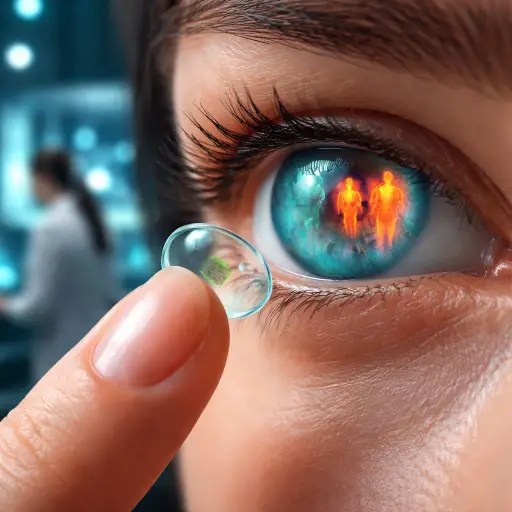
Experimental infrared-sensitive lenses may give humans a new form of night vision, opening doors for medicine, security, and scientific imaging
Scientists have unveiled a new type of experimental contact lens that could allow humans to see in near total darkness, marking a striking step forward in sensory technology and bio-integrated optics. The transparent lenses are designed to detect infrared light, a portion of the electromagnetic spectrum normally invisible to the human eye, potentially giving wearers the ability to perceive heat signatures and hidden sources of light even when the surrounding environment appears completely dark.
Researchers behind the project say the lenses rely on ultra-thin layers of nanomaterials capable of converting infrared radiation into visible wavelengths that the eye can process. When infrared photons strike the surface of the lens, the embedded particles transform the energy into colors the retina can interpret, effectively extending the visual range of the human eye beyond its natural biological limits.
Unlike bulky night-vision goggles or thermal cameras, the new system sits directly on the surface of the eye like a conventional soft contact lens. This design removes the need for batteries, wires, or external imaging equipment and allows the wearer to move freely without carrying additional devices. Early demonstrations suggest that the technology can function even when the environment contains almost no visible light.
In preliminary laboratory tests, volunteers wearing prototype lenses were able to detect infrared signals that remained invisible to people with unaided vision. Participants could identify shapes formed by infrared sources and distinguish simple patterns in a darkened room, suggesting that the human brain can adapt quickly to interpreting the converted signals.
Scientists say one of the most surprising results from the early trials is that the lenses appear to work even when the wearer’s eyes are closed. Because near infrared wavelengths can penetrate eyelid tissue more effectively than visible light, the converted signals still reach the retina, allowing users to detect light sources in situations where normal vision would fail.
The technology is still experimental, but its potential applications span a wide range of fields. In medicine, infrared-sensitive lenses could help surgeons visualize blood flow or detect subtle temperature changes in tissue during procedures. Researchers believe the approach could eventually assist doctors in identifying inflammation, vascular disorders, or early signs of disease without the need for large imaging systems.
Security and emergency response are also areas where the lenses could have a major impact. Firefighters navigating smoke-filled buildings could locate people by detecting body heat, while search and rescue teams might use the lenses to identify survivors in darkness or under debris. The ability to integrate thermal perception directly into human vision could significantly improve situational awareness in hazardous environments.
Military analysts are watching the technology closely as well, since compact infrared vision has long been a strategic advantage in night operations. However, scientists involved in the research emphasize that their primary focus remains civilian and medical innovation, highlighting how miniaturized optics could reshape the way people interact with the world around them.
Another intriguing possibility is the use of infrared vision for everyday activities that currently rely on specialized cameras. Engineers suggest the lenses could help technicians locate overheating components in machinery, identify heat leaks in buildings, or observe wildlife that remains hidden in darkness. By turning thermal detection into a natural extension of sight, the technology could redefine how humans perceive their environment.
Experts caution that significant development is still required before the lenses reach widespread use. Researchers must ensure long term safety for the eye, improve the clarity of the converted images, and scale up manufacturing methods capable of producing the nanomaterials at commercial levels. Regulatory approval will also be necessary before the lenses can move from experimental laboratories to everyday consumers.
Despite these challenges, the concept has already sparked excitement across the scientific community. Extending human vision beyond the visible spectrum has long been a goal of sensory research, and the contact lens approach suggests a future in which advanced perception technologies are seamlessly integrated into the body.
If the technology continues to progress, the simple act of putting in a contact lens could one day grant people the ability to see the hidden thermal landscape of the world around them, revealing warm footprints on cold ground, the faint glow of distant heat sources, and movement in darkness that once remained invisible to the human eye.




 The Tower Post